Newton Booth, Sacramento
Updated · 3,626 residents
Newton Booth is a dense, historic neighborhood in Sacramento characterized by its eclectic mix of Craftsman and Tudor architecture. While the area offers high walkability and proximity to popular dining, residents should expect significant noise from nearby highway traffic and closely spaced housing.
Key Highlights
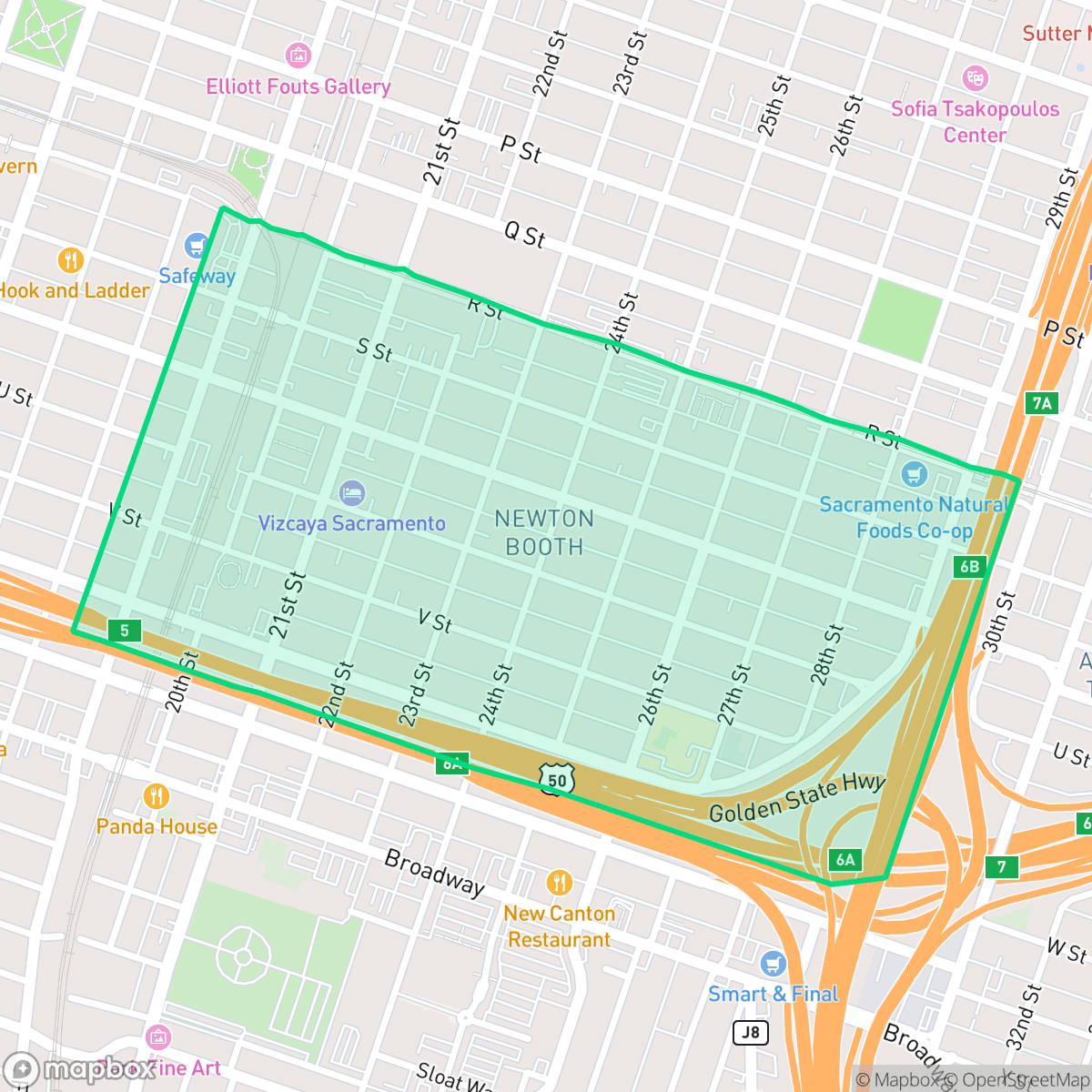
About Newton Booth
Located in the southeast corner of Sacramento’s original 1848 grid, the Newton Booth neighborhood emerged in the late 19th century as an electric streetcar suburb. Initially slow to develop due to its low-lying, flood-prone terrain, the area grew rapidly after streetcar lines were established along 28th Street in the 1890s. The neighborhood was named after the Newton Booth School, which began as a two-room wooden structure built in 1896 after working-class families petitioned for a local school to avoid muddy winter roads. The school honored California's 11th Governor, Newton Booth. Designated a historic district in 2014, the tree-lined neighborhood features an eclectic mix of Craftsman bungalows, Tudor Revival, and Spanish Revival homes. Today, it is anchored by local landmarks like the former school and the Sacramento Natural Foods Co-Op.
The area functions as a high-energy urban pocket defined by its proximity to major transit corridors and a mix of commercial and residential uses. Residents benefit from strong air quality and a central location that supports a vibrant, if busy, lifestyle. The neighborhood is home to notable culinary destinations and serves as an accessible hub for those who prioritize urban connectivity over quiet seclusion.
Living here involves specific trade-offs, particularly regarding acoustic comfort and privacy. Due to the high density of housing and the influence of nearby highway and rail traffic, the environment can be loud. The area is best suited for individuals who thrive in active, urban settings and value proximity to local amenities over expansive private outdoor spaces or quiet residential streets.
Neighborhood Scores Across 15 Qualities
Residential structures and apartment buildings are often positioned in close proximity with shared property lines. This density results in less buffer between neighbors than is typically found across the rest of Sacramento.
A dense grid and continuous sidewalk network make most errands easy to complete on foot, though major highway and rail lines occasionally interrupt the street pattern. This level of pedestrian accessibility is nearly comparable to the Sacramento average.
Uniform housing patterns and small yards define this area. The visual landscape is slightly less varied than the Sacramento average, consisting primarily of traditional grid layouts and apartment complexes.
Access to dog-friendly areas is below the Sacramento average due to narrow sidewalk verges and a reliance on private fenced yards. While some tree-lined streets and a large cemetery provide greenery, public park access is not consistent throughout the neighborhood.
Street layouts and green spaces provide a moderate balance of density. This environment is less urbanized than the typical Sacramento area, featuring a blend of single-family homes and commercial pockets.
Concentrated dining, local cafes, and urban blocks create a vibrant atmosphere that is significantly more lively than the Sacramento average. According to iHuus data, the area features a steady energy driven by diverse eateries and accessible green spaces near major transit corridors.
Persistent noise from nearby freeway and railroad corridors makes this area significantly louder than the Sacramento average. According to iHuus data, residents can expect frequent auditory disturbances from heavy transit activity.
Air quality remains mostly clean with rare instances of elevated readings. According to iHuus data, air conditions in this area are notably better than the Sacramento average.
Residential life is primarily uninterrupted by heavy industry, though a railway corridor and some large warehouse buildings are present near the southern edge. This area features slightly more commercial and transit-related infrastructure than the Sacramento average.
Health insurance coverage among residents is lower than the Sacramento average, according to iHuus data. This indicates a higher proportion of uninsured individuals compared to the rest of the city.
Voting patterns and census indicators in Newton Booth reflect a highly liberal political leaning that is even more pronounced than the Sacramento average.
Residents live alongside a diverse range of age demographics, including young professionals, families, and older adults. This age distribution is roughly in line with the average seen across Sacramento.
Residual flood risk exists within this area due to its location in the 500-year floodplain; however, safety levels remain notably higher than the Sacramento city average according to iHuus data.
Address-Level Insights for Newton Booth


iHuus Neighborhood Intelligence Insights
Get address-level neighborhood insights for Newton Booth
- Street-level scores — see how individual blocks compare, not just neighborhood averages
- Micro-zone boundaries — identify quiet pockets, flood boundaries, and walkable clusters before you visit
- 15 dimensions in full — walkability, noise, air quality, school quality, insurance coverage, population age profile, urban/rural index, and more
- Boundary risk alerts — know if your address sits near a block boundary where scores drop, the kind of detail no listing will ever mention
- School insights — individual school ratings and insights, not just district-level data
- Compare before you commit — side-by-side data across neighborhoods, down to block precision
No credit card required
Compare with Any Neighborhood
| Dimension | Newton Booth | Airport |
|---|---|---|
| 🚶 Walkabilityavg 8.5 | ||
| 🔊 Acoustic Comfortavg 3.22 | ||
| 🤫 Privacy Indexavg 5.34 | ||
| 🎨 Visual Appealavg 6.3 | ||
| 🐕 Dog Friendlinessavg 6.98 | ||
| 🗺️ Urban-Rural Indexavg 6.57 | ||
| ✨ Neighborhood Vibeavg 4.66 | ||
| 🏥 Health Insurance Coverageavg 7.4 | ||
| 🌿 Air Qualityavg 6.12 | ||
| 🏭 Industrial Proximityavg 8.32 | ||
| 🌊 Flood Safetyavg 6.04 | ||
| 🗳️ Ideological Leanavg 9.49 | ||
| 👥 Population Age Profileavg 4.75 | ||
| 🔥 Fire Safetyavg 0 | ||
| 🏫 School Quality |
Newton Booth Rankings
School Districts Serving Newton Booth
School Insights for Newton Booth
Below average outcomes; significant attendance and academic challenges.
School Insights
See what's really behind every school rating near Newton Booth
- Individual school ratings — each school's own score with outcome context, not just a district average
- Enrollment & class size data — student-to-teacher ratio and how it compares to the state average
- Full demographics breakdown — ethnicity and gender composition for every school in the enrollment zone
- Every school in the district — all schools within the enrollment boundary ranked by rating, not just the closest one
- Grade levels & benchmarks — elementary through high school, with below/above state-average flags
No credit card required