Midtown - Winn Park Capital Avenue, Sacramento
Updated · 6,765 residents
Midtown - Winn Park Capital Avenue is an exceptionally walkable urban enclave in Sacramento characterized by its dense grid and central public park access. While the area offers a vibrant, high-energy atmosphere with diverse local dining, residents should anticipate a dense living environment with limited privacy and notable road traffic noise.
Key Highlights
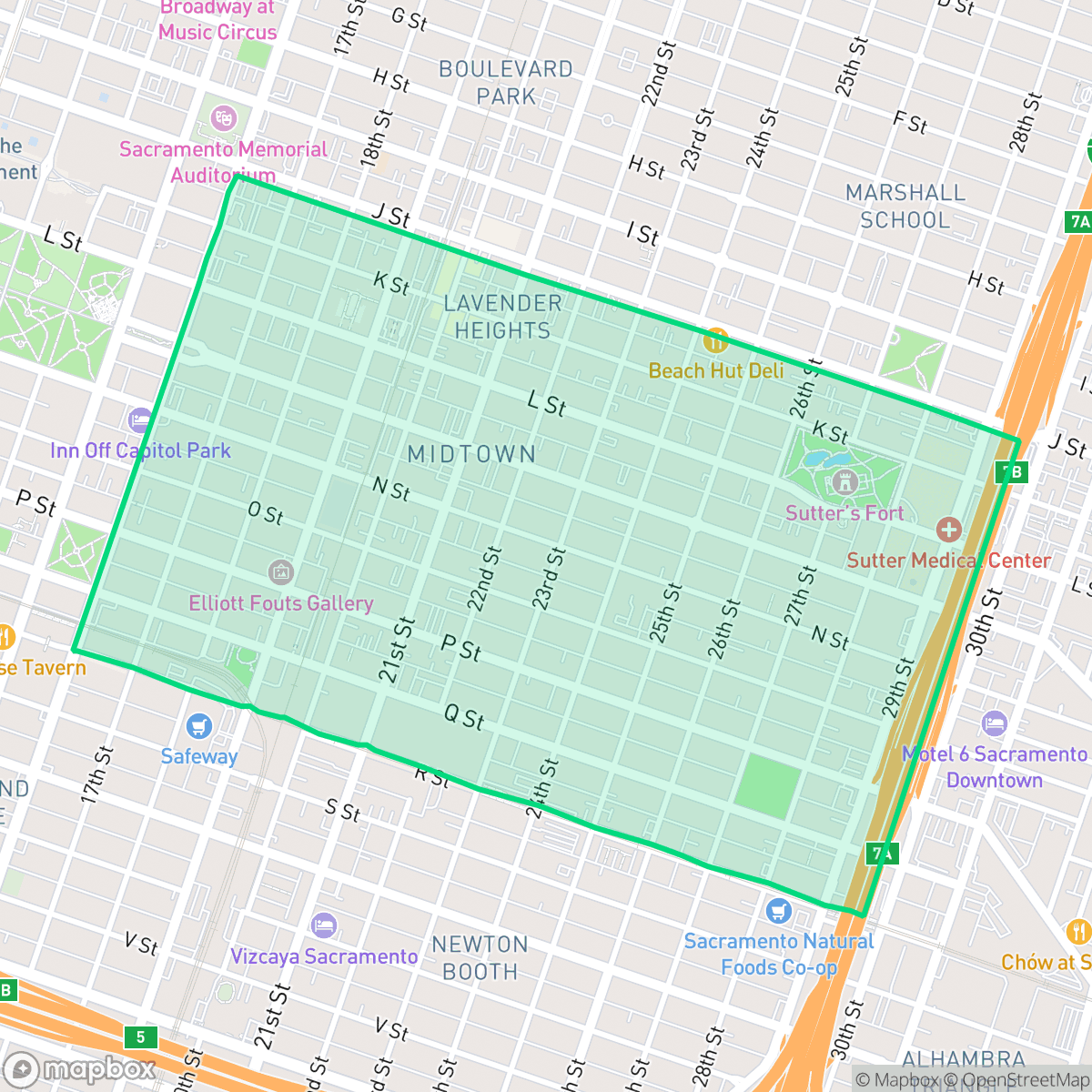
About Midtown - Winn Park Capital Avenue
The Midtown - Winn Park Capital Avenue neighborhood in Sacramento, California, centers around Albert Winn Park, one of ten public plazas donated to the city by John A. Sutter, Jr. in 1848. Named for General Albert Maver Winn, founder of the Native Sons of the Golden West, the neighborhood was established as a middle-class enclave in 1890. The Winn Park Historic District features a diverse architectural stock, including Queen Anne homes, Craftsman bungalows, Tudor-style courtyard apartments, and Streamline Moderne buildings. At the heart of the park is its most notable landmark: a 1937 Art Deco former Fire Alarm Station built by the Works Progress Administration (WPA), which once served as the city's emergency dispatch nerve center. Originally organized in 1991 as the Winn Park - Capitol Avenue Neighborhood Association, it was later renamed the Midtown Neighborhood Association.
The area functions as a high-density urban district defined by its superior walkability and mature tree canopy. Residents enjoy immediate access to a variety of restaurants and public green spaces, which contribute to a lively and energetic social environment. The neighborhood architecture consists of a mix of mid-rise residential buildings and commercial blocks, creating a cohesive urban fabric that remains well-connected to the rest of the city.
Prospective residents should consider the trade-offs associated with this high-density lifestyle. Data indicates that the close proximity of buildings results in limited privacy, and the neighborhood experiences higher-than-average noise levels primarily driven by road traffic. Additionally, families should be aware that the local school district is currently navigating significant fiscal instability and administrative turnover. This area is best suited for those who prioritize urban convenience and a walkable lifestyle over quietude or expansive private residential space.
Neighborhood Scores Across 15 Qualities
Residential structures and apartment buildings are closely spaced with narrow gaps between neighbors. According to iHuus data, this level of density is higher than the Sacramento average, resulting in less private buffer between properties.
Extensive sidewalk networks and frequent pedestrian crossings make most errands easy to complete on foot. This area offers superior walkability compared to the Sacramento average, though major highway and rail lines do interrupt the street grid.
Standard urban density dominates this area, featuring a mix of apartment complexes and commercial buildings with limited private greenery. This landscape is slightly below the Sacramento average for visual variety due to the prevalence of dense lots and small yards.
Tree-lined streets and nearby public park access provide decent walking options for pets, though the area is slightly below the Sacramento average for accessible green verges.
Residential streets and green spaces are found in roughly equal measure. This area is notably less urbanized than the Sacramento average, offering a more balanced mix of canopy cover and low-to-mid-rise density.
Diverse dining, social hubs, and mid-rise urban blocks create a highly active atmosphere that is significantly more energetic than the Sacramento average. Residents have access to a dense variety of local destinations, ranging from coffee shops and parks to established eateries near major transit corridors.
Frequent auditory disruptions occur due to the proximity of a busy freeway and railroad tracks. According to iHuus data, the acoustic environment is notably less tranquil than the Sacramento city average.
Air quality in this area is mostly clean with infrequent periods of elevated readings. According to iHuus data, the air quality is notably better than the Sacramento city average.
Primarily residential in character, this area lacks heavy industry and features mostly quiet streets and open green spaces. While a railway corridor and electrical substation are present in the southern quadrant, the neighborhood maintains a level of industrial separation slightly better than the Sacramento average.
Health insurance accessibility is lower than the Sacramento average, according to iHuus data. Residents may find fewer options for coverage within the immediate area compared to other parts of the city.
Voting patterns and census indicators show a predominantly liberal political leaning, which is slightly more pronounced than the Sacramento city average.
Residents live alongside a balanced mix of young professionals, families, and seniors. This demographic spread is slightly more varied than the typical Sacramento profile, according to iHuus data.
Residual flood risk exists as some areas fall within the 500 year floodplain; however, overall safety levels are higher than the Sacramento average, according to iHuus data.
Address-Level Insights for Midtown - Winn Park Capital Avenue


iHuus Neighborhood Intelligence Insights
Get address-level neighborhood insights for Midtown - Winn Park Capital Avenue
- Street-level scores — see how individual blocks compare, not just neighborhood averages
- Micro-zone boundaries — identify quiet pockets, flood boundaries, and walkable clusters before you visit
- 15 dimensions in full — walkability, noise, air quality, school quality, insurance coverage, population age profile, urban/rural index, and more
- Boundary risk alerts — know if your address sits near a block boundary where scores drop, the kind of detail no listing will ever mention
- School insights — individual school ratings and insights, not just district-level data
- Compare before you commit — side-by-side data across neighborhoods, down to block precision
No credit card required
Compare with Any Neighborhood
| Dimension | Midtown - Winn Park Capital Avenue | Airport |
|---|---|---|
| 🚶 Walkabilityavg 8.5 | ||
| 🔊 Acoustic Comfortavg 3.22 | ||
| 🤫 Privacy Indexavg 5.34 | ||
| 🎨 Visual Appealavg 6.3 | ||
| 🐕 Dog Friendlinessavg 6.98 | ||
| 🗺️ Urban-Rural Indexavg 6.57 | ||
| ✨ Neighborhood Vibeavg 4.66 | ||
| 🏥 Health Insurance Coverageavg 7.4 | ||
| 🌿 Air Qualityavg 6.12 | ||
| 🏭 Industrial Proximityavg 8.32 | ||
| 🌊 Flood Safetyavg 6.04 | ||
| 🗳️ Ideological Leanavg 9.49 | ||
| 👥 Population Age Profileavg 4.75 | ||
| 🔥 Fire Safetyavg 0 | ||
| 🏫 School Quality |
Midtown - Winn Park Capital Avenue Rankings
School Districts Serving Midtown - Winn Park Capital Avenue
School Insights for Midtown - Winn Park Capital Avenue
Below average outcomes; significant attendance and academic challenges.
School Insights
See what's really behind every school rating near Midtown - Winn Park Capital Avenue
- Individual school ratings — each school's own score with outcome context, not just a district average
- Enrollment & class size data — student-to-teacher ratio and how it compares to the state average
- Full demographics breakdown — ethnicity and gender composition for every school in the enrollment zone
- Every school in the district — all schools within the enrollment boundary ranked by rating, not just the closest one
- Grade levels & benchmarks — elementary through high school, with below/above state-average flags
No credit card required