Medical Center, Sacramento
Updated · 1,898 residents
Centered around the UC Davis Medical Center and the emerging Aggie Square innovation district, this neighborhood offers a blend of 1940s residential charm and institutional growth. Residents benefit from exceptional walkability, though the area experiences notable noise levels due to proximity to major roads. It provides a quiet, suburban atmosphere that balances its industrial and medical roots with a stable, health-conscious community.
Key Highlights
About Medical Center
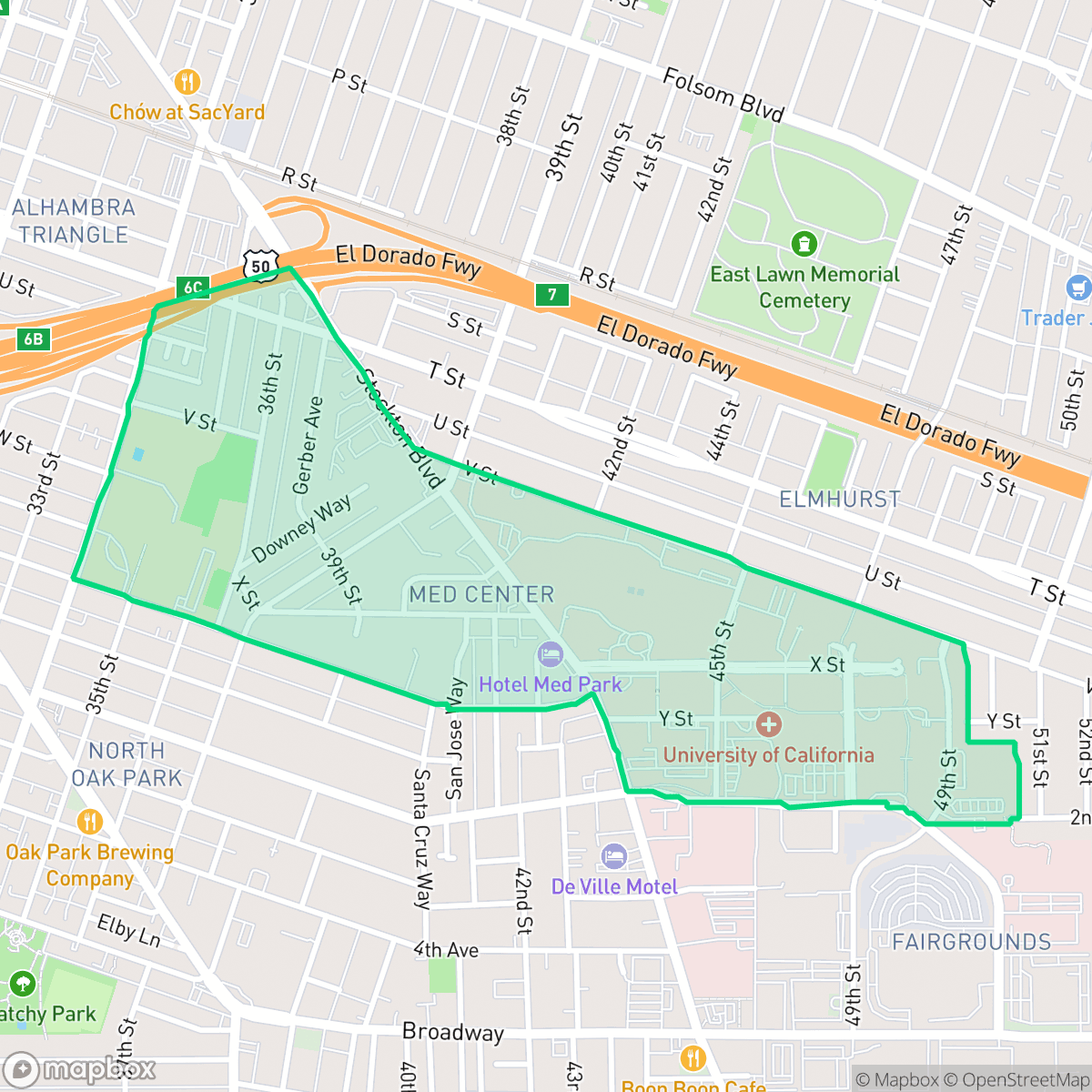
The Medical Center (or Med Center) neighborhood in Sacramento is historically defined by its proximity to the UC Davis Medical Center. The area's healthcare roots date back to 1871, when the Sacramento County Hospital relocated to a parcel at Stockton Boulevard and X Street. From 1908 to 1967, the neighborhood also hosted the sprawling California State Fairgrounds. Architecturally, the residential pocket features modest, tree-lined streets with homes primarily built during the 1930s and 1940s, alongside local landmarks like the historic Coca-Cola Bottling Plant. Today, the neighborhood is undergoing a major transformation with the development of Aggie Square, a multi-billion-dollar science and technology innovation district designed to connect the university's research campus with the surrounding community.
The area functions as a vital medical and research hub, characterized by its dense, tree-lined streets and proximity to significant healthcare infrastructure. While the neighborhood maintains a relatively quiet suburban feel, the ongoing development of Aggie Square is actively transforming the local landscape into a tech-focused innovation corridor. According to iHuus data, the community benefits from high health insurance coverage and a strong sense of ideological alignment among residents, making it a stable environment for those working within the medical or academic sectors. Prospective residents should weigh the benefits of high walkability against the acoustic reality of the neighborhood, which features elevated noise levels from surrounding road traffic. The public school options in the area are currently limited by systemic fiscal instability within the district, which may influence families with school-aged children. Ultimately, the area is best suited for healthcare professionals, researchers, and individuals who prioritize proximity to the medical campus over a high-energy social scene.
Neighborhood Scores Across 15 Qualities
Residential spacing is consistent with the city average, featuring mixed density and some buffer between neighboring structures. Certain pockets within the area have closely packed houses with narrow side-yard setbacks, according to iHuus data.
A consistent grid system with sidewalks and safe crossings makes most errands manageable on foot. This level of walkability is very similar to the Sacramento average.
Residential streetscapes consist primarily of middle-class tract housing with uniform rooflines and small yards. This level of visual variety is consistent with the Sacramento city average.
Extensive green verges and a large public park with ball fields offer reliable access for pets. While the area features safe paths and connected green spaces, dog accessibility is slightly below the Sacramento average according to iHuus data.
Dense suburban layouts with single-family homes and institutional buildings define the area. This landscape is very similar to the broader Sacramento urban-rural profile.
A steady rhythm of services and local eateries exists alongside green spaces, though the area is notably less lively than the Sacramento average. Most daily needs and social outings require a vehicle due to the sparse, suburban nature of the landscape.
Frequent noise from nearby freeway traffic and railroad corridors is a notable feature of this area. According to iHuus data, acoustic comfort is lower than the Sacramento average.
Air quality fluctuates between acceptable and unhealthy levels, presenting occasional concerns for sensitive groups. This level of air quality is largely consistent with the Sacramento average, according to iHuus data.
Minimal heavy industry or warehouse activity defines this area, which features primarily residential and institutional land use. According to iHuus data, the neighborhood has slightly more proximity to commercial zones than the Sacramento average.
Health insurance enrollment among residents is notably higher than the Sacramento average, according to iHuus data.
Voting patterns and census indicators reflect a highly liberal political landscape that is slightly more pronounced than the Sacramento average, according to iHuus data.
Residents live among a balanced demographic of young professionals, families, and seniors. This age distribution is slightly more varied than the Sacramento average, according to iHuus data.
Flood risk in this area is higher than the Sacramento average due to its location within the 500-year floodplain. According to iHuus data, some residual risk remains during extreme weather events.
Address-Level Insights for Medical Center


iHuus Neighborhood Intelligence Insights
Get address-level neighborhood insights for Medical Center
- Street-level scores — see how individual blocks compare, not just neighborhood averages
- Micro-zone boundaries — identify quiet pockets, flood boundaries, and walkable clusters before you visit
- 15 dimensions in full — walkability, noise, air quality, school quality, insurance coverage, population age profile, urban/rural index, and more
- Boundary risk alerts — know if your address sits near a block boundary where scores drop, the kind of detail no listing will ever mention
- School insights — individual school ratings and insights, not just district-level data
- Compare before you commit — side-by-side data across neighborhoods, down to block precision
No credit card required
Compare with Any Neighborhood
| Dimension | Medical Center | Airport |
|---|---|---|
| 🚶 Walkabilityavg 8.5 | ||
| 🔊 Acoustic Comfortavg 3.22 | ||
| 🤫 Privacy Indexavg 5.34 | ||
| 🎨 Visual Appealavg 6.3 | ||
| 🐕 Dog Friendlinessavg 6.98 | ||
| 🗺️ Urban-Rural Indexavg 6.57 | ||
| ✨ Neighborhood Vibeavg 4.66 | ||
| 🏥 Health Insurance Coverageavg 7.4 | ||
| 🌿 Air Qualityavg 6.12 | ||
| 🏭 Industrial Proximityavg 8.32 | ||
| 🌊 Flood Safetyavg 6.04 | ||
| 🗳️ Ideological Leanavg 9.49 | ||
| 👥 Population Age Profileavg 4.75 | ||
| 🔥 Fire Safetyavg 0 | ||
| 🏫 School Quality |
Medical Center Rankings
School Districts Serving Medical Center
School Insights for Medical Center
Below average outcomes; significant attendance and academic challenges.
School Insights
See what's really behind every school rating near Medical Center
- Individual school ratings — each school's own score with outcome context, not just a district average
- Enrollment & class size data — student-to-teacher ratio and how it compares to the state average
- Full demographics breakdown — ethnicity and gender composition for every school in the enrollment zone
- Every school in the district — all schools within the enrollment boundary ranked by rating, not just the closest one
- Grade levels & benchmarks — elementary through high school, with below/above state-average flags
No credit card required