Meadowview, Sacramento
Updated · 29,410 residents
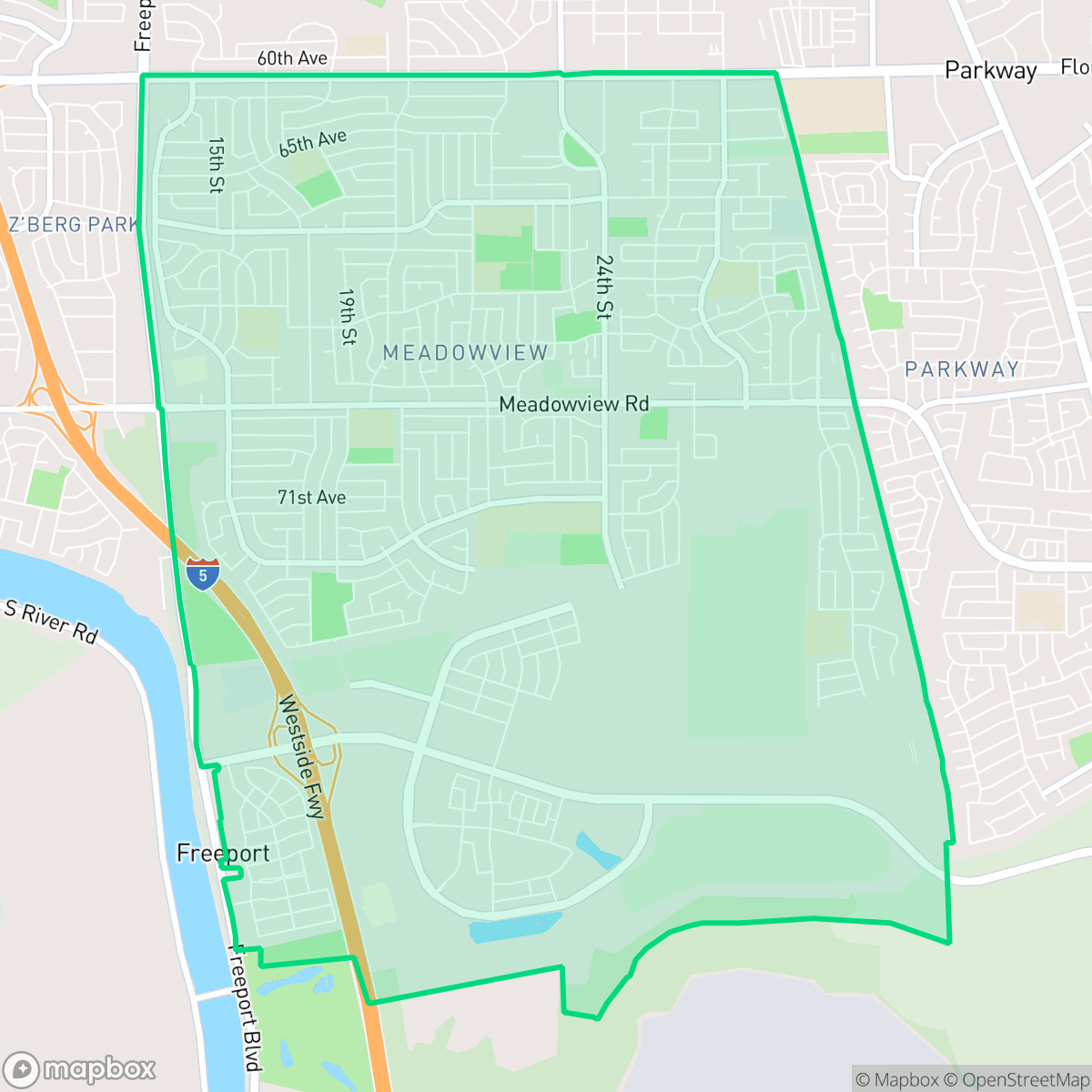
Meadowview is a culturally diverse South Sacramento community characterized by a highly walkable grid of suburban streets and consistent park access. Residents benefit from a dense network of sidewalks throughout the neighborhood, though the area experiences moderate noise levels primarily due to nearby freeway traffic.
Key Highlights
About Meadowview
Located in South Sacramento, Meadowview transformed rapidly in the mid-1950s from a rural farming area into a post-World War II suburb. Originally a predominantly white enclave in 1960, the neighborhood underwent a dramatic demographic shift during the 1970s. Affordable federal housing loans attracted working-class African American and Mexican American families, triggering "white flight". By the 1980s, the community's cultural landscape further diversified with the arrival of Tongan immigrants and Hmong refugees. Today, Meadowview is celebrated for its rich multicultural identity, anchored by local landmarks like the Samuel C. Pannell Meadowview Community Center—named after a prominent African American city official—and LeVar Burton Park, renamed in 2019 to honor the celebrated actor who grew up in Sacramento.
The neighborhood is a dense suburban environment defined by single-family homes and neighborhood-scale commercial hubs. The area features a high degree of walkability for a suburban setting, supported by continuous sidewalks and green corridors that connect residential blocks. While the area is largely residential, it contains several community-focused institutions and parks that serve as social anchors for the population.
The area presents a trade-off between its pedestrian-friendly infrastructure and its acoustic environment, which is impacted by proximity to major regional roadways. It is suited for families and individuals seeking a stable, established suburban setting with easy access to local schools and community centers. While the housing density creates a close-knit feel, residents should anticipate typical suburban noise levels and a reliance on personal vehicles for most major retail needs beyond the neighborhood borders.
Neighborhood Scores Across 15 Qualities
Housing layouts vary between closely packed structures in certain pockets and more standard suburban spacing elsewhere. This level of privacy is roughly in line with the Sacramento average.
Extensive sidewalk networks on both sides of residential streets and clear pedestrian crossings make navigating the area easy. This level of connectivity is slightly above the Sacramento average, providing safe paths through the neighborhood and nearby park areas.
Visual variety is average for Sacramento, characterized by a mix of standard tract housing, mobile home parks, and some industrial warehouses. While some areas feature larger homes with private pools, much of the landscape consists of uniform rooflines and modest lot sizes.
Abundant public parks and wide grass verges between sidewalks provide ample space for pet exercise. This level of accessibility to green corridors is consistent with the Sacramento average.
Open land and scattered housing amid fields or woodland provide a slightly more rural character than the typical Sacramento landscape. According to iHuus data, this area features more frequent open spaces and lower density than the city average.
Steady suburban rhythms and low-density residential blocks define this area. While the neighborhood maintains a similar level of activity to the rest of Sacramento, most amenities and social hubs require a car due to the sparse commercial character.
Frequent noise from nearby freeway and railroad activity defines the area. According to iHuus data, acoustic comfort in this neighborhood is roughly equivalent to the Sacramento average.
Air quality levels fluctuate between acceptable and unhealthy for sensitive groups; according to iHuus data, conditions in this area are roughly in line with the Sacramento average.
Industrial activity is virtually non-existent in this area, offering a landscape of residential and civic spaces that is notably cleaner of heavy industry than the Sacramento average. Residents will find an absence of warehouses or large-scale manufacturing plants within the neighborhood boundaries.
Health insurance coverage among residents is high and sits slightly above the Sacramento city average, according to iHuus data.
Voting patterns and census indicators in Meadowview reflect a predominantly liberal leaning, slightly more so than the Sacramento average according to iHuus data.
Residents live alongside a diverse range of generations, including young adults, families, and older individuals. This demographic variety is slightly lower than the Sacramento average, according to iHuus data.
Residual flood risks exist within the area, though the neighborhood offers greater safety from flooding than the Sacramento average according to iHuus data.
Fire safety conditions in Meadowview are consistent with the typical risk levels found across Sacramento. According to iHuus data, there are no notable deviations from the city average regarding fire safety features or vulnerabilities.
Address-Level Insights for Meadowview


iHuus Neighborhood Intelligence Insights
Get address-level neighborhood insights for Meadowview
- Street-level scores — see how individual blocks compare, not just neighborhood averages
- Micro-zone boundaries — identify quiet pockets, flood boundaries, and walkable clusters before you visit
- 15 dimensions in full — walkability, noise, air quality, school quality, insurance coverage, population age profile, urban/rural index, and more
- Boundary risk alerts — know if your address sits near a block boundary where scores drop, the kind of detail no listing will ever mention
- School insights — individual school ratings and insights, not just district-level data
- Compare before you commit — side-by-side data across neighborhoods, down to block precision
No credit card required
Compare with Any Neighborhood
| Dimension | Meadowview | Airport |
|---|---|---|
| 🚶 Walkabilityavg 8.5 | ||
| 🔊 Acoustic Comfortavg 3.22 | ||
| 🤫 Privacy Indexavg 5.34 | ||
| 🎨 Visual Appealavg 6.3 | ||
| 🐕 Dog Friendlinessavg 6.98 | ||
| 🗺️ Urban-Rural Indexavg 6.57 | ||
| ✨ Neighborhood Vibeavg 4.66 | ||
| 🏥 Health Insurance Coverageavg 7.4 | ||
| 🌿 Air Qualityavg 6.12 | ||
| 🏭 Industrial Proximityavg 8.32 | ||
| 🌊 Flood Safetyavg 6.04 | ||
| 🗳️ Ideological Leanavg 9.49 | ||
| 👥 Population Age Profileavg 4.75 | ||
| 🔥 Fire Safetyavg 0 | ||
| 🏫 School Quality |
Meadowview Rankings
School Districts Serving Meadowview
School Insights for Meadowview
Below average outcomes; significant attendance and academic challenges.
School Insights
See what's really behind every school rating near Meadowview
- Individual school ratings — each school's own score with outcome context, not just a district average
- Enrollment & class size data — student-to-teacher ratio and how it compares to the state average
- Full demographics breakdown — ethnicity and gender composition for every school in the enrollment zone
- Every school in the district — all schools within the enrollment boundary ranked by rating, not just the closest one
- Grade levels & benchmarks — elementary through high school, with below/above state-average flags
No credit card required