Marshall School, Sacramento
Updated · 1,634 residents
Marshall School is a highly walkable urban enclave in Sacramento known for its historic character and vibrant local dining scene. While the neighborhood offers exceptional access to amenities and pet-friendly spaces, residents should be aware of significant noise levels from nearby highway traffic.
Key Highlights
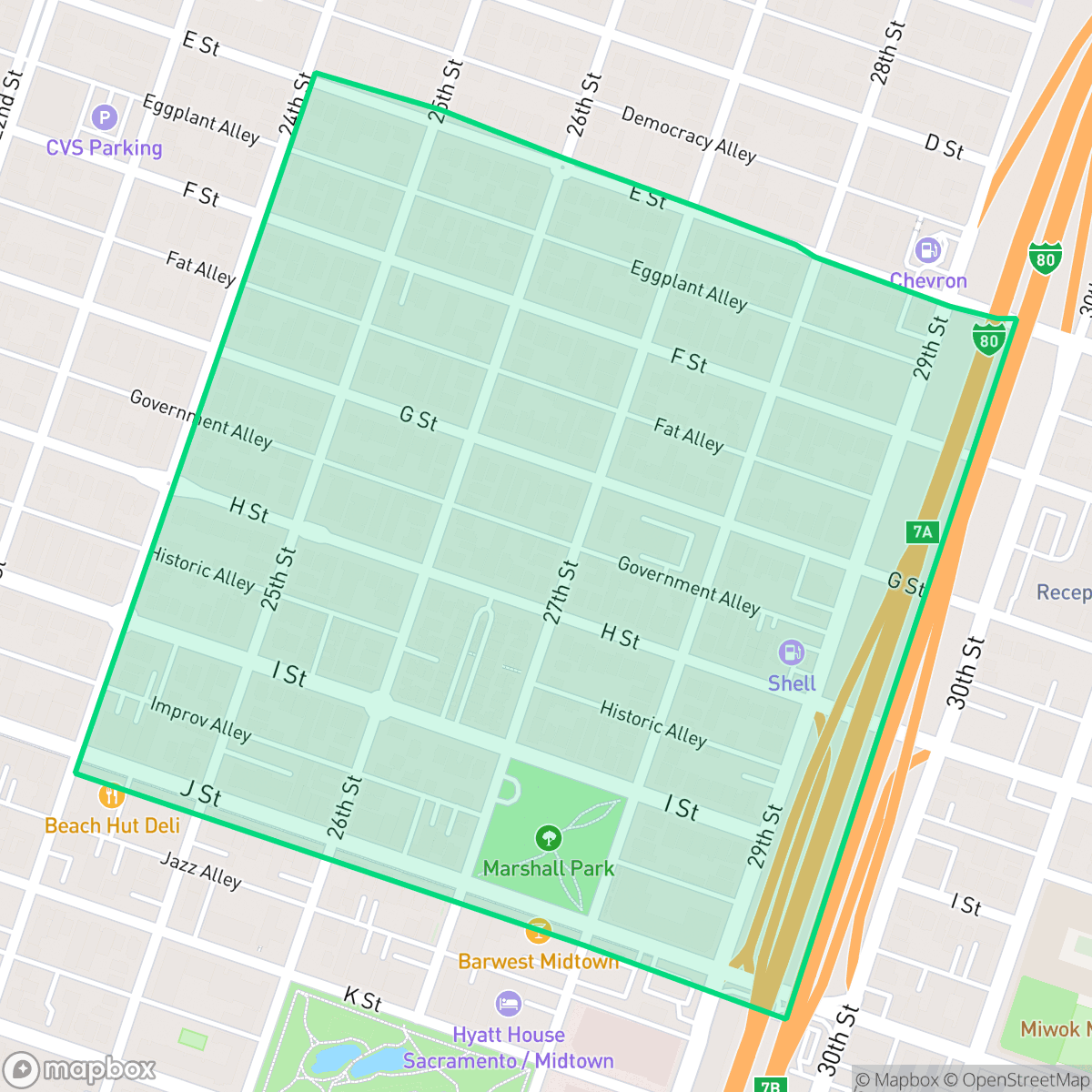
About Marshall School
The Marshall School neighborhood in Sacramento, California, developed at the turn of the 20th century as a prominent streetcar suburb. Although Marshall Park was platted in the city’s original 1848 grid, the surrounding area remained sparsely populated until the late 1800s, when streetcar lines on J, H, and 28th streets spurred residential growth. The neighborhood is named after the historic Old Marshall School, a landmark built in 1903 and designed by Rudolph Herold, the architect of Sacramento's City Hall. Centered around Marshall Park, the neighborhood is characterized by its cohesive late-19th and early-20th-century residential architecture, including Craftsman, Colonial Revival, and Neoclassical homes. Today, the Marshall Park Historic District preserves this rich architectural heritage, reflecting its origins as a middle-class residential enclave.
The area functions as a dense, pedestrian-friendly hub where residents can easily access local favorites like 3 Hermanas and Falafel Corner. Its proximity to Tiferet By The Park and various green spaces contributes to a lively atmosphere that distinguishes it from quieter surrounding districts. According to iHuus data, the neighborhood excels in walkability and pet friendliness, making it a convenient choice for those who prefer an active, outdoor-oriented lifestyle within the city grid.
Prospective residents should weigh these benefits against the acoustic environment, as the area experiences elevated noise levels primarily due to consistent road traffic from the adjacent highway. Additionally, while the community benefits from high rates of health insurance coverage, the local school district faces significant fiscal challenges and administrative instability. The neighborhood is best suited for individuals or couples who prioritize location and walkability over absolute quiet, and who are comfortable navigating the complexities of the current urban school landscape.
Neighborhood Scores Across 15 Qualities
Closely spaced buildings and narrow gaps between neighbors create less separation than typical Sacramento areas. According to iHuus data, the density of structures often results in minimal buffering between adjacent properties.
Pedestrian access is reliable due to a grid layout with frequent crossings, though some sidewalks are obscured by trees. While the area is slightly less walkable than the Sacramento average, most internal streets remain accessible for foot traffic.
Residential views consist of dense, uniform housing with small yards and minimal private greenery. This level of visual variety is lower than the Sacramento average according to iHuus data.
Green verges and street trees are consistent throughout the area, but direct access to public parks is below the Sacramento average. According to iHuus data, much of the neighborhood's vegetation is contained within private, fenced backyards.
Residential pockets vary between dense, low-rise urban blocks and areas with significant tree canopy. According to iHuus data, the landscape is largely comparable to the broader Sacramento area in its balance of built environments and open space.
Concentrated pockets of diverse dining and local businesses create a social atmosphere that is noticeably more active than the Sacramento average. While the area features engaging green spaces and varied amenities, the layout remains largely car-dependent.
Steady traffic noise from nearby busy streets is present, though levels remain slightly more tranquil than the Sacramento average according to iHuus data.
Air quality remains mostly clean with only rare instances of elevated readings, performing better than the Sacramento city average according to iHuus data.
Residential streets and green spaces dominate the area, though a nearby electrical substation and railway tracks introduce localized noise and visual impacts. This level of industrial presence is lower than the Sacramento average, according to iHuus data.
Health insurance coverage among residents is exceptionally high, well above the Sacramento average. According to iHuus data, the vast majority of the local population is covered.
Voting patterns and census indicators show a highly liberal political leaning that is even more pronounced than the Sacramento average, according to iHuus data.
A varied mix of young adults, families, and older residents defines the local demographic. According to iHuus data, this age distribution is slightly more balanced than the average seen across Sacramento.
Residual flood risk exists here due to the area's location within a 500-year floodplain, though safety levels remain notably higher than the Sacramento average according to iHuus data.
Address-Level Insights for Marshall School


iHuus Neighborhood Intelligence Insights
Get address-level neighborhood insights for Marshall School
- Street-level scores — see how individual blocks compare, not just neighborhood averages
- Micro-zone boundaries — identify quiet pockets, flood boundaries, and walkable clusters before you visit
- 15 dimensions in full — walkability, noise, air quality, school quality, insurance coverage, population age profile, urban/rural index, and more
- Boundary risk alerts — know if your address sits near a block boundary where scores drop, the kind of detail no listing will ever mention
- School insights — individual school ratings and insights, not just district-level data
- Compare before you commit — side-by-side data across neighborhoods, down to block precision
No credit card required
Compare with Any Neighborhood
| Dimension | Marshall School | Airport |
|---|---|---|
| 🚶 Walkabilityavg 8.5 | ||
| 🔊 Acoustic Comfortavg 3.22 | ||
| 🤫 Privacy Indexavg 5.34 | ||
| 🎨 Visual Appealavg 6.3 | ||
| 🐕 Dog Friendlinessavg 6.98 | ||
| 🗺️ Urban-Rural Indexavg 6.57 | ||
| ✨ Neighborhood Vibeavg 4.66 | ||
| 🏥 Health Insurance Coverageavg 7.4 | ||
| 🌿 Air Qualityavg 6.12 | ||
| 🏭 Industrial Proximityavg 8.32 | ||
| 🌊 Flood Safetyavg 6.04 | ||
| 🗳️ Ideological Leanavg 9.49 | ||
| 👥 Population Age Profileavg 4.75 | ||
| 🔥 Fire Safetyavg 0 | ||
| 🏫 School Quality |
Marshall School Rankings
School Districts Serving Marshall School
School Insights for Marshall School
Below average outcomes; significant attendance and academic challenges.
School Insights
See what's really behind every school rating near Marshall School
- Individual school ratings — each school's own score with outcome context, not just a district average
- Enrollment & class size data — student-to-teacher ratio and how it compares to the state average
- Full demographics breakdown — ethnicity and gender composition for every school in the enrollment zone
- Every school in the district — all schools within the enrollment boundary ranked by rating, not just the closest one
- Grade levels & benchmarks — elementary through high school, with below/above state-average flags
No credit card required