Mansion Flats, Sacramento
Updated · 1,516 residents
Mansion Flats is a highly walkable urban neighborhood in downtown Sacramento characterized by its dense grid of historic homes and mid-rise commercial buildings. Residents benefit from exceptional access to local amenities and cultural venues, though the area experiences notable noise levels from road traffic and nearby rail lines.
Key Highlights
About Mansion Flats
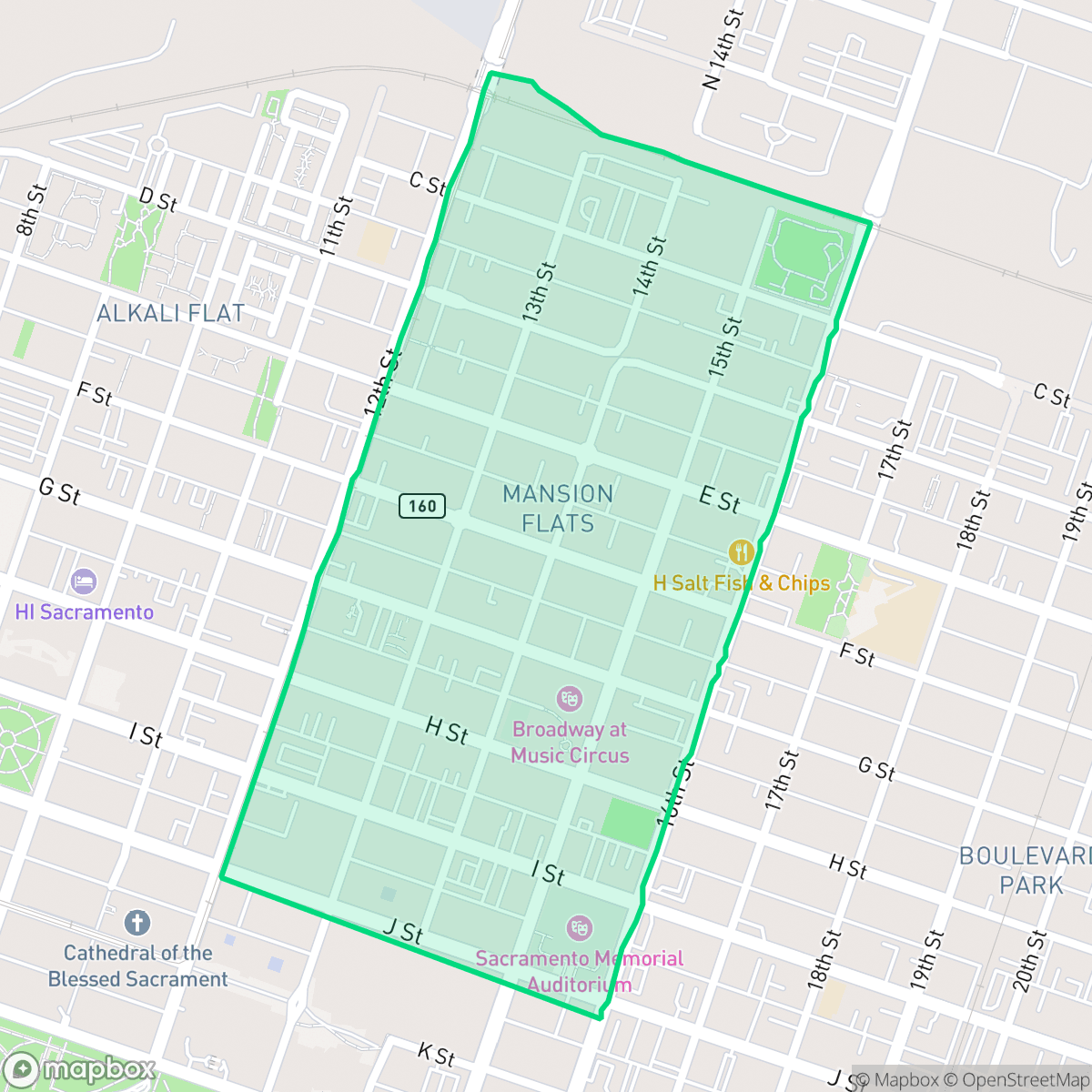
Mansion Flats, located in downtown Sacramento, was originally known as the Washington neighborhood before being renamed in the 1980s. The name references its proximity to the adjacent Alkali Flat and the neighborhood's crown jewel, the historic California Governor’s Mansion. Built in 1877 at 16th and H Streets, this Victorian landmark served as the executive residence for decades. The neighborhood features a rich architectural mix of Victorian, Queen Anne, and Craftsman homes alongside mid-century landmarks like the 1958 Dreyfuss + Blackford-designed Mansion Inn. Mansion Flats transitioned from an elite enclave to a diverse, mixed-use working-class and commercial hub in the 20th century. Today, it serves as a vibrant cultural corridor, hosting prominent local landmarks such as the Sacramento Memorial Auditorium, the Sacramento Theatre Company, and the Broadway at Music Circus.
The area functions as a central hub for urban living, defined by its high density and proximity to major Sacramento landmarks. The streetscape is dominated by a mix of residential blocks and commercial spaces, creating a lively environment that supports a variety of local dining options and social venues. Its location near transit corridors facilitates easy movement throughout the city, making it a practical choice for those who prioritize accessibility over seclusion.
Prospective residents should be aware that the neighborhood offers limited privacy due to the close proximity of structures and high-density development. While the walkability is among the highest in the city, the acoustic environment is influenced by consistent road and rail traffic. The area is best suited for individuals who enjoy a fast-paced urban lifestyle and value being within walking distance of downtown services and entertainment.
Neighborhood Scores Across 15 Qualities
Residential structures are positioned closely together with minimal separation between homes. This density is notably higher than the Sacramento average, resulting in less private buffer space between neighbors.
A dense grid system with wide sidewalks and frequent crossings makes navigating the area on foot easy. According to iHuus data, the neighborhood offers superior pedestrian infrastructure compared to the Sacramento average.
Standard residential density features tidy yards and rectangular apartment blocks, though the area lacks significant greenery or luxury amenities compared to the Sacramento average. Visual variety is limited by the presence of many uniform, boxy rooflines and commercial structures, according to iHuus data.
Street trees and medium verges provide adequate walking space for pets, though direct access to large public parks is limited. This area falls below the Sacramento average for dog friendliness according to iHuus data.
Characterized by a mix of residential and industrial zones, this area feels significantly more suburban than the typical Sacramento urban core. Streetscapes vary from dense, multi-story commercial blocks to low-density residential pockets and light industrial uses.
A high density of diverse dining and social hubs creates a much more active environment than the Sacramento average. Residents can access a wide variety of international cuisine and social spaces within a landscape of high-rises and mid-rise urban blocks, according to iHuus data.
Frequent noise from nearby freeway and railroad activity characterizes this area. According to iHuus data, acoustic comfort levels are slightly below the Sacramento average.
Air quality in Mansion Flats is generally good with infrequent periods of poor air. According to iHuus data, the atmosphere is notably cleaner than the Sacramento average.
Industrial presence is minimal, though some light commercial activity and logistics-related traffic are present near certain corridors. This level of industrial proximity is slightly higher than the Sacramento average.
Health insurance accessibility is significantly lower in this area than the Sacramento average, according to iHuus data. Most residents in this neighborhood lack employer-sponsored or private medical coverage.
Voting patterns and census indicators reflect a deeply liberal political leaning that is even more pronounced than the Sacramento average, according to iHuus data.
Residents live alongside a balanced distribution of young adults, families, and seniors. This age profile is closely aligned with the typical demographic seen across Sacramento.
Flood safety in Mansion Flats is notably higher than the Sacramento average, though some residual risk remains due to its location within a 500-year floodplain according to iHuus data.
Address-Level Insights for Mansion Flats


iHuus Neighborhood Intelligence Insights
Get address-level neighborhood insights for Mansion Flats
- Street-level scores — see how individual blocks compare, not just neighborhood averages
- Micro-zone boundaries — identify quiet pockets, flood boundaries, and walkable clusters before you visit
- 15 dimensions in full — walkability, noise, air quality, school quality, insurance coverage, population age profile, urban/rural index, and more
- Boundary risk alerts — know if your address sits near a block boundary where scores drop, the kind of detail no listing will ever mention
- School insights — individual school ratings and insights, not just district-level data
- Compare before you commit — side-by-side data across neighborhoods, down to block precision
No credit card required
Compare with Any Neighborhood
| Dimension | Mansion Flats | Airport |
|---|---|---|
| 🚶 Walkabilityavg 8.5 | ||
| 🔊 Acoustic Comfortavg 3.22 | ||
| 🤫 Privacy Indexavg 5.34 | ||
| 🎨 Visual Appealavg 6.3 | ||
| 🐕 Dog Friendlinessavg 6.98 | ||
| 🗺️ Urban-Rural Indexavg 6.57 | ||
| ✨ Neighborhood Vibeavg 4.66 | ||
| 🏥 Health Insurance Coverageavg 7.4 | ||
| 🌿 Air Qualityavg 6.12 | ||
| 🏭 Industrial Proximityavg 8.32 | ||
| 🌊 Flood Safetyavg 6.04 | ||
| 🗳️ Ideological Leanavg 9.49 | ||
| 👥 Population Age Profileavg 4.75 | ||
| 🔥 Fire Safetyavg 0 | ||
| 🏫 School Quality |
Mansion Flats Rankings
School Districts Serving Mansion Flats
School Insights for Mansion Flats
Below average outcomes; significant attendance and academic challenges.
School Insights
See what's really behind every school rating near Mansion Flats
- Individual school ratings — each school's own score with outcome context, not just a district average
- Enrollment & class size data — student-to-teacher ratio and how it compares to the state average
- Full demographics breakdown — ethnicity and gender composition for every school in the enrollment zone
- Every school in the district — all schools within the enrollment boundary ranked by rating, not just the closest one
- Grade levels & benchmarks — elementary through high school, with below/above state-average flags
No credit card required