Little Pocket, Sacramento
Updated · 1,381 residents
Little Pocket is a quiet, low-density enclave known for its mid-century ranch homes and scenic river access. While the area offers high visual appeal and a serene, semi-rural atmosphere, residents experience significant noise levels due to its close proximity to Interstate 5.
Key Highlights
About Little Pocket
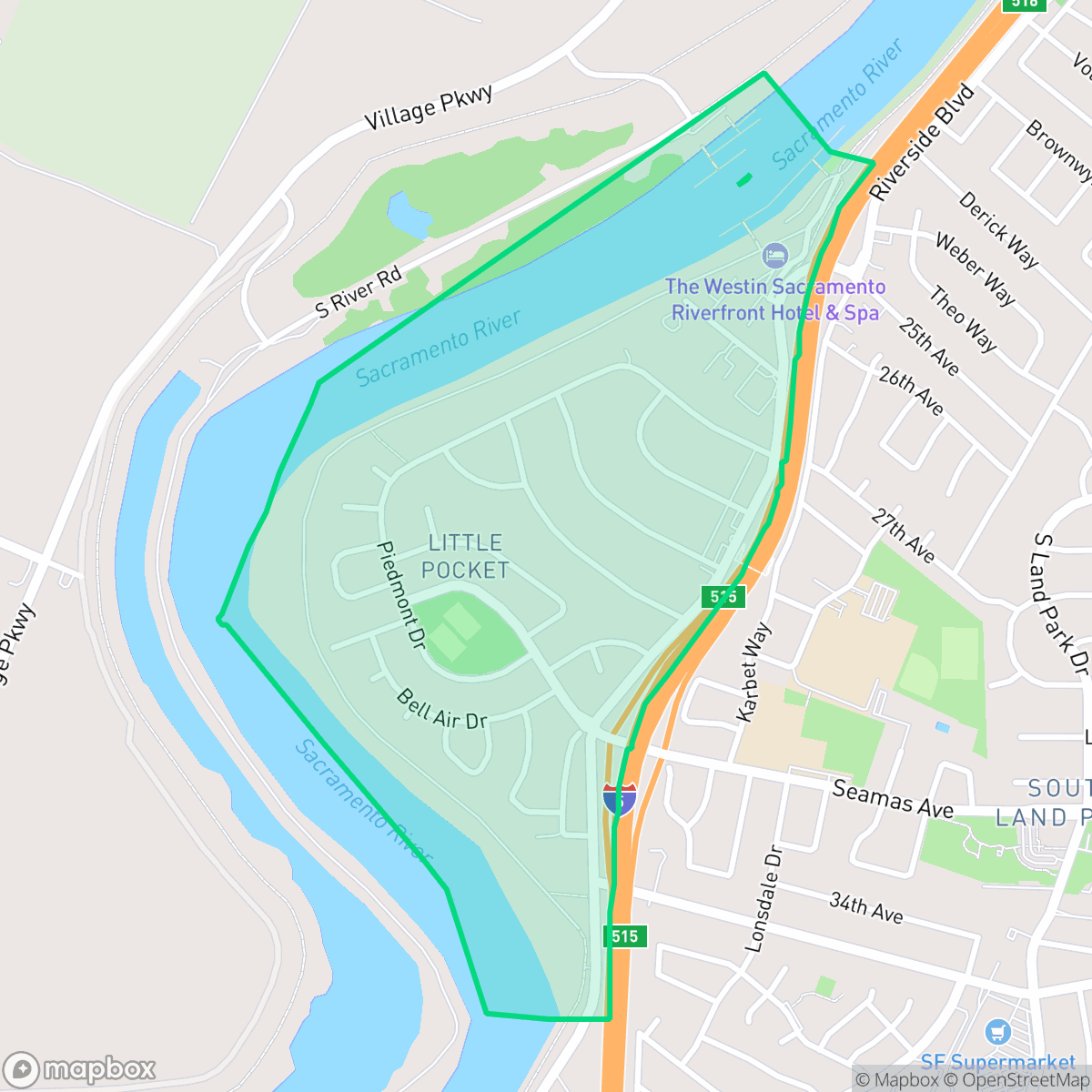
Tucked into a bend of the Sacramento River just north of the larger Pocket-Greenhaven area, the Little Pocket neighborhood of Sacramento, California, originated as rural agricultural land farmed by Portuguese immigrants in the late 19th and early 20th centuries. Subdivided for residential use primarily between 1940 and 1969, the secluded, semi-rural enclave is characterized by spacious lots, mature trees, and custom mid-century ranch-style homes. The neighborhood is bounded by Interstate 5 to the east and the river levee to the west, which serves as a popular recreational path. Local landmarks defining its quiet, community-oriented character include Emil Bahnfleth Park and Scott’s Seafood on the River, located at the northern tip near the Westin Sacramento.
The area is defined by its spacious lots and mature tree canopy, providing a visually appealing environment that contrasts with the denser urban core of Sacramento. Residents benefit from direct access to the river levee for recreation, while the limited commercial footprint keeps the streets peaceful. According to iHuus data, the neighborhood maintains a distinct residential character that favors privacy and open space over commercial convenience. Living here requires balancing the aesthetic benefits of a semi-rural setting against the reality of high ambient noise from the adjacent highway. The area is well-suited for those who prioritize a quiet, stable environment and are less concerned with immediate walkability to businesses. Families should note that the neighborhood falls within districts experiencing significant operational and academic challenges, making local school research a priority for prospective residents.
Neighborhood Scores Across 15 Qualities
Residential spacing offers a moderate degree of separation between neighbors. This level of privacy is slightly higher than the Sacramento average, providing some buffer between adjacent properties.
Sidewalks and safe crossings facilitate easy pedestrian movement, though the overall walkability is slightly lower than the Sacramento average.
Large residential properties and frequent upscale amenities create a landscape that is significantly more aesthetically pleasing than the Sacramento average. According to iHuus data, the area is characterized by spacious driveways and well-maintained surroundings.
Connected green spaces and wide, traffic-safe paths make this area more dog friendly than the Sacramento average, according to iHuus data.
Frequent open land and scattered homes amid fields or woodland provide a more spacious feel than much of Sacramento. According to iHuus data, this area features significantly more open space and greenery than the city average.
Residential life here is characterized by low density and significant open space, providing a much more tranquil atmosphere than the Sacramento average. According to iHuus data, the area lacks commercial character and offers very few local business destinations or nearby services.
Frequent aircraft noise from the nearby airport runway dominates the environment. According to iHuus data, acoustic comfort in this area is significantly lower than the Sacramento average.
Air quality in this area fluctuates between acceptable and unhealthy levels, posing occasional concerns for sensitive groups. According to iHuus data, these conditions are roughly in line with the Sacramento city average.
Industrial activity and warehouses are entirely absent from this area, offering a residential environment that is more secluded than the Sacramento average. According to iHuus data, the neighborhood consists of quiet streets and open green spaces without proximity to hazard sites.
Health insurance accessibility is notably higher here than the Sacramento average, according to iHuus data.
Voting patterns and census indicators show a deeply liberal leaning that is very similar to the broader Sacramento area. According to iHuus data, the political landscape here aligns closely with the city average.
Residents live alongside a balanced mix of young adults, families, and older individuals. This demographic variety is more widespread than the typical age distribution found across Sacramento.
Residual flood risk exists within this area as it is located inside the 500-year floodplain, though the level of safety is higher than the Sacramento average according to iHuus data.
Address-Level Insights for Little Pocket


iHuus Neighborhood Intelligence Insights
Get address-level neighborhood insights for Little Pocket
- Street-level scores — see how individual blocks compare, not just neighborhood averages
- Micro-zone boundaries — identify quiet pockets, flood boundaries, and walkable clusters before you visit
- 15 dimensions in full — walkability, noise, air quality, school quality, insurance coverage, population age profile, urban/rural index, and more
- Boundary risk alerts — know if your address sits near a block boundary where scores drop, the kind of detail no listing will ever mention
- School insights — individual school ratings and insights, not just district-level data
- Compare before you commit — side-by-side data across neighborhoods, down to block precision
No credit card required
Compare with Any Neighborhood
| Dimension | Little Pocket | Airport |
|---|---|---|
| 🚶 Walkabilityavg 8.5 | ||
| 🔊 Acoustic Comfortavg 3.22 | ||
| 🤫 Privacy Indexavg 5.34 | ||
| 🎨 Visual Appealavg 6.3 | ||
| 🐕 Dog Friendlinessavg 6.98 | ||
| 🗺️ Urban-Rural Indexavg 6.57 | ||
| ✨ Neighborhood Vibeavg 4.66 | ||
| 🏥 Health Insurance Coverageavg 7.4 | ||
| 🌿 Air Qualityavg 6.12 | ||
| 🏭 Industrial Proximityavg 8.32 | ||
| 🌊 Flood Safetyavg 6.04 | ||
| 🗳️ Ideological Leanavg 9.49 | ||
| 👥 Population Age Profileavg 4.75 | ||
| 🔥 Fire Safetyavg 0 | ||
| 🏫 School Quality |
Little Pocket Rankings
School Districts Serving Little Pocket
School Insights for Little Pocket
Below average outcomes; significant attendance and academic challenges.
School Insights
See what's really behind every school rating near Little Pocket
- Individual school ratings — each school's own score with outcome context, not just a district average
- Enrollment & class size data — student-to-teacher ratio and how it compares to the state average
- Full demographics breakdown — ethnicity and gender composition for every school in the enrollment zone
- Every school in the district — all schools within the enrollment boundary ranked by rating, not just the closest one
- Grade levels & benchmarks — elementary through high school, with below/above state-average flags
No credit card required