Land Park, Sacramento
Updated · 8,466 residents
Land Park is a highly walkable, tree-lined suburb characterized by its diverse historic architecture and proximity to expansive green spaces. Residents benefit from a quiet residential atmosphere with easy access to local dining and community services, though road traffic noise is a notable factor in certain areas.
Key Highlights
About Land Park
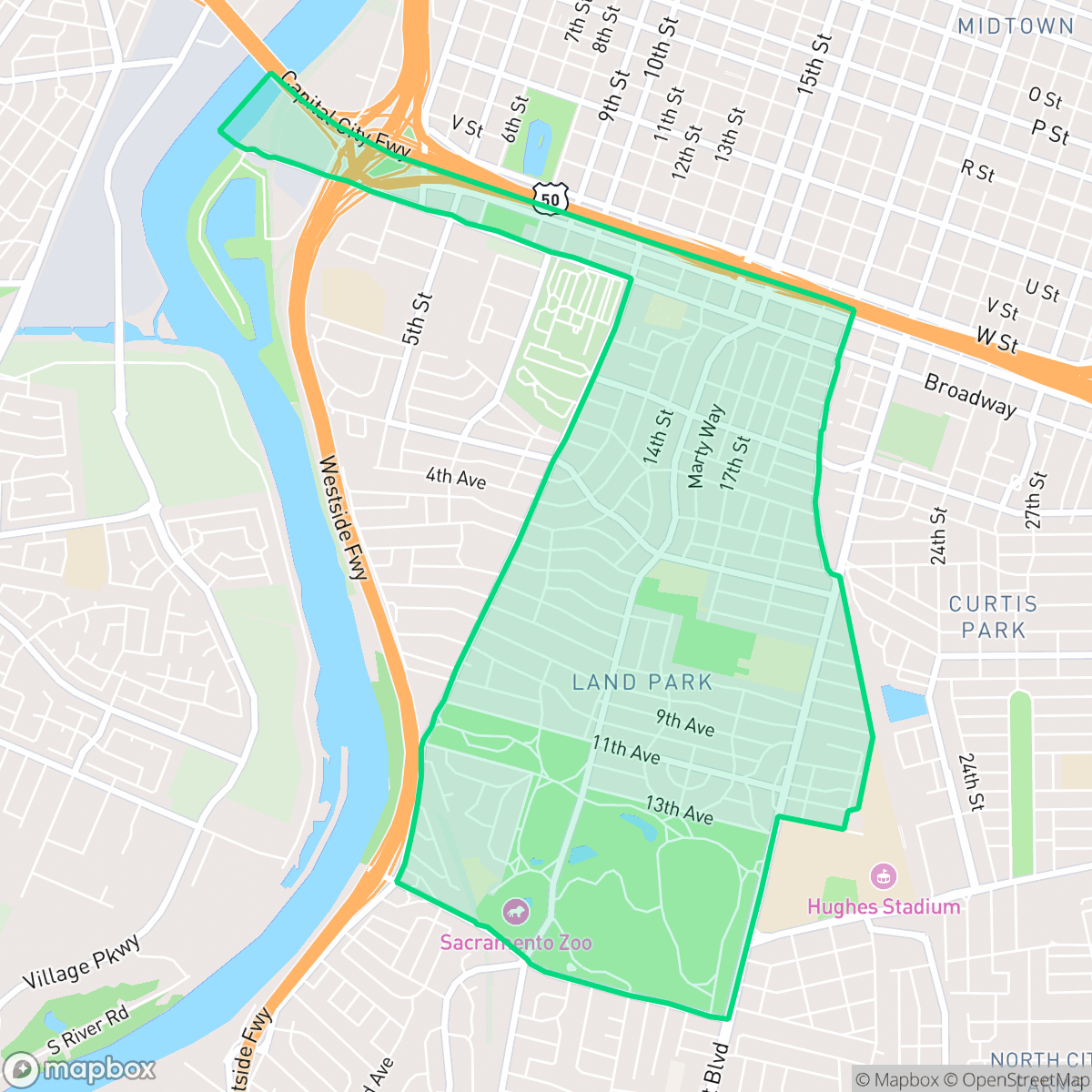
Land Park, a historic Sacramento neighborhood, developed around the 238-acre William Land Park. The park's land was purchased in 1918 using a $250,000 bequest from former mayor William Land. Previously part of John Sutter’s New Helvetia grant, the low-lying tract had served as ranches, a flood spill, and a raw sewage drainage slough. Residential development flourished from the 1920s through the 1940s as a streetcar suburb, characterized by Tudor, Craftsman, and Mediterranean-style homes. The neighborhood is defined by its mature canopy of planetrees and elms, as well as local landmarks like the 1938 Tower Theatre, Vic’s Ice Cream, and William Land Park itself—which hosts the Sacramento Zoo and Fairytale Town. Notable residents raised in the neighborhood include U.S. Supreme Court Justice Anthony Kennedy.
Land Park features a dense grid of streets shaded by a mature canopy of planetrees and elms, creating a distinct visual appeal defined by well-maintained homes with complex rooflines and private yards. The neighborhood maintains a strong residential identity, entirely free from industrial activity, and offers residents high levels of health insurance coverage and a quiet, suburban environment. Its layout supports high walkability, allowing residents to easily access local institutions and neighborhood services on foot while enjoying wide grassy parkways that contribute to the area's dog-friendly reputation.
Prospective residents should consider the trade-offs regarding acoustic comfort, as the area experiences an average noise level of 60 decibels primarily due to road traffic. While the neighborhood offers a peaceful setting, families should note that the local Sacramento City Unified School District faces significant fiscal instability and varied academic performance across its schools. The area is best suited for those who prioritize aesthetic character, walkability, and proximity to major recreational amenities like the zoo and local parks, provided they are comfortable with the noise profile and the broader challenges facing the local school system.
Neighborhood Scores Across 15 Qualities
Detached homes feature typical suburban spacing with private yards and mature tree screening providing some buffer between neighbors. This level of density is slightly higher than the Sacramento average, according to iHuus data.
Pedestrian connectivity is excellent due to a dense grid of tree-lined streets with wide sidewalks on both sides. According to iHuus data, the neighborhood offers superior sidewalk coverage and more direct walking paths than the Sacramento average.
Large homes with well-maintained landscapes and private pools characterize much of the area. According to iHuus data, the visual quality of the streetscape sits above the Sacramento average.
Wide, tree-lined streets and proximity to large public parks provide ample space for pets. According to iHuus data, these interconnected green spaces and grassy verges offer a higher level of dog friendliness than the Sacramento average.
Residential streets feature a dense canopy of mature trees and low-rise housing that mirrors the broader city landscape. This area presents a balance of suburban greenery and localized infrastructure, consistent with the Sacramento average.
A diverse mix of quiet residential streets and active social hubs provides a level of activity that is higher than the Sacramento average. Residents can access a variety of cafes, bakeries, and dining options within walkable pockets of the neighborhood according to iHuus data.
Frequent noise from nearby railroad tracks and major roadways is a consistent feature of the area. According to iHuus data, the acoustic environment here is comparable to the average levels found throughout Sacramento.
Air quality remains mostly clean with infrequent periods of elevated readings. According to iHuus data, the air quality in this area is better than the Sacramento city average.
No warehouses, industrial facilities, or hazardous sites are detected within the neighborhood. This area offers a significantly higher level of separation from industrial activity than the Sacramento average, according to iHuus data.
Health insurance enrollment is exceptionally high among Land Park residents, significantly exceeding the Sacramento average according to iHuus data.
Voting patterns and census indicators show a highly progressive political leaning that is slightly more pronounced than the Sacramento average, according to iHuus data.
A balanced mix of young adults, families, and older residents characterizes this area. According to iHuus data, the age distribution is slightly more varied than the Sacramento average.
Flood safety in this area is higher than the Sacramento average, although some residual risk remains due to its location within the 500-year floodplain according to iHuus data.
Address-Level Insights for Land Park


iHuus Neighborhood Intelligence Insights
Get address-level neighborhood insights for Land Park
- Street-level scores — see how individual blocks compare, not just neighborhood averages
- Micro-zone boundaries — identify quiet pockets, flood boundaries, and walkable clusters before you visit
- 15 dimensions in full — walkability, noise, air quality, school quality, insurance coverage, population age profile, urban/rural index, and more
- Boundary risk alerts — know if your address sits near a block boundary where scores drop, the kind of detail no listing will ever mention
- School insights — individual school ratings and insights, not just district-level data
- Compare before you commit — side-by-side data across neighborhoods, down to block precision
No credit card required
Compare with Any Neighborhood
| Dimension | Land Park | Airport |
|---|---|---|
| 🚶 Walkabilityavg 8.5 | ||
| 🔊 Acoustic Comfortavg 3.22 | ||
| 🤫 Privacy Indexavg 5.34 | ||
| 🎨 Visual Appealavg 6.3 | ||
| 🐕 Dog Friendlinessavg 6.98 | ||
| 🗺️ Urban-Rural Indexavg 6.57 | ||
| ✨ Neighborhood Vibeavg 4.66 | ||
| 🏥 Health Insurance Coverageavg 7.4 | ||
| 🌿 Air Qualityavg 6.12 | ||
| 🏭 Industrial Proximityavg 8.32 | ||
| 🌊 Flood Safetyavg 6.04 | ||
| 🗳️ Ideological Leanavg 9.49 | ||
| 👥 Population Age Profileavg 4.75 | ||
| 🔥 Fire Safetyavg 0 | ||
| 🏫 School Quality |
Land Park Rankings
School Districts Serving Land Park
School Insights for Land Park
Below average outcomes; significant attendance and academic challenges.
School Insights
See what's really behind every school rating near Land Park
- Individual school ratings — each school's own score with outcome context, not just a district average
- Enrollment & class size data — student-to-teacher ratio and how it compares to the state average
- Full demographics breakdown — ethnicity and gender composition for every school in the enrollment zone
- Every school in the district — all schools within the enrollment boundary ranked by rating, not just the closest one
- Grade levels & benchmarks — elementary through high school, with below/above state-average flags
No credit card required