Hagginwood, Sacramento
Updated · 5,391 residents
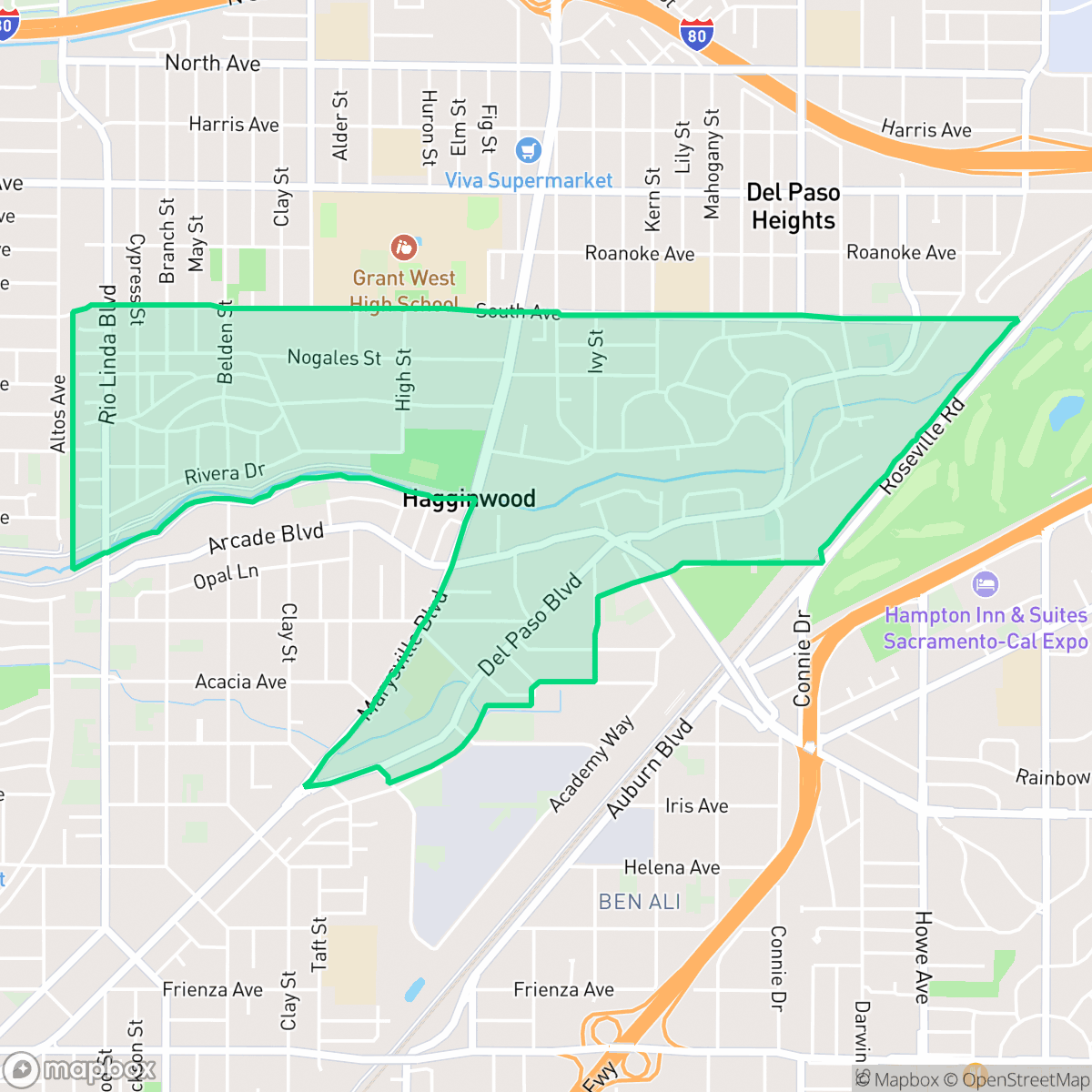
Hagginwood is a quiet, suburban neighborhood defined by its traditional grid layout and consistent pedestrian access. Residents benefit from a peaceful atmosphere and proximity to local green spaces, though the area maintains a low-key social profile with limited commercial density.
Key Highlights
About Hagginwood
Hagginwood’s history is rooted in the 44,000-acre Rancho Del Paso, a former Mexican land grant acquired in 1859 by attorney and tycoon James Ben Ali Haggin. Haggin transformed the land into a world-renowned thoroughbred horse breeding ranch. Following the ranch's sale and subdivision in 1910, the North Sacramento Land Company deeded land to establish the historic Hagginwood School. The community grew with older, mid-century single-family homes, mature oak trees, and oversized lots. Operating as an unincorporated area with its own local fire department, Hagginwood was officially annexed into the City of Sacramento in 1963. Today, the neighborhood's cultural and civic hub is the Joe Mims, Jr. Hagginwood Community Center, which honors a long-serving local youth recreation leader.
The area features a mix of mid-century single-family homes and established green spaces, creating a classic suburban environment. According to iHuus data, the neighborhood maintains a balanced urban-rural feel, providing a quiet residential setting that is largely removed from heavy industrial activity. Streets are generally walkable, with continuous sidewalks and accessible pedestrian crossings connecting residents to local parks and communal areas. Prospective residents should note that the neighborhood offers a tranquil pace of life, though it lacks a high density of retail or entertainment venues. While the area provides stable health insurance coverage and a strong sense of community, it faces challenges regarding flood safety and academic consistency within the surrounding school districts. It is well-suited for those prioritizing quiet residential living and reliable access to neighborhood elementary education over proximity to urban nightlife.
Neighborhood Scores Across 15 Qualities
Residential spacing is slightly higher than the Sacramento average, providing a modest buffer between homes. While many structures are closely packed on standard suburban lots, there is still some separation between neighbors.
Sidewalk networks and park trails facilitate pedestrian movement, though some areas experience interruptions near high-traffic arterial roads. This level of accessibility is slightly below the Sacramento city average according to iHuus data.
Uniform tract housing and small yard spaces define the area, resulting in a visual profile that is below the Sacramento average. According to iHuus data, the neighborhood features simple rooflines and limited private greenery or luxury amenities.
Access to dedicated pet space varies, as some areas feature large public parks and green canal corridors while others primarily consist of narrow sidewalk verges and fenced yards. Overall, opportunities for canine exercise are slightly below the Sacramento average according to iHuus data.
Low-density residential layouts with significant open space and greenery characterize this area. This landscape feels slightly more semi-rural than the typical Sacramento urban environment according to iHuus data.
Low-density residential streets and green spaces provide a calm atmosphere, though social activity and commercial density are lower than the Sacramento average. Most local services and dining options are concentrated near major roadways and are primarily accessible by vehicle.
Steady noise from nearby busy streets is a consistent feature here, though it remains slightly quieter than the Sacramento average according to iHuus data.
Air quality levels fluctuate between acceptable and unhealthy, which may cause occasional concern for sensitive groups. According to iHuus data, these conditions are roughly in line with the Sacramento city average.
Primarily residential in character, this area lacks significant heavy industry or large warehouses. According to iHuus data, the level of industrial proximity is slightly lower than the Sacramento average, with only occasional light commercial activity present.
Health insurance accessibility in this area is slightly below the Sacramento average, according to iHuus data.
Voting patterns and census indicators in Hagginwood align closely with the liberal lean of the broader Sacramento area, according to iHuus data.
A balanced distribution of young adults, families, and seniors characterizes this area, reflecting a demographic profile similar to the broader Sacramento area according to iHuus data.
Some residual flood risk exists within this area due to its location in the 500 year floodplain; however, safety levels remain slightly above the Sacramento city average according to iHuus data.
Address-Level Insights for Hagginwood


iHuus Neighborhood Intelligence Insights
Get address-level neighborhood insights for Hagginwood
- Street-level scores — see how individual blocks compare, not just neighborhood averages
- Micro-zone boundaries — identify quiet pockets, flood boundaries, and walkable clusters before you visit
- 15 dimensions in full — walkability, noise, air quality, school quality, insurance coverage, population age profile, urban/rural index, and more
- Boundary risk alerts — know if your address sits near a block boundary where scores drop, the kind of detail no listing will ever mention
- School insights — individual school ratings and insights, not just district-level data
- Compare before you commit — side-by-side data across neighborhoods, down to block precision
No credit card required
Compare with Any Neighborhood
| Dimension | Hagginwood | Airport |
|---|---|---|
| 🚶 Walkabilityavg 8.5 | ||
| 🔊 Acoustic Comfortavg 3.22 | ||
| 🤫 Privacy Indexavg 5.34 | ||
| 🎨 Visual Appealavg 6.3 | ||
| 🐕 Dog Friendlinessavg 6.98 | ||
| 🗺️ Urban-Rural Indexavg 6.57 | ||
| ✨ Neighborhood Vibeavg 4.66 | ||
| 🏥 Health Insurance Coverageavg 7.4 | ||
| 🌿 Air Qualityavg 6.12 | ||
| 🏭 Industrial Proximityavg 8.32 | ||
| 🌊 Flood Safetyavg 6.04 | ||
| 🗳️ Ideological Leanavg 9.49 | ||
| 👥 Population Age Profileavg 4.75 | ||
| 🔥 Fire Safetyavg 0 | ||
| 🏫 School Quality |
Hagginwood Rankings
School Districts Serving Hagginwood
School Insights for Hagginwood
Below average outcomes; significant attendance and academic challenges.
School Insights
See what's really behind every school rating near Hagginwood
- Individual school ratings — each school's own score with outcome context, not just a district average
- Enrollment & class size data — student-to-teacher ratio and how it compares to the state average
- Full demographics breakdown — ethnicity and gender composition for every school in the enrollment zone
- Every school in the district — all schools within the enrollment boundary ranked by rating, not just the closest one
- Grade levels & benchmarks — elementary through high school, with below/above state-average flags
No credit card required