Granite Regional Park, Sacramento
Updated · 588 residents
Granite Regional Park is a unique area defined by its conversion from a former quarry into a hub for outdoor recreation, including popular soccer fields and skate facilities. While the neighborhood offers an exceptionally rural atmosphere and top-tier dog friendliness, residents must contend with significant noise levels from nearby road traffic and a reliance on personal vehicles for daily errands.
Key Highlights
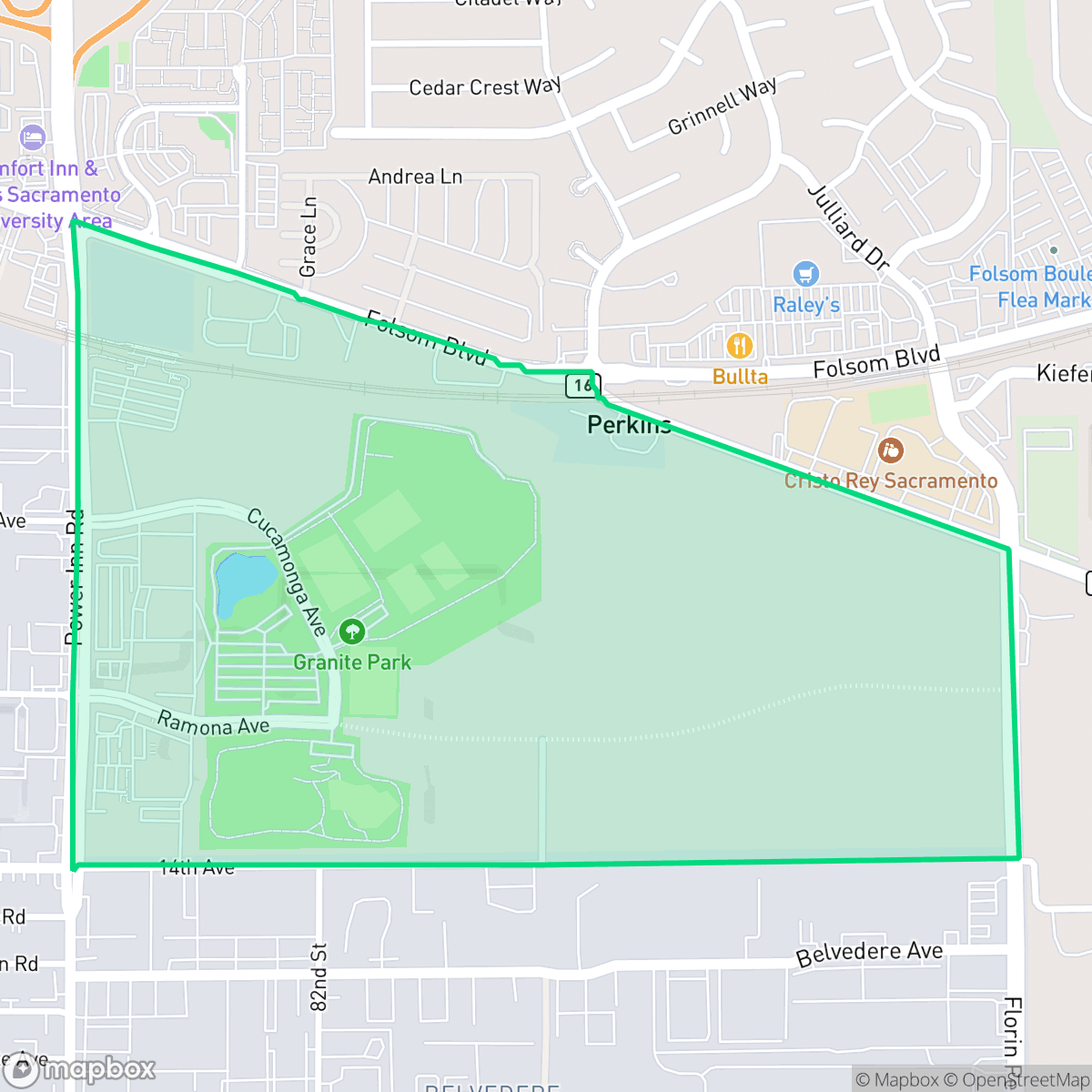
About Granite Regional Park
The Granite Regional Park neighborhood in Sacramento, California, has its origins in a 33-year gravel mining operation run by the Granite Construction Company. For decades, the site supplied the rock used to build regional infrastructure, including Highway 50 and the Yolo Bypass. Following the mine's closure in 1989, company president Richard Solari sought to donate the land to the city as a public park. To fund the development, local developers George Separovich and Dain Domich proposed an innovative public-private partnership. They built a Class-A office park along the rim of the former quarry, using the commercial equity to construct the 252-acre regional park. Opened in 2001, the master-planned area blends modern office buildings with extensive recreational facilities, including soccer fields, a dog park, and a major skate park.
The neighborhood functions as a distinct blend of commercial office space and expansive recreational land, maintaining a notably rural character despite its location within the city. The area is defined by its open spaces and light industrial presence, which creates a quiet, low-density environment that stands in contrast to the more densely populated surrounding districts. According to iHuus data, the neighborhood provides a unique lifestyle for those who prioritize access to outdoor amenities and pet-friendly environments over traditional urban walkability.
Prospective residents should consider the trade-offs associated with this location, particularly regarding acoustic comfort and industrial proximity. The area experiences significant noise from road traffic, and its history as a mining site places it near an EPA Superfund zone, which may involve considerations regarding soil and groundwater quality. While the neighborhood lacks the high walkability scores found in neighboring areas, it remains a suitable option for individuals who prefer a car-dependent, open landscape and easy access to specialized athletic facilities.
Neighborhood Scores Across 15 Qualities
Homes feature mixed spacing with some distance between neighbors, offering slightly more seclusion than the Sacramento average.
Sidewalks are available on one side of the streets and safe crossings are present, though the area is slightly less walkable than the Sacramento average.
Residential vistas consist of typical tract housing with uniform rooflines and modest yard spaces. This level of visual variety is slightly lower than the average seen across Sacramento.
Wide paths and connected green spaces provide an environment that is more favorable for pet owners than the Sacramento average. According to iHuus data, these areas are well-integrated with nature and separated from heavy traffic.
Open land and scattered homes provide a more rural feel than much of Sacramento. This area features a mix of woodland, fields, and low-density urban fringe landscape according to iHuus data.
A mix of quiet industrial zones and suburban blocks offers a varied atmosphere with more dining and service options than the Sacramento average. While some areas feature vast open spaces and freight corridors, others provide accessible social hubs and diverse eateries according to iHuus data.
Frequent noise from nearby railroad tracks and heavy freeway traffic defines the area. According to iHuus data, acoustic comfort is significantly lower than the Sacramento average.
Air quality in this area is generally acceptable, though sensitive groups may experience occasional concern on certain days. According to iHuus data, the levels are roughly in line with the Sacramento average.
Residential life remains largely undisturbed by heavy industry, though some areas near the neighborhood periphery are adjacent to an EPA Superfund site. This proximity to industrial zones and logistics facilities is slightly higher than the Sacramento average, according to iHuus data.
Health insurance coverage among residents is slightly below the Sacramento average, according to iHuus data.
Voting patterns and census indicators show a predominantly liberal leaning, though this is slightly less pronounced than the average across Sacramento.
Residents live alongside a balanced mix of young adults, families, and older populations. This demographic spread is nearly identical to the typical age distribution found across Sacramento.
Flood safety in this area is higher than the Sacramento average, though some residual risk remains due to its location within the 500-year floodplain. According to iHuus data, residents should be aware of potential seasonal water fluctuations.
Address-Level Insights for Granite Regional Park


iHuus Neighborhood Intelligence Insights
Get address-level neighborhood insights for Granite Regional Park
- Street-level scores — see how individual blocks compare, not just neighborhood averages
- Micro-zone boundaries — identify quiet pockets, flood boundaries, and walkable clusters before you visit
- 15 dimensions in full — walkability, noise, air quality, school quality, insurance coverage, population age profile, urban/rural index, and more
- Boundary risk alerts — know if your address sits near a block boundary where scores drop, the kind of detail no listing will ever mention
- School insights — individual school ratings and insights, not just district-level data
- Compare before you commit — side-by-side data across neighborhoods, down to block precision
No credit card required
Compare with Any Neighborhood
| Dimension | Granite Regional Park | Airport |
|---|---|---|
| 🚶 Walkabilityavg 8.5 | ||
| 🔊 Acoustic Comfortavg 3.22 | ||
| 🤫 Privacy Indexavg 5.34 | ||
| 🎨 Visual Appealavg 6.3 | ||
| 🐕 Dog Friendlinessavg 6.98 | ||
| 🗺️ Urban-Rural Indexavg 6.57 | ||
| ✨ Neighborhood Vibeavg 4.66 | ||
| 🏥 Health Insurance Coverageavg 7.4 | ||
| 🌿 Air Qualityavg 6.12 | ||
| 🏭 Industrial Proximityavg 8.32 | ||
| 🌊 Flood Safetyavg 6.04 | ||
| 🗳️ Ideological Leanavg 9.49 | ||
| 👥 Population Age Profileavg 4.75 | ||
| 🔥 Fire Safetyavg 0 | ||
| 🏫 School Quality |
Granite Regional Park Rankings
School Districts Serving Granite Regional Park
School Insights for Granite Regional Park
Below average outcomes; significant attendance and academic challenges.
School Insights
See what's really behind every school rating near Granite Regional Park
- Individual school ratings — each school's own score with outcome context, not just a district average
- Enrollment & class size data — student-to-teacher ratio and how it compares to the state average
- Full demographics breakdown — ethnicity and gender composition for every school in the enrollment zone
- Every school in the district — all schools within the enrollment boundary ranked by rating, not just the closest one
- Grade levels & benchmarks — elementary through high school, with below/above state-average flags
No credit card required