Golf Course Terrace, Sacramento
Updated · 3,953 residents
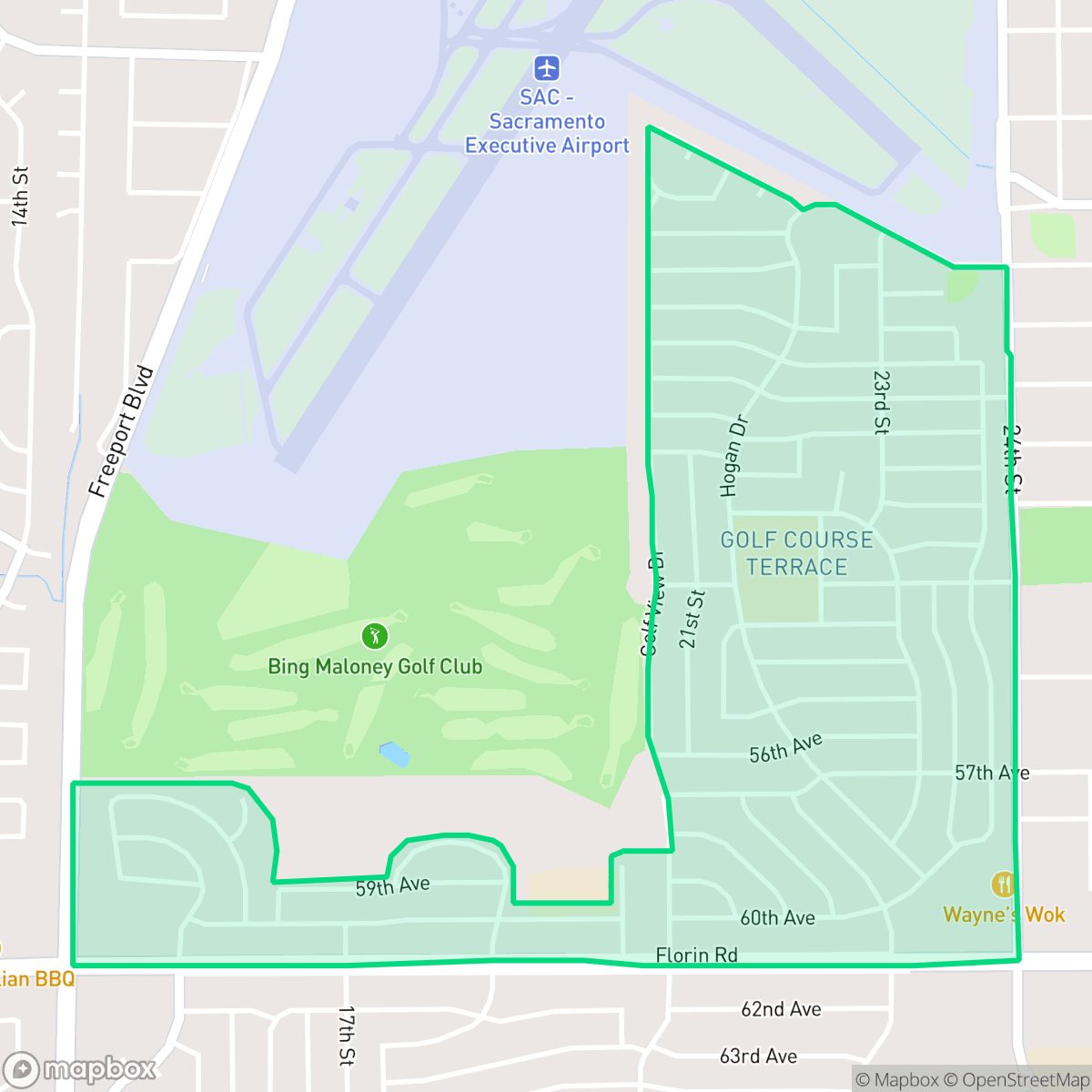
Golf Course Terrace is a quiet, residential enclave defined by its mid-century ranch architecture and proximity to the Bing Maloney Golf Course. While the area offers excellent walkability and ample green space for pet owners, residents should expect notable noise levels due to its location near the Sacramento Executive Airport.
Key Highlights
About Golf Course Terrace
Developed between 1955 and 1970 to meet Sacramento’s post-World War II housing demand, the Golf Course Terrace Estates neighborhood was designed as a modern suburban alternative to the city’s traditional street grid. The city installed the initial infrastructure and invited 25 regional builders and architects to construct unique model homes, resulting in a diverse collection of classic mid-century ranch architecture. True to its name, the neighborhood wraps around the historic Bing Maloney Golf Course and the Sacramento Executive Airport. Reflecting this association, many of its residential streets—such as Hogan, Demaret, and Middlecoff—were named after legendary professional golfers.
This residential area is characterized by a consistent suburban layout with a grid design that supports easy pedestrian movement. The neighborhood remains purely residential and recreational, free from industrial hazards or warehouses, which helps maintain a stable community atmosphere. According to iHuus data, the area benefits from wide green verges and multiple public parks, making it a practical choice for those seeking outdoor access within a suburban setting. The architecture remains largely consistent with its mid-century roots, featuring modest yards and houses spaced roughly 10 to 15 meters apart.
Prospective residents should note that the primary trade-off for this location is the significant acoustic impact from aviation activities, which limits quiet enjoyment in outdoor spaces. Additionally, the neighborhood is served by the Sacramento City Unified School District, an organization currently experiencing fiscal instability and administrative challenges. The area is best suited for individuals who prioritize a highly walkable, established community over a high-energy urban environment, provided they are comfortable with the noise profile identified in recent assessments.
Neighborhood Scores Across 15 Qualities
Detached homes feature modest side-yard buffers and shared fence lines. According to iHuus data, this level of spacing offers slightly more separation between neighbors than is typical for Sacramento.
Pedestrian infrastructure is exceptionally strong here, featuring consistent sidewalks on both sides of streets and safe, well-marked crossings. According to iHuus data, the neighborhood offers superior connectivity and safety for walkers compared to the Sacramento average.
Large homes with multi-car driveways and private backyard pools contribute to a visual landscape that is slightly more polished than the Sacramento average. According to iHuus data, the area features a mix of affluent estates and standard tract housing with varying lot densities.
Extensive green verges and several large public parks provide ample space for pets. According to iHuus data, this area offers more continuous walking paths and safer, traffic-free zones than the Sacramento average.
Residential density is slightly higher than the Sacramento average, featuring a mix of single-family homes and established tree canopies. According to iHuus data, the area maintains a semi-rural feel with frequent pockets of open land interspersed among suburban layouts.
Residential streets and green spaces offer a peaceful, suburban rhythm, though the area is notably less active than the Sacramento average. Most daily needs require a car due to the sparse distribution of local businesses and services.
Frequent disturbances from nearby freeway traffic and railroad corridors are common here. This level of acoustic interference is notably higher than the Sacramento average, according to iHuus data.
Air quality levels fluctuate between acceptable and unhealthy, presenting occasional concerns for sensitive groups. According to iHuus data, these conditions are roughly in line with the average seen across Sacramento.
Residential and recreational spaces dominate this area with no detectable warehouses or heavy industrial hazards. This lack of industrial presence is notably higher than the Sacramento average, according to iHuus data.
Most residents in this area maintain health insurance coverage, which is roughly in line with the Sacramento average according to iHuus data.
Voting patterns and census indicators show a predominantly liberal political leaning that is slightly more pronounced than the Sacramento average.
Residents live alongside a balanced range of young adults, families, and older individuals, mirroring the broader Sacramento demographic. According to iHuus data, there is no significant skew toward any specific life stage in this area.
Residual flood risk exists within this area due to its location in the 500-year floodplain; however, safety levels are notably higher than the Sacramento city average according to iHuus data.
Address-Level Insights for Golf Course Terrace


iHuus Neighborhood Intelligence Insights
Get address-level neighborhood insights for Golf Course Terrace
- Street-level scores — see how individual blocks compare, not just neighborhood averages
- Micro-zone boundaries — identify quiet pockets, flood boundaries, and walkable clusters before you visit
- 15 dimensions in full — walkability, noise, air quality, school quality, insurance coverage, population age profile, urban/rural index, and more
- Boundary risk alerts — know if your address sits near a block boundary where scores drop, the kind of detail no listing will ever mention
- School insights — individual school ratings and insights, not just district-level data
- Compare before you commit — side-by-side data across neighborhoods, down to block precision
No credit card required
Compare with Any Neighborhood
| Dimension | Golf Course Terrace | Airport |
|---|---|---|
| 🚶 Walkabilityavg 8.5 | ||
| 🔊 Acoustic Comfortavg 3.22 | ||
| 🤫 Privacy Indexavg 5.34 | ||
| 🎨 Visual Appealavg 6.3 | ||
| 🐕 Dog Friendlinessavg 6.98 | ||
| 🗺️ Urban-Rural Indexavg 6.57 | ||
| ✨ Neighborhood Vibeavg 4.66 | ||
| 🏥 Health Insurance Coverageavg 7.4 | ||
| 🌿 Air Qualityavg 6.12 | ||
| 🏭 Industrial Proximityavg 8.32 | ||
| 🌊 Flood Safetyavg 6.04 | ||
| 🗳️ Ideological Leanavg 9.49 | ||
| 👥 Population Age Profileavg 4.75 | ||
| 🔥 Fire Safetyavg 0 | ||
| 🏫 School Quality |
Golf Course Terrace Rankings
School Districts Serving Golf Course Terrace
School Insights for Golf Course Terrace
Below average outcomes; significant attendance and academic challenges.
School Insights
See what's really behind every school rating near Golf Course Terrace
- Individual school ratings — each school's own score with outcome context, not just a district average
- Enrollment & class size data — student-to-teacher ratio and how it compares to the state average
- Full demographics breakdown — ethnicity and gender composition for every school in the enrollment zone
- Every school in the district — all schools within the enrollment boundary ranked by rating, not just the closest one
- Grade levels & benchmarks — elementary through high school, with below/above state-average flags
No credit card required