Glen Elder, Sacramento
Updated · 2,961 residents
Glen Elder is a quiet, diverse residential neighborhood in Sacramento defined by its mid-century tract housing and industrial-suburban landscape. While the area offers a stable, grid-like layout, residents rely on vehicles for daily errands due to limited walkable commercial options and proximity to freight corridors.
Key Highlights
About Glen Elder
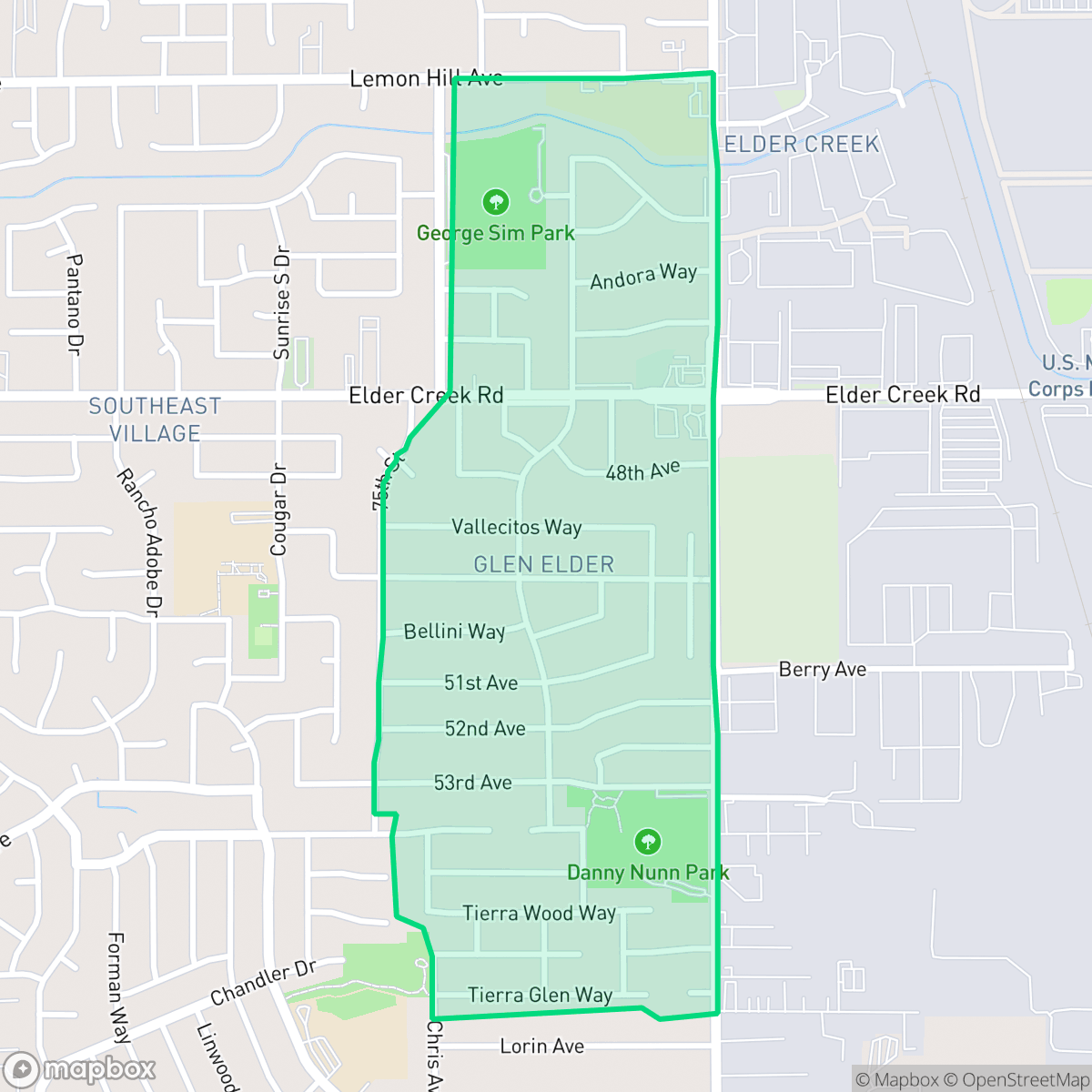
Approved in 1954 at the northwest corner of Elder Creek Road and Power Inn Road, the Glen Elder subdivision was built by Sun River Homes, Inc. as an "unrestricted" community. At a time when postwar suburbs across Sacramento County enforced strict racial covenants, Glen Elder stood out as one of the few neighborhoods where Black homebuyers could secure FHA loans and purchase homes. By the 1960s, it had grown into a close-knit, predominantly African American enclave. This supportive community shaped the upbringing of prominent public intellectual Cornel West, whose family moved to the neighborhood in the 1950s. Today, Glen Elder is recognized for its historic role in navigating Sacramento's mid-century housing segregation, having transitioned into a highly diverse neighborhood.
The area maintains a low-density urban character, blending single-family residential blocks with nearby industrial and commercial zones. It features standard tract housing with small yards and is home to local amenities such as Danny Nunn Park and various religious landmarks. According to iHuus data, the neighborhood provides a quiet atmosphere, though residents should expect consistent road traffic noise from surrounding thoroughfares. The local environment is shaped by a mix of residential life and active commercial daytime traffic, reflecting the neighborhood's position within a broader industrial-suburban corridor.
Prospective residents should consider the trade-offs of living in an industrial-adjacent zone, which includes proximity to freight traffic and an EPA Superfund site that warrants attention to local environmental reports. While the area offers favorable flood safety, it lacks the high walkability found in some neighboring districts. It is best suited for those prioritizing an established community feel and affordability over immediate access to dense retail or pedestrian-friendly corridors.
Neighborhood Scores Across 15 Qualities
Detached homes feature modest side yards and typical suburban spacing. According to iHuus data, this level of separation between neighbors is slightly higher than the Sacramento average.
Sidewalk networks are available on many residential streets and major thoroughfares, though overall walkability is slightly lower than the Sacramento average. Low traffic on interior roads and safe crossings facilitate easier movement for pedestrians within the neighborhood.
Standard tract housing characterizes this area, featuring uniform rooflines and small yards. According to iHuus data, the visual landscape is slightly less varied than the Sacramento average.
Grassy canal buffers and a large public park provide ample space for pet exercise. While walking options are available, the overall accessibility for dogs is slightly below the Sacramento average due to a reliance on private backyards.
Residential pockets feature low-density single-family homes and open fields, though these areas often border large-scale industrial and commercial corridors. This balance of open land and industrial use is very similar to the typical layout found across Sacramento.
Low density and industrial presence create a quiet, car-oriented environment with limited walkability to local services. This area lacks the social energy found in more active parts of Sacramento, according to iHuus data.
Steady sounds from nearby busy streets are present, though acoustic levels are notably more tranquil than the average for Sacramento. According to iHuus data, residents can expect a consistent but manageable level of ambient traffic hum.
Air quality in this area fluctuates between acceptable and unhealthy levels, posing occasional concerns for sensitive groups. According to iHuus data, these conditions are roughly in line with the average seen across Sacramento.
Active commercial zones and heavy industrial facilities are present near residential areas, marking a significantly higher industrial density than the Sacramento average. Residents should be aware of nearby Superfund sites that may involve soil or groundwater contamination risks according to iHuus data.
Health insurance accessibility in this area is below the Sacramento average, according to iHuus data. Residents may find fewer opportunities for employer-sponsored coverage compared to other parts of the city.
Voting patterns and census indicators reflect a political landscape that is very similar to the broader Sacramento area. According to iHuus data, the neighborhood maintains a highly progressive leaning consistent with the city average.
Residents live among a balanced spread of young adults, families, and older individuals. According to iHuus data, the age distribution in Glen Elder is slightly more varied than the Sacramento average.
Residual flood risks exist within this area due to its location in a 500-year floodplain; however, overall flood safety is higher than the Sacramento average according to iHuus data.
Address-Level Insights for Glen Elder


iHuus Neighborhood Intelligence Insights
Get address-level neighborhood insights for Glen Elder
- Street-level scores — see how individual blocks compare, not just neighborhood averages
- Micro-zone boundaries — identify quiet pockets, flood boundaries, and walkable clusters before you visit
- 15 dimensions in full — walkability, noise, air quality, school quality, insurance coverage, population age profile, urban/rural index, and more
- Boundary risk alerts — know if your address sits near a block boundary where scores drop, the kind of detail no listing will ever mention
- School insights — individual school ratings and insights, not just district-level data
- Compare before you commit — side-by-side data across neighborhoods, down to block precision
No credit card required
Compare with Any Neighborhood
| Dimension | Glen Elder | Airport |
|---|---|---|
| 🚶 Walkabilityavg 8.5 | ||
| 🔊 Acoustic Comfortavg 3.22 | ||
| 🤫 Privacy Indexavg 5.34 | ||
| 🎨 Visual Appealavg 6.3 | ||
| 🐕 Dog Friendlinessavg 6.98 | ||
| 🗺️ Urban-Rural Indexavg 6.57 | ||
| ✨ Neighborhood Vibeavg 4.66 | ||
| 🏥 Health Insurance Coverageavg 7.4 | ||
| 🌿 Air Qualityavg 6.12 | ||
| 🏭 Industrial Proximityavg 8.32 | ||
| 🌊 Flood Safetyavg 6.04 | ||
| 🗳️ Ideological Leanavg 9.49 | ||
| 👥 Population Age Profileavg 4.75 | ||
| 🔥 Fire Safetyavg 0 | ||
| 🏫 School Quality |
Glen Elder Rankings
School Districts Serving Glen Elder
School Insights for Glen Elder
Below average outcomes; significant attendance and academic challenges.
School Insights
See what's really behind every school rating near Glen Elder
- Individual school ratings — each school's own score with outcome context, not just a district average
- Enrollment & class size data — student-to-teacher ratio and how it compares to the state average
- Full demographics breakdown — ethnicity and gender composition for every school in the enrollment zone
- Every school in the district — all schools within the enrollment boundary ranked by rating, not just the closest one
- Grade levels & benchmarks — elementary through high school, with below/above state-average flags
No credit card required