Gardenland, Sacramento
Updated · 4,739 residents
Gardenland is a dense suburban residential area in northern Sacramento characterized by a consistent grid of single-family homes and proximity to major transit corridors. While the neighborhood offers a quiet atmosphere with local green spaces, residents should be aware of high road noise levels and significant flood risks.
Key Highlights
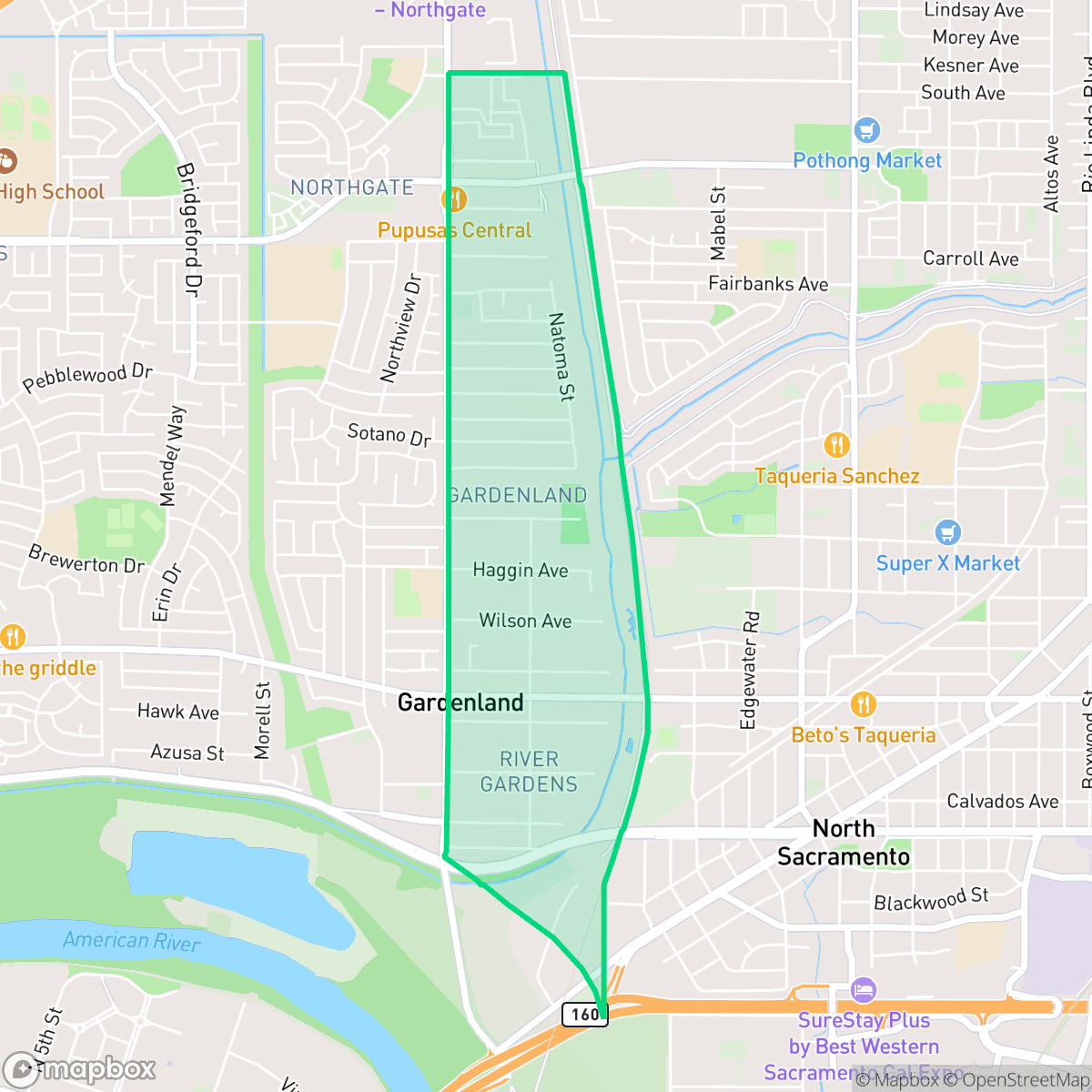
About Gardenland
Established in the 1920s following the completion of the Reclamation District 1000 levee system, the Gardenland neighborhood in northern Sacramento was originally subdivided into 10-acre agricultural plots. Named for its fertile soil and abundant trees, the area was initially settled by immigrant farmworkers and railroad employees of Portuguese and Mexican descent. By the mid-20th century, Gardenland had the city's largest concentration of Mexican-American residents, many of whom worked for the Southern Pacific Railroad, Campbell Soup, and Blue Diamond Almond Growers. Originally unincorporated, the neighborhood was annexed by Sacramento in 1962. In the 1970s, the community underwent significant modernization, which replaced hazardous drainage ditches with modern sidewalks and sewer systems, and established Gardenland Park along Bowman Avenue as a central gathering space.
The neighborhood features a compact, car-oriented layout where homes are closely spaced, creating a high-density suburban environment. It functions as a quiet residential pocket with limited commercial activity, though residents can access neighborhood-level dining and services. The area maintains a consistent network of sidewalks, providing basic connectivity for pedestrians despite the lack of major amenities within comfortable walking distance. Its character is defined by standard tract housing and a reliance on nearby arterial roads for regional access.
Prospective residents should consider several livability trade-offs, most notably the high levels of ambient noise generated by road traffic and a significant vulnerability to flooding. The local school system, managed by the Twin Rivers Unified School District, is currently navigating a period of academic and administrative transition. Given these factors, the area is often considered by those prioritizing residential affordability and transit access over proximity to top-tier public amenities or absolute quietude.
Neighborhood Scores Across 15 Qualities
Residential spacing is varied, featuring a mix of closely set suburban homes and larger lots with private backyards. This level of separation is slightly higher than the Sacramento average, according to iHuus data.
Continuous sidewalks and low-traffic residential grids make navigating the area on foot easy. According to iHuus data, the pedestrian experience here is very similar to the Sacramento average.
Standard tract housing features uniform rooflines and small yards. According to iHuus data, the visual variety in this area is slightly lower than the Sacramento average.
Accessible green spaces, including a central park and large school fields, provide reliable areas for pet exercise. According to iHuus data, the availability of connected paths and sidewalk verges is slightly below the Sacramento city average.
Low density residential lots and significant open land provide a sense of openness that matches the Sacramento average. This landscape features a mix of single-family homes situated among larger plots and some woodland areas.
Residential blocks offer a calm atmosphere with scattered dining and social spots, though the area feels less active than the Sacramento average. Most local services and commercial units require a car, as walking options are limited throughout the neighborhood.
Frequent disturbances from nearby railroad tracks and freeway traffic characterize the area. According to iHuus data, acoustic comfort in this neighborhood is lower than the Sacramento average.
Air quality levels here are generally stable but occasionally present concerns for sensitive groups. This neighborhood experiences air quality similar to the Sacramento average, according to iHuus data.
Heavy industrial activity and hazardous sites are virtually absent from this area, offering a cleaner environment than much of Sacramento. According to iHuus data, the neighborhood is predominantly residential with only minimal light commercial storage present near the central corridor.
Health insurance coverage among residents is notably lower than the Sacramento average, according to iHuus data.
Voting patterns and census indicators reflect a deeply liberal political leaning that is very similar to the broader Sacramento area. Residents will find a political landscape consistent with the city average according to iHuus data.
Residents live alongside a balanced mix of young adults, families, and older individuals. This demographic variety is slightly lower than the typical Sacramento profile, according to iHuus data.
Property located within a designated floodplain face significant flood risks; according to iHuus data, this area is notably more susceptible to flooding than the Sacramento average.
Address-Level Insights for Gardenland


iHuus Neighborhood Intelligence Insights
Get address-level neighborhood insights for Gardenland
- Street-level scores — see how individual blocks compare, not just neighborhood averages
- Micro-zone boundaries — identify quiet pockets, flood boundaries, and walkable clusters before you visit
- 15 dimensions in full — walkability, noise, air quality, school quality, insurance coverage, population age profile, urban/rural index, and more
- Boundary risk alerts — know if your address sits near a block boundary where scores drop, the kind of detail no listing will ever mention
- School insights — individual school ratings and insights, not just district-level data
- Compare before you commit — side-by-side data across neighborhoods, down to block precision
No credit card required
Compare with Any Neighborhood
| Dimension | Gardenland | Airport |
|---|---|---|
| 🚶 Walkabilityavg 8.5 | ||
| 🔊 Acoustic Comfortavg 3.22 | ||
| 🤫 Privacy Indexavg 5.34 | ||
| 🎨 Visual Appealavg 6.3 | ||
| 🐕 Dog Friendlinessavg 6.98 | ||
| 🗺️ Urban-Rural Indexavg 6.57 | ||
| ✨ Neighborhood Vibeavg 4.66 | ||
| 🏥 Health Insurance Coverageavg 7.4 | ||
| 🌿 Air Qualityavg 6.12 | ||
| 🏭 Industrial Proximityavg 8.32 | ||
| 🌊 Flood Safetyavg 6.04 | ||
| 🗳️ Ideological Leanavg 9.49 | ||
| 👥 Population Age Profileavg 4.75 | ||
| 🔥 Fire Safetyavg 0 | ||
| 🏫 School Quality |
Gardenland Rankings
School Districts Serving Gardenland
School Insights for Gardenland
Below average outcomes; significant attendance and academic challenges.
School Insights
See what's really behind every school rating near Gardenland
- Individual school ratings — each school's own score with outcome context, not just a district average
- Enrollment & class size data — student-to-teacher ratio and how it compares to the state average
- Full demographics breakdown — ethnicity and gender composition for every school in the enrollment zone
- Every school in the district — all schools within the enrollment boundary ranked by rating, not just the closest one
- Grade levels & benchmarks — elementary through high school, with below/above state-average flags
No credit card required