Fruitridge Manor, Sacramento
Updated · 5,519 residents
Fruitridge Manor is a highly walkable south Sacramento neighborhood characterized by its mid-century suburban grid and diverse local dining scene. While the area offers convenient access to amenities and transit corridors, residents should be aware of significant noise levels from nearby road traffic.
Key Highlights
About Fruitridge Manor
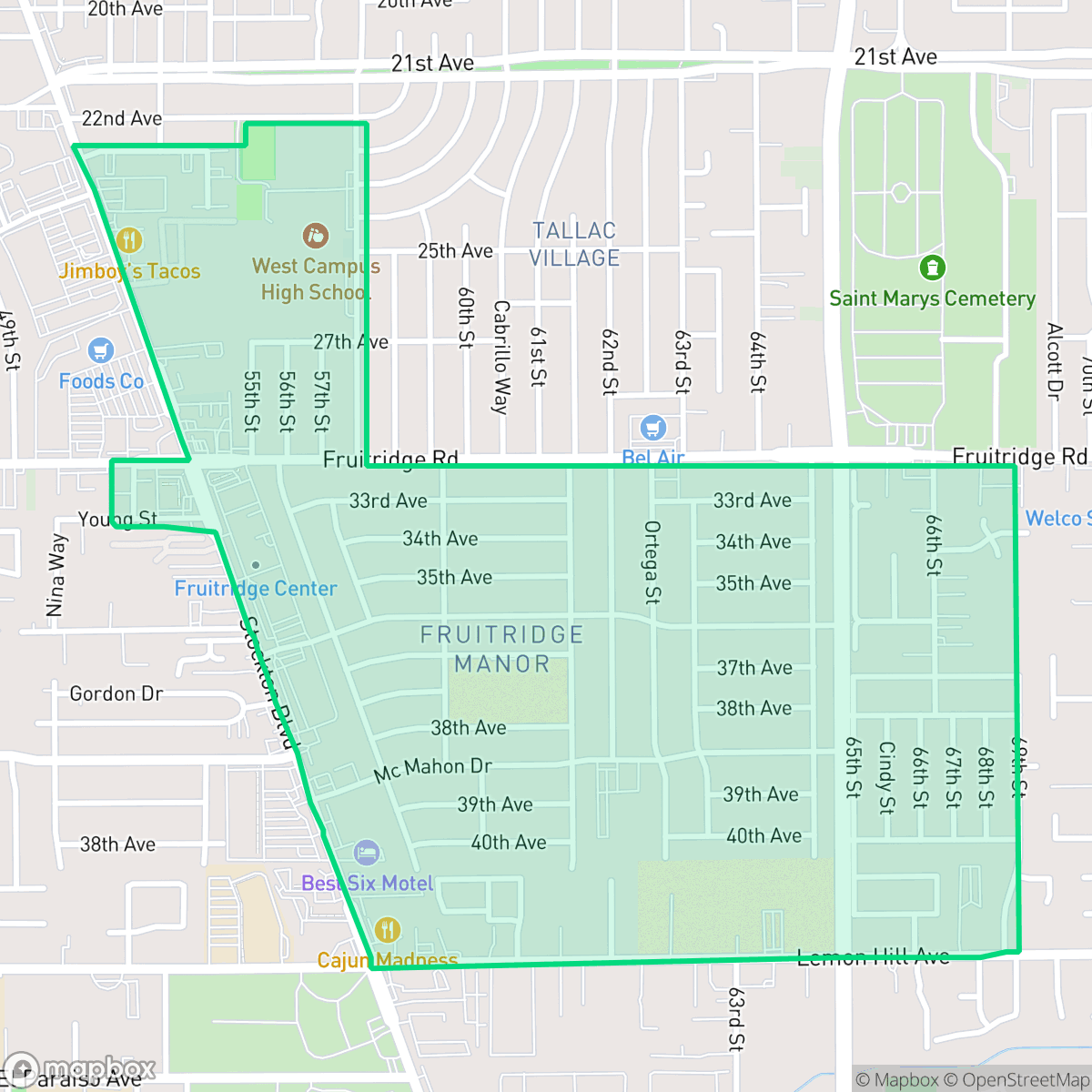
Fruitridge Manor in south Sacramento was developed starting in 1946 by the prominent local real estate firm McMahon & Ford. Designed to meet the housing needs of returning World War II veterans, the neighborhood offered affordable single-family homes financed through low-interest federal loan programs. Bounded primarily by Fruitridge Road and 47th Avenue, the subdivision quickly grew with mid-century homes built mostly between 1940 and 1969. To serve this new suburban community, the historic Fruitridge Shopping Center was established at the intersection of Fruitridge Road and Stockton Boulevard between 1947 and 1954. In recent years, the neighborhood has undergone revitalization along its Stockton Boulevard transit corridor, highlighted by the redevelopment of the long-vacant San Juan and Park Villa Victoria motel sites into a modern affordable housing complex.
The neighborhood maintains a classic suburban layout defined by its grid of single-family homes and established sidewalks. It serves as a hub for local culinary options, featuring a variety of Mexican, sushi, and pizza establishments that provide a lively atmosphere for residents. The area benefits from its proximity to major transit corridors, which have seen recent revitalization efforts to improve housing and commercial accessibility. Potential residents should note that the area experiences high levels of traffic noise, which impacts acoustic comfort significantly. While the neighborhood boasts exceptional walkability, those considering a move should weigh this against the broader challenges of the local school district and the presence of nearby environmental factors, such as a local Superfund site. The area is best suited for individuals who prioritize transit accessibility and a dense, established community feel over quiet, secluded living.
Neighborhood Scores Across 15 Qualities
Residential spacing is typical for the area, with houses positioned at moderate distances from one another. According to iHuus data, the level of separation between neighbors is roughly in line with the Sacramento average.
A well-defined grid and consistent sidewalk networks make navigating residential blocks easy and safe. This level of accessibility for pedestrians is slightly above the Sacramento average according to iHuus data.
Standard tract housing and apartment complexes define the area, characterized by uniform rooflines and modest yards. This visual landscape is slightly below the Sacramento average due to the prevalence of small lots and fewer private amenities like swimming pools.
Abundant parkland, school fields, and grassy canal buffers offer reliable walking routes for pets. While street-level grass verges can be narrow, the availability of open space is slightly below the Sacramento average according to iHuus data.
Open land and scattered homes among fields or woodland characterize the area. This landscape is largely consistent with the broader Sacramento average.
A mix of quiet residential blocks and active commercial pockets creates a more vibrant atmosphere than the typical Sacramento neighborhood. Residents can find a diverse selection of local dining and services, though some areas remain primarily car-oriented and low-density.
Frequent noise from nearby railroad tracks and major freeways characterizes this area. Levels of acoustic disturbance are higher here than the Sacramento average, according to iHuus data.
Air quality fluctuates between acceptable and unhealthy levels, with occasional concerns for sensitive groups. This condition is largely in line with the typical air quality found throughout Sacramento.
Industrial presence is minimal within the neighborhood, though some large commercial structures exist on the western edge. According to iHuus data, residents should be aware of a nearby EPA Superfund site that may impact local soil and groundwater.
Health insurance accessibility is lower in this area than the Sacramento average. According to iHuus data, a significant portion of the resident population lacks coverage.
Voting patterns and census indicators show a predominantly liberal political leaning, which is very similar to the broader Sacramento area.
Residents live alongside a balanced mix of young adults, families, and seniors. This age distribution is largely consistent with the broader Sacramento area, according to iHuus data.
Residual flood risk exists within the 500-year floodplain, though safety levels are slightly above the Sacramento average according to iHuus data.
Address-Level Insights for Fruitridge Manor


iHuus Neighborhood Intelligence Insights
Get address-level neighborhood insights for Fruitridge Manor
- Street-level scores — see how individual blocks compare, not just neighborhood averages
- Micro-zone boundaries — identify quiet pockets, flood boundaries, and walkable clusters before you visit
- 15 dimensions in full — walkability, noise, air quality, school quality, insurance coverage, population age profile, urban/rural index, and more
- Boundary risk alerts — know if your address sits near a block boundary where scores drop, the kind of detail no listing will ever mention
- School insights — individual school ratings and insights, not just district-level data
- Compare before you commit — side-by-side data across neighborhoods, down to block precision
No credit card required
Compare with Any Neighborhood
| Dimension | Fruitridge Manor | Airport |
|---|---|---|
| 🚶 Walkabilityavg 8.5 | ||
| 🔊 Acoustic Comfortavg 3.22 | ||
| 🤫 Privacy Indexavg 5.34 | ||
| 🎨 Visual Appealavg 6.3 | ||
| 🐕 Dog Friendlinessavg 6.98 | ||
| 🗺️ Urban-Rural Indexavg 6.57 | ||
| ✨ Neighborhood Vibeavg 4.66 | ||
| 🏥 Health Insurance Coverageavg 7.4 | ||
| 🌿 Air Qualityavg 6.12 | ||
| 🏭 Industrial Proximityavg 8.32 | ||
| 🌊 Flood Safetyavg 6.04 | ||
| 🗳️ Ideological Leanavg 9.49 | ||
| 👥 Population Age Profileavg 4.75 | ||
| 🔥 Fire Safetyavg 0 | ||
| 🏫 School Quality |
Fruitridge Manor Rankings
School Districts Serving Fruitridge Manor
School Insights for Fruitridge Manor
Below average outcomes; significant attendance and academic challenges.
School Insights
See what's really behind every school rating near Fruitridge Manor
- Individual school ratings — each school's own score with outcome context, not just a district average
- Enrollment & class size data — student-to-teacher ratio and how it compares to the state average
- Full demographics breakdown — ethnicity and gender composition for every school in the enrollment zone
- Every school in the district — all schools within the enrollment boundary ranked by rating, not just the closest one
- Grade levels & benchmarks — elementary through high school, with below/above state-average flags
No credit card required