Freeport Manor, Sacramento
Updated · 984 residents
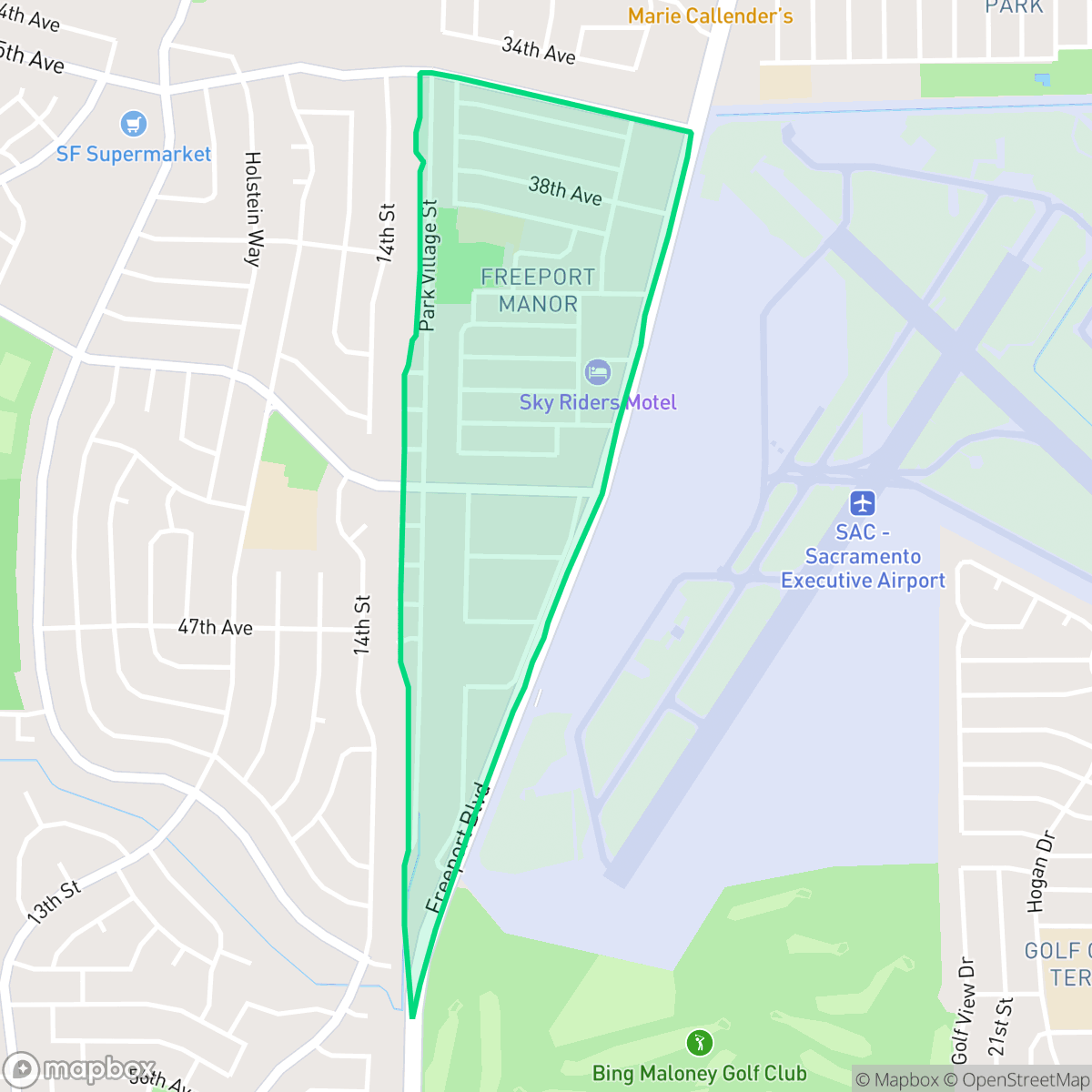
Freeport Manor is a highly walkable, grid-based residential enclave in southern Sacramento characterized by its mid-century housing stock and access to local services. While residents benefit from high flood safety and strong health insurance coverage, the area faces challenges including significant noise from road and aviation traffic and close proximity to industrial infrastructure.
Key Highlights
About Freeport Manor
Developed primarily in the late 1940s and 1950s, Freeport Manor is a residential neighborhood in southern Sacramento annexed by the city in 1953. The neighborhood features mid-century single-family cottages built between 1948 and 1960. During mid-century urban renewal projects like the Capitol Mall redevelopment, Freeport Manor became a primary relocation area for Sacramento’s displaced Black community, with prominent civil rights attorney Nathaniel Colley representing many of these residents. A key local landmark is the historic AMF Land Park Lanes on Freeport Boulevard. Designed in 1960 by Japanese American developer Gonzo Sakai, the mid-century modern bowling alley served as a vital social and recreational refuge for the post-war Japanese American community and was designated a city landmark in 2025.
The neighborhood functions as a dense suburban environment defined by a consistent grid of single-family homes built during the post-war era. Its layout promotes high walkability, allowing residents to access local services and green spaces on foot despite a lack of commercial vibrancy. The area maintains a stable population and a strong ideological alignment, contributing to a quiet, residential atmosphere that prioritizes functional access over entertainment or nightlife. According to local data, the community experiences a notably low level of liveliness, making it a destination better suited for those seeking a predictable, low-key living environment rather than an active social scene.
Prospective residents should consider several trade-offs regarding the local environment. The neighborhood sits near a large wastewater treatment facility, which impacts the overall industrial proximity score. Acoustic comfort is also a factor, as average noise levels reach approximately 62 decibels due to a combination of road traffic and aviation activity. While the area offers excellent flood safety and moderate air quality, families should be aware that local schools within the Sacramento City Unified School District currently face significant fiscal and operational challenges. The neighborhood is best suited for individuals who value high walkability and a established residential character, provided they are comfortable with the surrounding industrial and acoustic environment.
Neighborhood Scores Across 15 Qualities
Residential spacing offers a moderate degree of separation between neighbors, providing slightly more personal buffer than the typical Sacramento area according to iHuus data.
Pedestrian navigation is easy due to wide sidewalks and frequent crossings. According to iHuus data, this area offers superior walkability compared to the Sacramento average.
Large residential properties and frequent upscale amenities contribute to a visual environment that is more aesthetically pleasing than the Sacramento average, according to iHuus data.
Integrated green spaces and wide paths provide safe walking routes away from traffic. This level of accessibility is roughly in line with the Sacramento average, according to iHuus data.
Residential streets consist of a dense suburban grid characterized by single-family homes and nearby utility infrastructure. This landscape aligns with the typical urban-rural balance found across Sacramento.
Low-density residential blocks and light industrial units create a calm, suburban atmosphere with limited commercial activity. According to iHuus data, the area lacks a vibrant social core and offers fewer walking-distance amenities than the Sacramento average.
Frequent noise from nearby railroad tracks and major freeways characterizes the area. According to iHuus data, acoustic comfort levels are lower than the Sacramento average.
Air quality levels are generally acceptable, though residents may encounter occasional periods of concern during certain seasons. According to iHuus data, these conditions are roughly in line with the average experienced across Sacramento.
Active commercial zones and a large wastewater treatment plant are located near residential streets, making industrial proximity notably higher than the Sacramento average. According to iHuus data, residents may encounter increased daytime traffic and noise from nearby airport operations and commercial hangars.
Health insurance accessibility is notably higher in Freeport Manor than in the rest of Sacramento, according to iHuus data.
Voting patterns and census indicators show a very high concentration of liberal-leaning residents, slightly exceeding the Sacramento average according to iHuus data.
Residents live alongside a balanced mix of young professionals, families, and seniors. According to iHuus data, this demographic spread is slightly more varied than the average seen across Sacramento.
Residual flood risks exist within this area as it is situated within a 500-year floodplain; however, safety levels remain higher than the Sacramento city average according to iHuus data.
Address-Level Insights for Freeport Manor


iHuus Neighborhood Intelligence Insights
Get address-level neighborhood insights for Freeport Manor
- Street-level scores — see how individual blocks compare, not just neighborhood averages
- Micro-zone boundaries — identify quiet pockets, flood boundaries, and walkable clusters before you visit
- 15 dimensions in full — walkability, noise, air quality, school quality, insurance coverage, population age profile, urban/rural index, and more
- Boundary risk alerts — know if your address sits near a block boundary where scores drop, the kind of detail no listing will ever mention
- School insights — individual school ratings and insights, not just district-level data
- Compare before you commit — side-by-side data across neighborhoods, down to block precision
No credit card required
Compare with Any Neighborhood
| Dimension | Freeport Manor | Airport |
|---|---|---|
| 🚶 Walkabilityavg 8.5 | ||
| 🔊 Acoustic Comfortavg 3.22 | ||
| 🤫 Privacy Indexavg 5.34 | ||
| 🎨 Visual Appealavg 6.3 | ||
| 🐕 Dog Friendlinessavg 6.98 | ||
| 🗺️ Urban-Rural Indexavg 6.57 | ||
| ✨ Neighborhood Vibeavg 4.66 | ||
| 🏥 Health Insurance Coverageavg 7.4 | ||
| 🌿 Air Qualityavg 6.12 | ||
| 🏭 Industrial Proximityavg 8.32 | ||
| 🌊 Flood Safetyavg 6.04 | ||
| 🗳️ Ideological Leanavg 9.49 | ||
| 👥 Population Age Profileavg 4.75 | ||
| 🔥 Fire Safetyavg 0 | ||
| 🏫 School Quality |
Freeport Manor Rankings
School Districts Serving Freeport Manor
School Insights for Freeport Manor
Below average outcomes; significant attendance and academic challenges.
School Insights
See what's really behind every school rating near Freeport Manor
- Individual school ratings — each school's own score with outcome context, not just a district average
- Enrollment & class size data — student-to-teacher ratio and how it compares to the state average
- Full demographics breakdown — ethnicity and gender composition for every school in the enrollment zone
- Every school in the district — all schools within the enrollment boundary ranked by rating, not just the closest one
- Grade levels & benchmarks — elementary through high school, with below/above state-average flags
No credit card required