Fairgrounds, Sacramento
Updated · 1,352 residents
Fairgrounds is a quiet, primarily residential enclave in Sacramento defined by its proximity to the UC Davis Medical Center and its unique transition from a historic state fair site. The area offers a walkable environment with ample green space, though it remains a relatively low-key neighborhood with limited commercial activity.
Key Highlights
About Fairgrounds
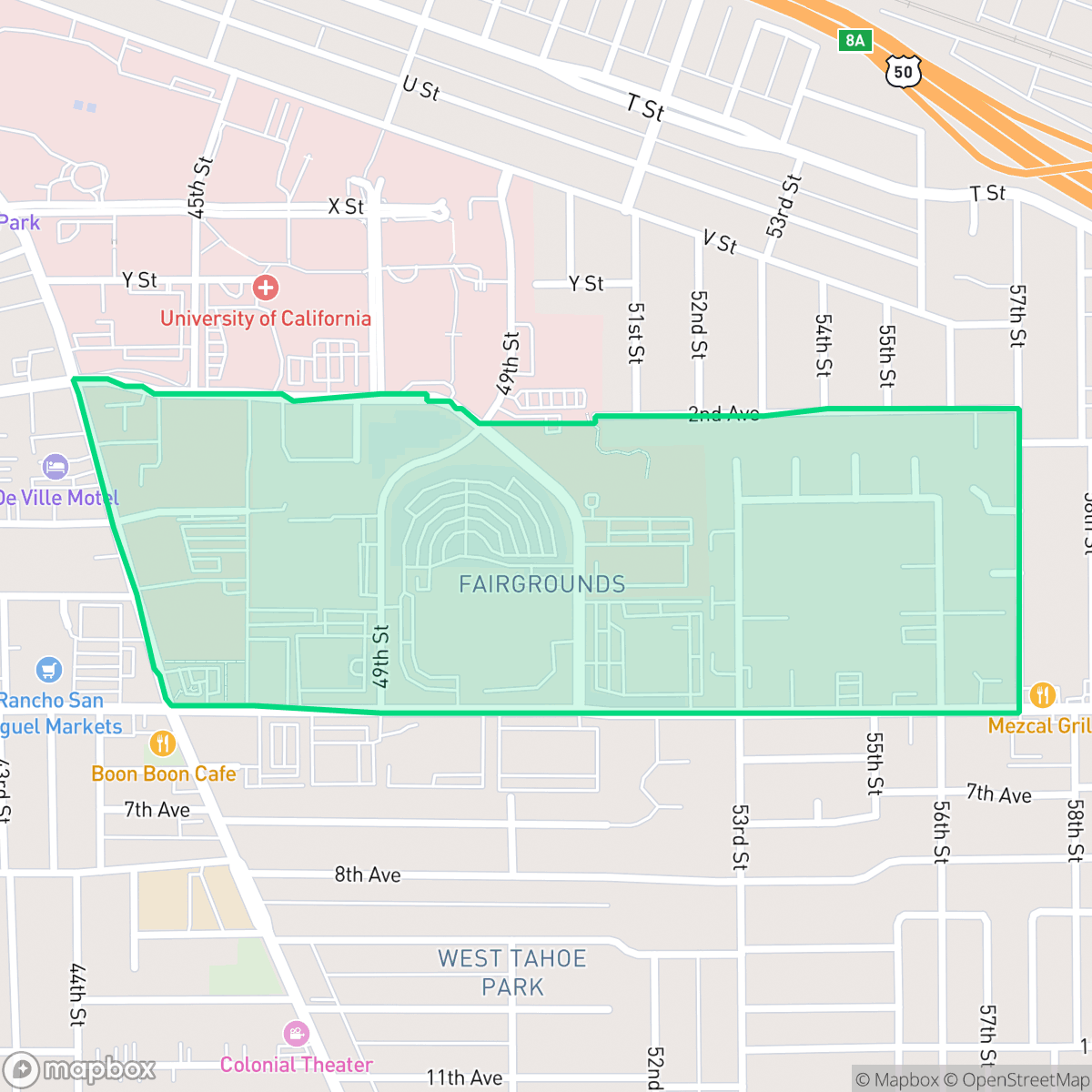
Named for the former California State Fairgrounds that operated at Stockton Boulevard and Broadway from 1906 to 1967, Sacramento's Fairgrounds neighborhood carries a rich civic legacy. During its peak, the 155-acre site was a major regional draw, even serving as a military mobilization camp during World War I and World War II. After the state fair relocated to Cal Expo in 1968, much of the land was acquired by the expanding UC Davis Medical Center. Two notable historic landmarks still stand at the intersection: Governor’s Hall, which served as the fair's grand entrance, and the Agricultural Pavilion, now a UC Davis facility. In recent decades, the neighborhood has transitioned into a residential enclave, with vacant fairground parcels redeveloped into modern housing communities like "The Grounds" along Fairgrounds Drive.
The area serves as a residential hub characterized by its evolution from the former state fairgrounds into a modern living space. It maintains a distinct identity through the preservation of landmarks like the Agricultural Pavilion and Governor’s Hall. Residents benefit from high levels of health insurance coverage and a peaceful atmosphere, as the neighborhood is largely free from heavy industrial encroachment and maintains a suburban feel despite its central location.
While the area is highly walkable and dog-friendly, it lacks a vibrant nightlife or extensive commercial density, making it better suited for those who prioritize tranquility over an active social scene. Prospective residents should consider the local school district's fiscal challenges, although options like The Language Academy of Sacramento provide alternative educational paths. The neighborhood balances suburban comfort with a central location, though it requires reliance on nearby districts for most daily retail and entertainment needs.
Neighborhood Scores Across 15 Qualities
Residential spacing is consistent with the city average, though some areas feature closely packed houses with narrow gaps between structures. According to iHuus data, the neighborhood offers a mix of varying distances between neighbors.
Pedestrian infrastructure is excellent due to a consistent grid layout featuring wide sidewalks and marked crosswalks on both residential and commercial streets. This area offers superior walkability compared to the Sacramento average according to iHuus data.
Standard tract housing dominates the landscape with boxy rooflines and small, tidy yards. This visual character is slightly below the Sacramento average according to iHuus data.
Accessible parkland and shaded green verges provide ample space for walking pets. According to iHuus data, the availability of continuous green spaces and safe paths is slightly above the Sacramento average.
Residential areas feature a blend of small lots and medium-sized commercial blocks, reflecting a density very similar to the Sacramento average. According to iHuus data, the landscape is primarily composed of a suburban mix rather than open farmland.
Suburban streets and green spaces offer a serene setting, though the area is less lively than the Sacramento average. Most daily needs and social activities require driving, as few businesses are located within easy walking distance.
Frequent noise from nearby railroad tracks and major freeways is a persistent feature of this area. According to iHuus data, acoustic levels are slightly higher than the Sacramento average.
Air quality fluctuates between acceptable and unhealthy levels, presenting occasional concerns for sensitive groups. This condition is roughly in line with the average seen across Sacramento.
Residential streets and open green spaces are notably free from heavy industry, warehouses, or hazardous facilities. This area offers a cleaner environment than much of Sacramento, featuring only light commercial activity and mixed-use zones according to iHuus data.
Health insurance access is widespread among residents in this area. According to iHuus data, coverage levels in Fairgrounds are slightly above the Sacramento average.
Voting patterns and census indicators in Fairgrounds show a markedly liberal leaning, which is even more pronounced than the average found across Sacramento.
A balanced mix of young adults, families, and older residents characterizes this area. According to iHuus data, the age distribution is slightly more varied than the Sacramento average.
Residual flood risk exists due to the area's location within a 500-year floodplain; however, safety levels remain notably higher than the Sacramento city average according to iHuus data.
Address-Level Insights for Fairgrounds


iHuus Neighborhood Intelligence Insights
Get address-level neighborhood insights for Fairgrounds
- Street-level scores — see how individual blocks compare, not just neighborhood averages
- Micro-zone boundaries — identify quiet pockets, flood boundaries, and walkable clusters before you visit
- 15 dimensions in full — walkability, noise, air quality, school quality, insurance coverage, population age profile, urban/rural index, and more
- Boundary risk alerts — know if your address sits near a block boundary where scores drop, the kind of detail no listing will ever mention
- School insights — individual school ratings and insights, not just district-level data
- Compare before you commit — side-by-side data across neighborhoods, down to block precision
No credit card required
Compare with Any Neighborhood
| Dimension | Fairgrounds | Airport |
|---|---|---|
| 🚶 Walkabilityavg 8.5 | ||
| 🔊 Acoustic Comfortavg 3.22 | ||
| 🤫 Privacy Indexavg 5.34 | ||
| 🎨 Visual Appealavg 6.3 | ||
| 🐕 Dog Friendlinessavg 6.98 | ||
| 🗺️ Urban-Rural Indexavg 6.57 | ||
| ✨ Neighborhood Vibeavg 4.66 | ||
| 🏥 Health Insurance Coverageavg 7.4 | ||
| 🌿 Air Qualityavg 6.12 | ||
| 🏭 Industrial Proximityavg 8.32 | ||
| 🌊 Flood Safetyavg 6.04 | ||
| 🗳️ Ideological Leanavg 9.49 | ||
| 👥 Population Age Profileavg 4.75 | ||
| 🔥 Fire Safetyavg 0 | ||
| 🏫 School Quality |
Fairgrounds Rankings
School Districts Serving Fairgrounds
School Insights for Fairgrounds
Below average outcomes; significant attendance and academic challenges.
School Insights
See what's really behind every school rating near Fairgrounds
- Individual school ratings — each school's own score with outcome context, not just a district average
- Enrollment & class size data — student-to-teacher ratio and how it compares to the state average
- Full demographics breakdown — ethnicity and gender composition for every school in the enrollment zone
- Every school in the district — all schools within the enrollment boundary ranked by rating, not just the closest one
- Grade levels & benchmarks — elementary through high school, with below/above state-average flags
No credit card required