East Sacramento, Sacramento
Updated · 19,418 residents
East Sacramento is a historic, tree-lined neighborhood known for its diverse architectural styles and high walkability. While the area offers a quiet, suburban atmosphere with well-manicured properties, residents should anticipate elevated noise levels primarily from road traffic.
Key Highlights
About East Sacramento
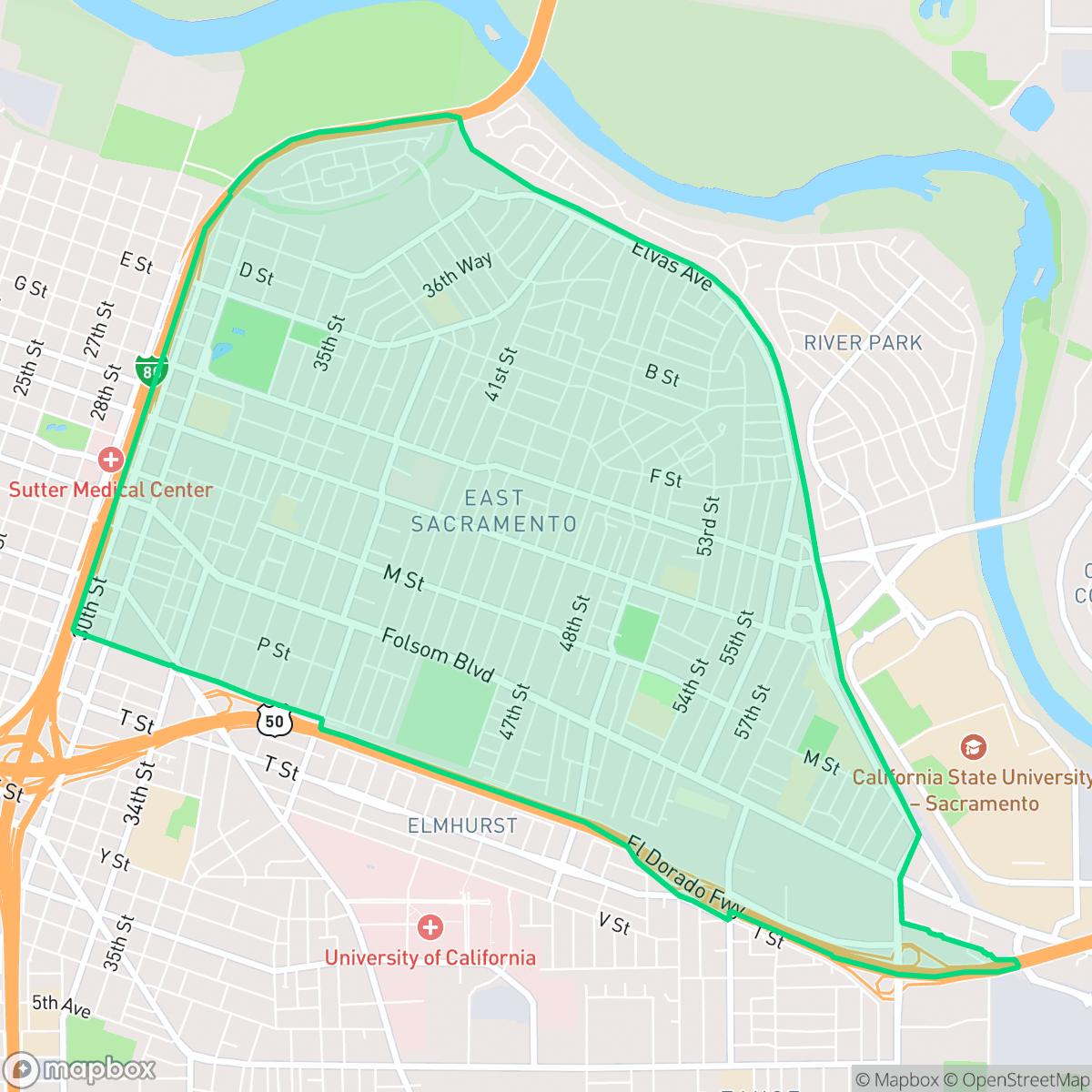
Developed in the 1890s as a streetcar suburb and annexed in 1911, East Sacramento is one of the city's most historic and architecturally diverse neighborhoods. Shaded by mature sycamore and elm trees, the area is renowned for its early 20th-century Craftsman, Tudor, Colonial Revival, and Mediterranean Revival homes. Its most famous enclave, the "Fabulous Forties" (40th to 49th Streets), features grand estates, including the former home of Governor Ronald Reagan and the iconic "Blue House" featured in Greta Gerwig’s film Lady Bird. At the heart of the community is the 32-acre McKinley Park, established in the early 1900s, which boasts a historic rose garden and the 1936 Clunie Memorial Clubhouse. Other local landmarks include the historic East Lawn Memorial Park and the legendary Corti Brothers specialty grocery store.
The neighborhood maintains a distinct identity defined by its dense suburban layout, characterized by detached single-family homes and a high frequency of private backyard pools. According to iHuus data, the area benefits from a high level of health insurance coverage and a consistent grid system that supports a walkable environment for residents. Local amenities, including various coffee shops and dining options, are distributed throughout the neighborhood, providing convenient access for those living near the tree-lined residential streets.
Prospective residents should consider that the neighborhood experiences an average noise level of 64 decibels, largely attributed to road traffic. While the area is home to several high-performing elementary schools like David Lubin and Phoebe A. Hearst, the broader school district faces significant fiscal and administrative challenges. The neighborhood is best suited for those seeking a established, visually appealing environment with strong walkability, provided they are comfortable with the noise profile and the complexities of the local public school system.
Neighborhood Scores Across 15 Qualities
Detached homes feature consistent setbacks and private yards, providing more separation between neighbors than the Sacramento average. According to iHuus data, housing density increases slightly near the river and campus areas.
Pedestrians benefit from a continuous sidewalk network and mature tree canopy that provides shade on many residential streets. Most local amenities are easily accessible on foot, offering a level of connectivity that is slightly above the Sacramento average.
Large, well-maintained homes and frequent private backyard pools contribute to a visual landscape that is more polished than the Sacramento average. High-quality landscaping and spacious properties characterize much of the area according to iHuus data.
Access to the American River trails and various local parks provides excellent opportunities for pet exercise. Tree-lined streets and continuous sidewalks offer shaded, safe walking routes that are slightly better than the Sacramento average, according to iHuus data.
Dense suburban layouts with significant tree cover and single-family homes characterize this area. This residential density remains consistent with the broader Sacramento average.
Suburban streets and green spaces offer a steady, calm pace with a sparse selection of walkable dining and services. According to iHuus data, this level of activity is slightly lower than the city average.
Frequent noise from nearby railroad tracks and major transit corridors creates a disruptive acoustic environment. According to iHuus data, these disturbance levels are higher than the Sacramento average.
Air quality in this area fluctuates between acceptable and unhealthy levels, which may pose occasional concerns for sensitive groups. According to iHuus data, these conditions are roughly in line with the average for Sacramento.
Residential life remains largely uninterrupted by heavy industry, as the area consists primarily of quiet streets and light commercial uses. According to iHuus data, the lack of significant industrial activity in this neighborhood is consistent with the broader Sacramento area.
Health insurance access is exceptionally high for residents, significantly exceeding the Sacramento city average according to iHuus data.
Voting patterns and census indicators show a deeply liberal leaning that is slightly more pronounced than the Sacramento city average.
Residents live alongside a balanced mix of young professionals, families, and seniors. This age distribution is largely consistent with the broader Sacramento area, according to iHuus data.
Flood risk levels are higher than the Sacramento average due to the area's location within a 500-year floodplain. Residents should account for some residual risk as noted by iHuus data.
Address-Level Insights for East Sacramento


iHuus Neighborhood Intelligence Insights
Get address-level neighborhood insights for East Sacramento
- Street-level scores — see how individual blocks compare, not just neighborhood averages
- Micro-zone boundaries — identify quiet pockets, flood boundaries, and walkable clusters before you visit
- 15 dimensions in full — walkability, noise, air quality, school quality, insurance coverage, population age profile, urban/rural index, and more
- Boundary risk alerts — know if your address sits near a block boundary where scores drop, the kind of detail no listing will ever mention
- School insights — individual school ratings and insights, not just district-level data
- Compare before you commit — side-by-side data across neighborhoods, down to block precision
No credit card required
Compare with Any Neighborhood
| Dimension | East Sacramento | Airport |
|---|---|---|
| 🚶 Walkabilityavg 8.5 | ||
| 🔊 Acoustic Comfortavg 3.22 | ||
| 🤫 Privacy Indexavg 5.34 | ||
| 🎨 Visual Appealavg 6.3 | ||
| 🐕 Dog Friendlinessavg 6.98 | ||
| 🗺️ Urban-Rural Indexavg 6.57 | ||
| ✨ Neighborhood Vibeavg 4.66 | ||
| 🏥 Health Insurance Coverageavg 7.4 | ||
| 🌿 Air Qualityavg 6.12 | ||
| 🏭 Industrial Proximityavg 8.32 | ||
| 🌊 Flood Safetyavg 6.04 | ||
| 🗳️ Ideological Leanavg 9.49 | ||
| 👥 Population Age Profileavg 4.75 | ||
| 🔥 Fire Safetyavg 0 | ||
| 🏫 School Quality |
East Sacramento Rankings
School Districts Serving East Sacramento
School Insights for East Sacramento
Below average outcomes; significant attendance and academic challenges.
School Insights
See what's really behind every school rating near East Sacramento
- Individual school ratings — each school's own score with outcome context, not just a district average
- Enrollment & class size data — student-to-teacher ratio and how it compares to the state average
- Full demographics breakdown — ethnicity and gender composition for every school in the enrollment zone
- Every school in the district — all schools within the enrollment boundary ranked by rating, not just the closest one
- Grade levels & benchmarks — elementary through high school, with below/above state-average flags
No credit card required