Downtown, Sacramento
Updated · 6,683 residents
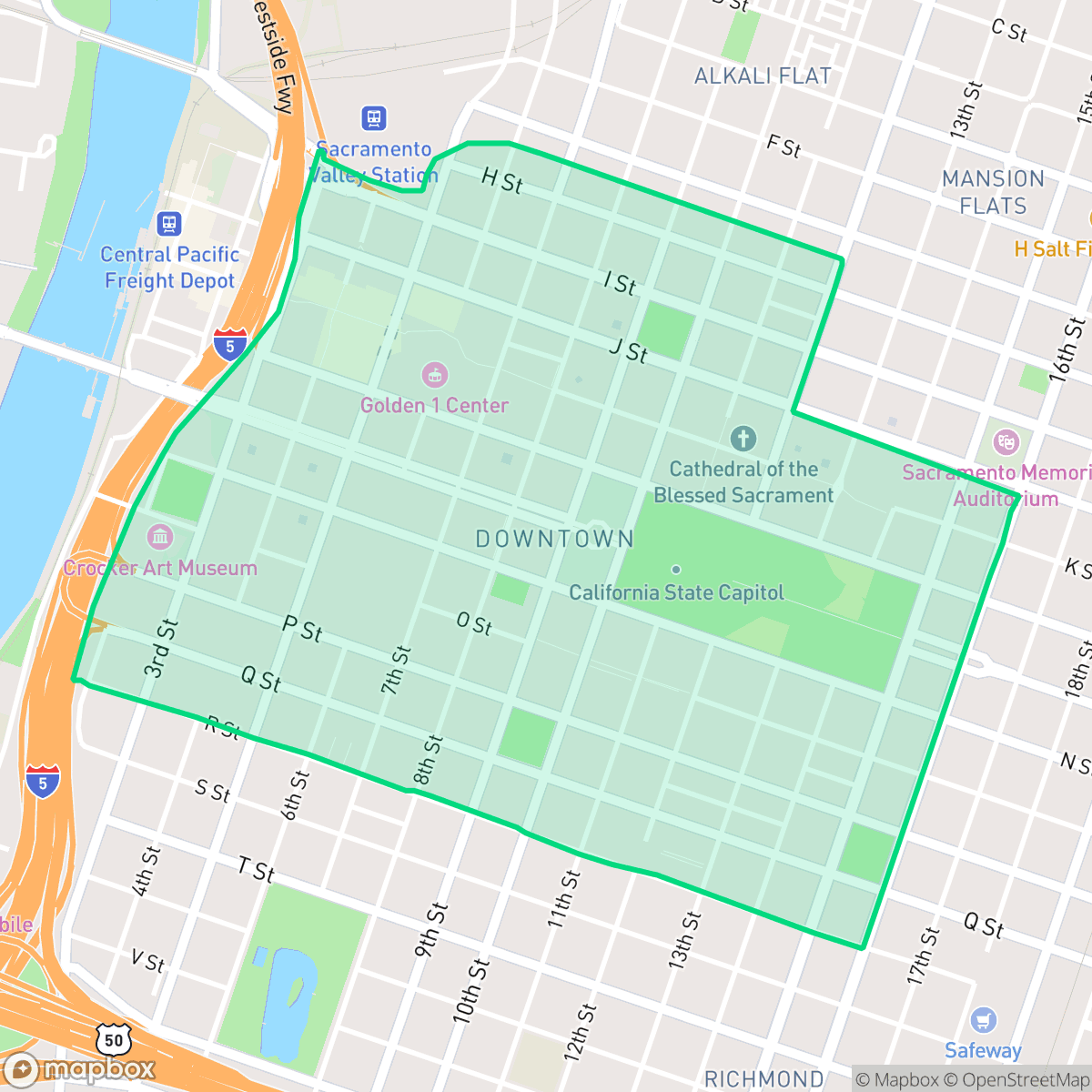
Downtown Sacramento is a highly walkable urban core defined by its dense architecture, government offices, and vibrant social atmosphere. While it offers unparalleled access to dining and cultural amenities, residents must navigate a bustling environment characterized by limited privacy and frequent noise from nearby transit routes.
Key Highlights
About Downtown
Downtown Sacramento was laid out in 1848 by John Sutter Jr. and Samuel Brannan near the Sacramento River, quickly becoming a commercial hub during the California Gold Rush. Following devastating floods in the early 1850s, the city undertook a massive engineering feat between 1862 and 1869 to raise the street level by up to fifteen feet, leaving subterranean tunnels beneath many historic structures. The neighborhood serves as the seat of California's government, anchored by the 1874 California State Capitol. It features significant landmarks such as the Old Sacramento State Historic Park, which preserves the city's Gold Rush-era commercial district, and the Leland Stanford Mansion. Once a bustling riverfront terminus for the Pony Express and transcontinental railroad, the area remains a center for civic life, government, and historic preservation.
The neighborhood functions as the central hub of California's state government and commerce, featuring a dense landscape of high-rise buildings and modern commercial spaces. It is exceptionally easy to navigate on foot, with a well-connected grid of sidewalks that provide immediate access to a wide variety of restaurants, entertainment venues, and social hubs. This urban environment is notably energetic, attracting a diverse demographic of residents who value being at the center of city life.
Living in this area involves specific trade-offs, particularly regarding acoustic comfort and personal space. Due to the proximity of major freeways and rail lines, noise levels are elevated, and the high-density layout results in limited private outdoor areas for residents. Prospective homeowners or renters should also be aware that the local school district is currently managing significant fiscal and administrative hurdles, and the area lies within a 500-year floodplain. Despite these challenges, according to iHuus data, the neighborhood maintains cleaner air quality than much of the surrounding city, making it a distinct choice for those prioritizing urban convenience over suburban seclusion.
Neighborhood Scores Across 15 Qualities
Dense urban layouts and shared walls create a lack of private buffers, making this area significantly less private than the Sacramento average. Most residential structures are closely packed with minimal separation between buildings.
Pedestrian navigation is easy due to a dense grid of continuous sidewalks, high intersection density, and dedicated pedestrian zones. According to iHuus data, the connectivity and infrastructure here are significantly better than the Sacramento average.
Urban density is characterized by a mix of apartment complexes, commercial buildings, and modern structures like the nearby arena. This visual landscape is slightly less varied than the Sacramento average, featuring mostly rectangular rooftops and shared residential amenities.
Access to greenery for walks is primarily concentrated near the riverfront and Southside Park, though some areas consist mainly of concrete and highways. According to iHuus data, the availability of pet-friendly spaces is roughly comparable to the rest of Sacramento.
High-rise buildings and large commercial structures dominate this landscape, resulting in a much more built-up environment than the Sacramento average. According to iHuus data, the area features a dense mix of multi-story residential and commercial blocks with very limited vegetation.
Dense high-rises, diverse dining, and frequent social hubs create a highly active atmosphere that is significantly more energetic than the Sacramento average. According to iHuus data, this district offers a concentrated variety of cultural and culinary destinations concentrated near major transit corridors and park spaces.
Frequent noise from nearby railroads and major freeway traffic is common here. According to iHuus data, acoustic comfort in this area is notably lower than the Sacramento average.
Air quality remains mostly clean with only rare instances of elevated readings. This level of air purity is significantly better than the Sacramento city average, according to iHuus data.
Primarily composed of residential and commercial spaces, this area lacks heavy industrial hazards. While a rail corridor and electrical substation are present, the level of industrial proximity is consistent with the city average.
Health insurance accessibility is significantly lower in this area than the Sacramento average. According to iHuus data, a small portion of the resident population maintains active health coverage.
Voting patterns and census indicators show a predominantly liberal leaning that is even more pronounced than the Sacramento average, according to iHuus data.
Residents live among a varied demographic of young professionals, families, and seniors. This population spread is slightly more balanced than the Sacramento average, according to iHuus data.
Flood risk is notably higher than the Sacramento average due to the area's location within a 500-year floodplain. According to iHuus data, some residual flood risk remains for properties in this district.
Address-Level Insights for Downtown


iHuus Neighborhood Intelligence Insights
Get address-level neighborhood insights for Downtown
- Street-level scores — see how individual blocks compare, not just neighborhood averages
- Micro-zone boundaries — identify quiet pockets, flood boundaries, and walkable clusters before you visit
- 15 dimensions in full — walkability, noise, air quality, school quality, insurance coverage, population age profile, urban/rural index, and more
- Boundary risk alerts — know if your address sits near a block boundary where scores drop, the kind of detail no listing will ever mention
- School insights — individual school ratings and insights, not just district-level data
- Compare before you commit — side-by-side data across neighborhoods, down to block precision
No credit card required
Compare with Any Neighborhood
| Dimension | Downtown | Airport |
|---|---|---|
| 🚶 Walkabilityavg 8.5 | ||
| 🔊 Acoustic Comfortavg 3.22 | ||
| 🤫 Privacy Indexavg 5.34 | ||
| 🎨 Visual Appealavg 6.3 | ||
| 🐕 Dog Friendlinessavg 6.98 | ||
| 🗺️ Urban-Rural Indexavg 6.57 | ||
| ✨ Neighborhood Vibeavg 4.66 | ||
| 🏥 Health Insurance Coverageavg 7.4 | ||
| 🌿 Air Qualityavg 6.12 | ||
| 🏭 Industrial Proximityavg 8.32 | ||
| 🌊 Flood Safetyavg 6.04 | ||
| 🗳️ Ideological Leanavg 9.49 | ||
| 👥 Population Age Profileavg 4.75 | ||
| 🔥 Fire Safetyavg 0 | ||
| 🏫 School Quality |
Downtown Rankings
School Districts Serving Downtown
School Insights for Downtown
Below average outcomes; significant attendance and academic challenges.
School Insights
See what's really behind every school rating near Downtown
- Individual school ratings — each school's own score with outcome context, not just a district average
- Enrollment & class size data — student-to-teacher ratio and how it compares to the state average
- Full demographics breakdown — ethnicity and gender composition for every school in the enrollment zone
- Every school in the district — all schools within the enrollment boundary ranked by rating, not just the closest one
- Grade levels & benchmarks — elementary through high school, with below/above state-average flags
No credit card required