Del Paso Park, Sacramento
Updated · 3,450 residents
Del Paso Park is a quiet, car-dependent neighborhood defined by its expansive green space and proximity to the historic Haggin Oaks Golf Complex. While the area offers a peaceful, suburban environment with high dog-friendliness, residents should be aware of significant noise levels from nearby highway traffic.
Key Highlights
About Del Paso Park
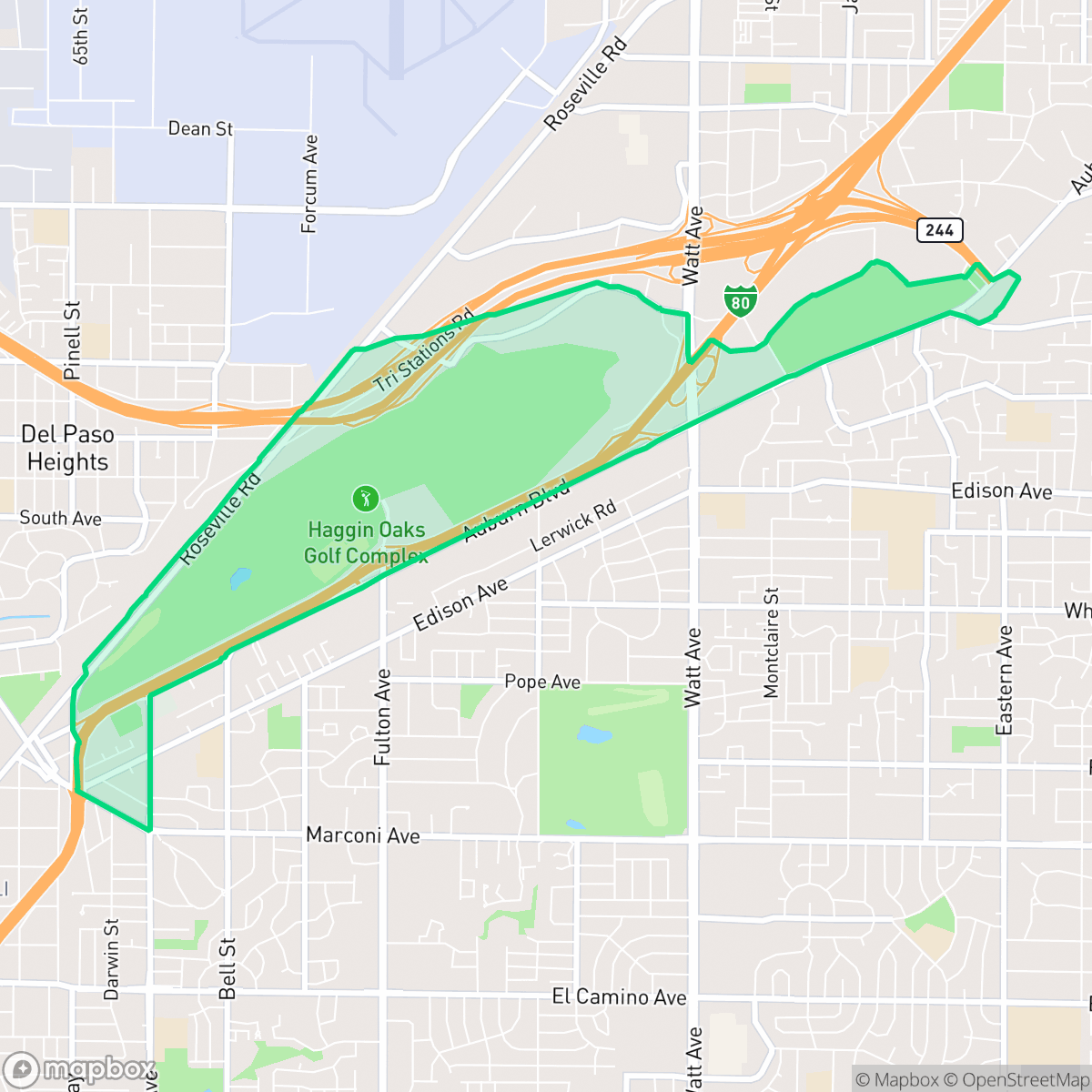
The Del Paso Park neighborhood in Sacramento originates from the historic 44,371-acre Rancho Del Paso, a Mexican land grant established in 1844. In the late 19th century, prominent landowner James Ben-Ali Haggin utilized the area as a world-renowned thoroughbred horse breeding farm. In 1914, the city of Sacramento commissioned the development of Del Paso Park, which officially opened in 1924. A premier local landmark is the Haggin Oaks Golf Complex, featuring a championship course designed in 1932 by legendary architect Alister MacKenzie that historically attracted celebrities like Bing Crosby and Babe Ruth. The area's historic infrastructure includes the 1935 Arcade Creek Bridge along Bridge Road, which served as the park's original main entrance from US Routes 40 and 99E before the neighborhood was later severed by the construction of the Watt Avenue freeway interchange.
The neighborhood functions as a blend of residential pockets, light industrial zones, and significant recreational land. It maintains a distinct suburban feel characterized by low-density development and open areas. Residents have access to local staples like Mackenzie’s Sports Bar and Grille, though the overall commercial landscape remains sparse. The area is largely defined by its relationship to the surrounding freeway infrastructure, which provides regional connectivity at the cost of ambient noise.
Prospective residents should weigh the benefits of a spacious, dog-friendly environment against the reality of a car-oriented lifestyle. According to iHuus data, the area faces challenges with acoustic comfort due to road traffic, making it better suited for those who prioritize proximity to outdoor recreation over a walkable urban experience. With schools served by the San Juan and Twin Rivers districts, families often navigate a wide range of academic performance outcomes when considering local educational options.
Neighborhood Scores Across 15 Qualities
Residential lots feature suburban spacing with distinct, fenced backyards that offer more separation than the Sacramento average. According to iHuus data, houses are positioned with moderate buffers between neighbors.
Pedestrian navigation is supported by continuous sidewalks on main roads and low-traffic residential loops, though overall accessibility is lower than the Sacramento average. Safe crossings and park paths facilitate movement throughout the neighborhood according to iHuus data.
Large homes and well-landscaped yards contribute to a visual quality that is slightly above the Sacramento average. Streetscapes range from upscale estates with private pools to more uniform, middle-class suburban tracts.
Wide verges and a centrally located public park with winding trails provide excellent walking spaces that are notably more accessible than the Sacramento average. According to iHuus data, these green spaces and buffered sidewalks offer a safe environment for pets away from traffic.
Frequent open land and scattered homes create a more semi-rural environment than the Sacramento average. This landscape features a mix of residential pockets and large-scale industrial or commercial zones according to iHuus data.
Suburban streets and industrial corridors create a tranquil atmosphere with a sparse selection of local businesses. Activity levels here are slightly below the Sacramento average, as many social and dining options require a car to reach.
Frequent disturbances from nearby railroad tracks and heavy freeway traffic characterize this area. According to iHuus data, acoustic comfort in this neighborhood is significantly lower than the Sacramento average.
Air quality levels are generally acceptable, though residents may experience occasional periods of unhealthy air similar to the broader Sacramento area. According to iHuus data, sensitive groups should remain mindful of fluctuations in air particulate levels.
Residential life remains largely uninterrupted by heavy industry, as the area is primarily composed of housing and light commercial activity. This lack of large-scale manufacturing is consistent with the broader Sacramento area.
Health insurance accessibility in this area is consistent with the Sacramento average. Residents have access to coverage at levels comparable to the rest of the city, according to iHuus data.
Political demographics in this area lean liberal, though the concentration of progressive voters is slightly less pronounced than the Sacramento city average.
Residents live alongside a diverse range of age groups, including young adults, families, and seniors. This demographic distribution is consistent with the broader Sacramento area, according to iHuus data.
Some residual flood risk exists due to the neighborhood's location within a 500-year floodplain, though safety levels remain higher than the Sacramento average according to iHuus data.
Address-Level Insights for Del Paso Park


iHuus Neighborhood Intelligence Insights
Get address-level neighborhood insights for Del Paso Park
- Street-level scores — see how individual blocks compare, not just neighborhood averages
- Micro-zone boundaries — identify quiet pockets, flood boundaries, and walkable clusters before you visit
- 15 dimensions in full — walkability, noise, air quality, school quality, insurance coverage, population age profile, urban/rural index, and more
- Boundary risk alerts — know if your address sits near a block boundary where scores drop, the kind of detail no listing will ever mention
- School insights — individual school ratings and insights, not just district-level data
- Compare before you commit — side-by-side data across neighborhoods, down to block precision
No credit card required
Compare with Any Neighborhood
| Dimension | Del Paso Park | Airport |
|---|---|---|
| 🚶 Walkabilityavg 8.5 | ||
| 🔊 Acoustic Comfortavg 3.22 | ||
| 🤫 Privacy Indexavg 5.34 | ||
| 🎨 Visual Appealavg 6.3 | ||
| 🐕 Dog Friendlinessavg 6.98 | ||
| 🗺️ Urban-Rural Indexavg 6.57 | ||
| ✨ Neighborhood Vibeavg 4.66 | ||
| 🏥 Health Insurance Coverageavg 7.4 | ||
| 🌿 Air Qualityavg 6.12 | ||
| 🏭 Industrial Proximityavg 8.32 | ||
| 🌊 Flood Safetyavg 6.04 | ||
| 🗳️ Ideological Leanavg 9.49 | ||
| 👥 Population Age Profileavg 4.75 | ||
| 🔥 Fire Safetyavg 0 | ||
| 🏫 School Quality |
Del Paso Park Rankings
School Districts Serving Del Paso Park
School Insights for Del Paso Park
Below average outcomes; significant attendance and academic challenges.
School Insights
See what's really behind every school rating near Del Paso Park
- Individual school ratings — each school's own score with outcome context, not just a district average
- Enrollment & class size data — student-to-teacher ratio and how it compares to the state average
- Full demographics breakdown — ethnicity and gender composition for every school in the enrollment zone
- Every school in the district — all schools within the enrollment boundary ranked by rating, not just the closest one
- Grade levels & benchmarks — elementary through high school, with below/above state-average flags
No credit card required