Del Paso Heights, Sacramento
Updated · 4,742 residents
Del Paso Heights is a historic North Sacramento neighborhood characterized by its dense grid of single-family homes and deep roots in the city's African American and immigrant communities. While the area offers a quiet, suburban atmosphere, residents should be aware of the consistent road noise from nearby highways and limited public green space.
Key Highlights
About Del Paso Heights
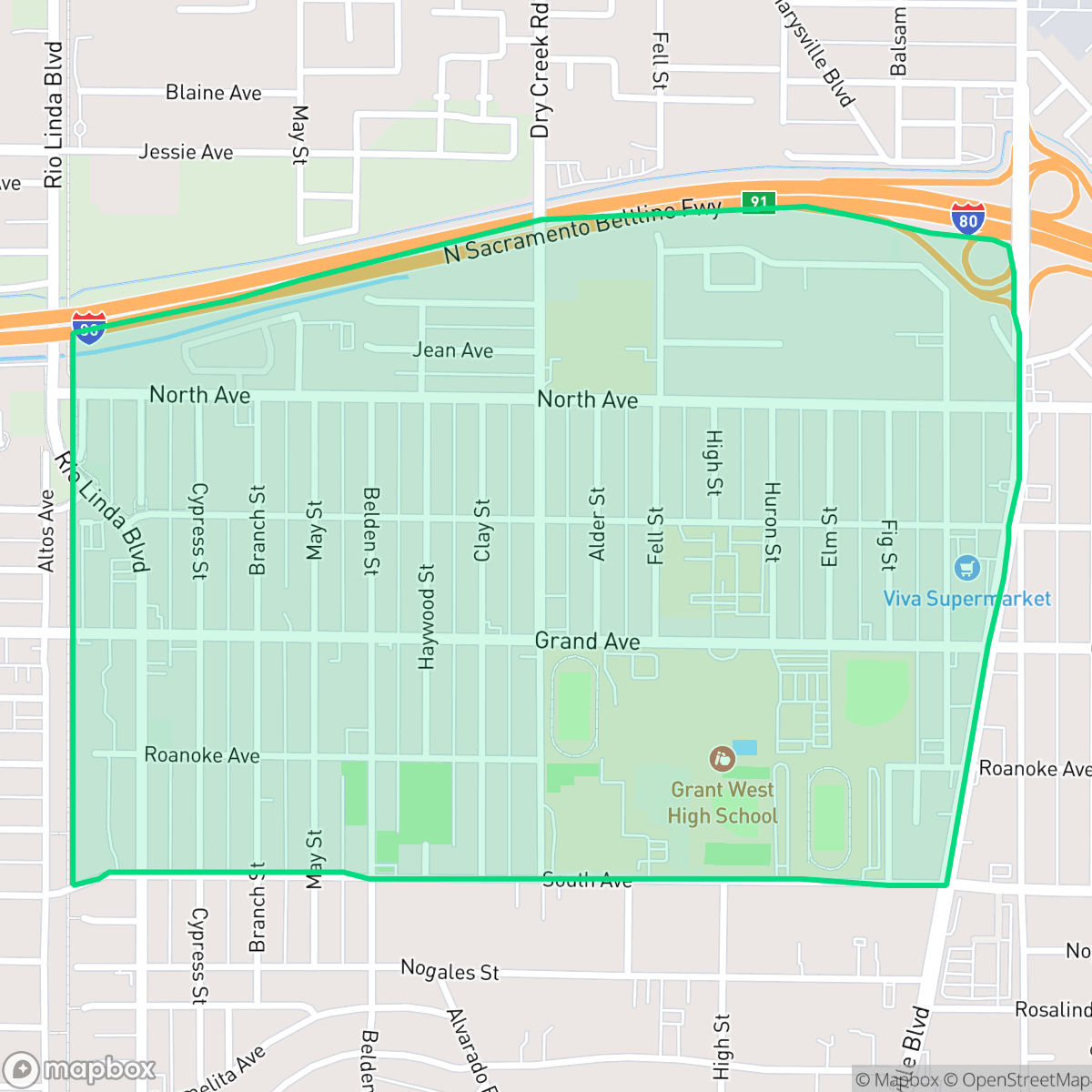
Del Paso Heights in north Sacramento originated as part of the 44,000-acre Rancho Del Paso Mexican land grant, awarded to Eliab Grimes in 1844. In 1862, James Ben Ali Haggin acquired the land, transforming it into a world-renowned thoroughbred horse-breeding farm that produced California’s first Kentucky Derby winner, Ben Ali, in 1886. The area was subdivided for residential development in 1910 by the North Sacramento Land Company. Anchored by historic institutions like Grant Union High School and the Robla School, both serving the community for over a century, the neighborhood evolved into a distinct, working-class enclave. Following its 1964 annexation into Sacramento, Del Paso Heights developed a rich, diverse cultural identity, becoming a historic hub for the city's African American community and later welcoming waves of Southeast Asian immigrants.
The character of the area is defined by its residential grid and proximity to educational landmarks like Grant Union High School. It maintains a steady rhythm of life, featuring local dining spots and community-focused institutions that serve as neighborhood anchors. The landscape is primarily residential, with an absence of heavy industrial development, which contributes to a consistent, low-key suburban environment that prioritizes neighborhood stability over commercial density.
Prospective residents should consider specific livability trade-offs, including high levels of ambient road traffic noise and a lack of expansive private outdoor space due to closely packed housing. While the area provides strong health insurance coverage and a stable residential environment, school performance in the local districts remains varied, with significant challenges in academic proficiency and attendance. It is best suited for those seeking a tight-knit, established community that values cultural diversity and accessibility over luxury amenities or rural-style seclusion.
Neighborhood Scores Across 15 Qualities
Residential spacing is consistent with the Sacramento average, featuring a mix of closely packed homes and small side yards. According to iHuus data, some areas contain higher density housing with shared walls and minimal buffer between neighbors.
Pedestrian navigation is supported by a consistent grid and sidewalk access, though nearby highway and industrial zones create notable barriers to movement. This level of walkability is slightly lower than the Sacramento average according to iHuus data.
Standard tract housing with uniform rooflines and small yards characterizes the area. According to iHuus data, the visual variety is slightly below the Sacramento average due to the prevalence of simple lot geometries and nearby industrial infrastructure.
Walking routes for pets are limited due to narrow sidewalk verges and a lack of large dedicated public parks, making this area less dog-friendly than the Sacramento average. While some residents benefit from nearby canal trails, much of the neighborhood's greenery is confined to private fenced yards.
Residential areas consist primarily of a dense suburban grid featuring single-family homes and multi-unit structures. This layout is largely comparable to the broader Sacramento area in terms of land use and density.
Low density and limited commercial activity create a subdued atmosphere that is less active than the Sacramento average. Most residents will find the area primarily composed of quiet residential streets and industrial pockets, where social hubs are sparse and often require a vehicle to reach.
Frequent sounds from nearby freeway and railroad corridors create a noisy environment. According to iHuus data, acoustic comfort in this area is slightly below the Sacramento city average.
Air quality levels in this area are mostly acceptable, though residents may encounter occasional days with unhealthy conditions. This status is roughly in line with the average seen throughout Sacramento.
Largely residential streets and open green spaces characterize the neighborhood, though some heavy logistics warehouses and truck storage areas are visible in the northwest and northeast quadrants. This level of industrial proximity is roughly in line with the Sacramento average.
Health insurance accessibility is high in this area, sitting above the Sacramento average according to iHuus data.
Voting patterns and census indicators show a highly liberal political leaning that is consistent with the broader Sacramento area, according to iHuus data.
Residents experience a balanced distribution of young adults, families, and older individuals, though the demographic leans slightly younger than the Sacramento average according to iHuus data.
Flood risk in this area remains uncertain because a detailed federal study has not yet been completed. This level of risk is consistent with the average seen across Sacramento.
Address-Level Insights for Del Paso Heights


iHuus Neighborhood Intelligence Insights
Get address-level neighborhood insights for Del Paso Heights
- Street-level scores — see how individual blocks compare, not just neighborhood averages
- Micro-zone boundaries — identify quiet pockets, flood boundaries, and walkable clusters before you visit
- 15 dimensions in full — walkability, noise, air quality, school quality, insurance coverage, population age profile, urban/rural index, and more
- Boundary risk alerts — know if your address sits near a block boundary where scores drop, the kind of detail no listing will ever mention
- School insights — individual school ratings and insights, not just district-level data
- Compare before you commit — side-by-side data across neighborhoods, down to block precision
No credit card required
Compare with Any Neighborhood
| Dimension | Del Paso Heights | Airport |
|---|---|---|
| 🚶 Walkabilityavg 8.5 | ||
| 🔊 Acoustic Comfortavg 3.22 | ||
| 🤫 Privacy Indexavg 5.34 | ||
| 🎨 Visual Appealavg 6.3 | ||
| 🐕 Dog Friendlinessavg 6.98 | ||
| 🗺️ Urban-Rural Indexavg 6.57 | ||
| ✨ Neighborhood Vibeavg 4.66 | ||
| 🏥 Health Insurance Coverageavg 7.4 | ||
| 🌿 Air Qualityavg 6.12 | ||
| 🏭 Industrial Proximityavg 8.32 | ||
| 🌊 Flood Safetyavg 6.04 | ||
| 🗳️ Ideological Leanavg 9.49 | ||
| 👥 Population Age Profileavg 4.75 | ||
| 🔥 Fire Safetyavg 0 | ||
| 🏫 School Quality |
Del Paso Heights Rankings
School Districts Serving Del Paso Heights
School Insights for Del Paso Heights
Below average outcomes; significant attendance and academic challenges.
School Insights
See what's really behind every school rating near Del Paso Heights
- Individual school ratings — each school's own score with outcome context, not just a district average
- Enrollment & class size data — student-to-teacher ratio and how it compares to the state average
- Full demographics breakdown — ethnicity and gender composition for every school in the enrollment zone
- Every school in the district — all schools within the enrollment boundary ranked by rating, not just the closest one
- Grade levels & benchmarks — elementary through high school, with below/above state-average flags
No credit card required