Curtis Park, Sacramento
Updated · 6,391 residents
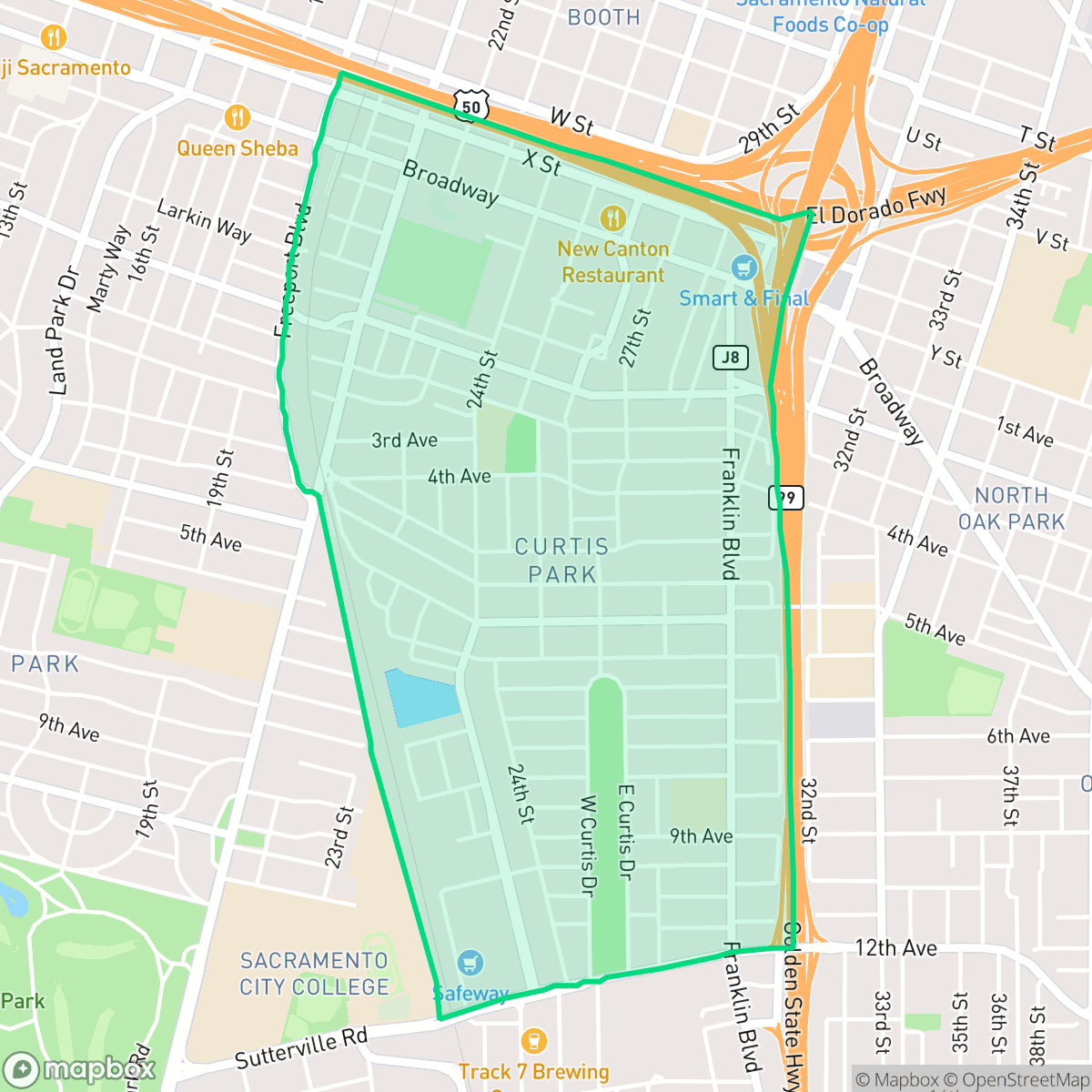
Curtis Park is a highly walkable Sacramento neighborhood defined by its dense grid of tree-lined streets and historic early 20th-century architecture. While the area offers excellent pedestrian access to local dining and community parks, residents should be aware of significant noise levels stemming from nearby highway traffic.
Key Highlights
About Curtis Park
Curtis Park in Sacramento originated from a 200-acre agricultural homestead established by William Curtis in 1852. In the early 1900s, the farmland was subdivided into developments like Curtis Oaks, becoming one of Sacramento’s first transit-oriented “streetcar suburbs”. Today, the neighborhood is celebrated for its mature tree canopy and well-preserved early 20th-century architecture, including Craftsman bungalows, Tudor, and Spanish Mediterranean Revival homes. Notably, the architectural firm Dean and Dean designed landmark-status model homes on Montgomery Way in 1923. At the heart of the community is the 18-acre William Curtis Park, a linear green space established during the subdivision era. The neighborhood's distinct character is further anchored by the Sierra 2 Community Center and iconic local institutions like Gunther’s Quality Ice Cream, which has served the area since 1940.
The neighborhood functions as a dense, transit-oriented suburb that maintains a strong sense of community through its central green space and active local centers. Residents benefit from high walkability, with consistent sidewalk coverage and convenient access to diverse local eateries and coffee shops. The housing stock remains a defining feature, characterized by closely spaced single-family homes that offer a traditional suburban aesthetic within a compact, urban-adjacent footprint. Prospective residents should weigh these lifestyle benefits against the local acoustic environment, as road traffic noise is a notable factor due to the proximity of major thoroughfares. While the broader school district faces significant fiscal and administrative challenges, the local Bret Harte Elementary maintains a strong performance rating. The area is well-suited for those who prioritize pedestrian-friendly living and proximity to established community hubs over absolute quiet or expansive private yards.
Neighborhood Scores Across 15 Qualities
Residential structures feature mixed spacing with some areas showing closely packed houses and others offering mature tree screening. This level of density is roughly comparable to the Sacramento average, according to iHuus data.
Tree-lined streets feature a dense grid of sidewalks and clear pedestrian crossings, offering connectivity that is slightly above the Sacramento average. While major highways and rail lines intersect the area, pedestrian bridges and established networks facilitate easy movement near local schools and parks.
Streetscapes range from high-density apartment blocks to larger, well-maintained homes with manicured lots. This visual variety is roughly in line with the typical Sacramento residential landscape according to iHuus data.
Wide parkway strips and proximity to local parks provide ample space for pet owners; however, overall dog friendliness is slightly below the Sacramento average according to iHuus data.
Residential streets and green spaces are distributed in roughly equal measure. This area presents a slightly more suburban character than the Sacramento average, featuring a mix of single-family homes and significant tree canopy.
Social activity is notably higher than the Sacramento average, featuring a diverse mix of dining, cafes, and galleries spread across both quiet suburban blocks and more energetic urban corridors. According to iHuus data, residents can access a variety of local establishments ranging from specialty coffee roasters to international eateries.
Frequent acoustic disturbances from nearby rail lines and heavy freeway traffic characterize this area. According to iHuus data, noise levels in Curtis Park are significantly higher than the Sacramento average.
Air quality remains mostly clean with only rare instances of elevated readings. This level of air quality is notably better than the Sacramento average, according to iHuus data.
Minimal industrial activity characterizes this area, which primarily consists of residential, educational, and light commercial spaces. According to iHuus data, the neighborhood lacks significant warehouses or heavy industrial hazards, performing slightly better than the Sacramento average for industrial avoidance.
Health insurance access among residents is higher than the Sacramento average, according to iHuus data.
Voting patterns and census indicators reflect a deeply liberal political leaning that is even more pronounced than the Sacramento average, according to iHuus data.
Residents live among a diverse range of age groups, including young professionals, families, and seniors. According to iHuus data, this demographic spread is slightly more varied than the average seen across Sacramento.
Residual flood risk exists within this area due to its location in the 500-year floodplain, though safety levels are higher than the Sacramento average according to iHuus data.
Address-Level Insights for Curtis Park


iHuus Neighborhood Intelligence Insights
Get address-level neighborhood insights for Curtis Park
- Street-level scores — see how individual blocks compare, not just neighborhood averages
- Micro-zone boundaries — identify quiet pockets, flood boundaries, and walkable clusters before you visit
- 15 dimensions in full — walkability, noise, air quality, school quality, insurance coverage, population age profile, urban/rural index, and more
- Boundary risk alerts — know if your address sits near a block boundary where scores drop, the kind of detail no listing will ever mention
- School insights — individual school ratings and insights, not just district-level data
- Compare before you commit — side-by-side data across neighborhoods, down to block precision
No credit card required
Compare with Any Neighborhood
| Dimension | Curtis Park | Airport |
|---|---|---|
| 🚶 Walkabilityavg 8.5 | ||
| 🔊 Acoustic Comfortavg 3.22 | ||
| 🤫 Privacy Indexavg 5.34 | ||
| 🎨 Visual Appealavg 6.3 | ||
| 🐕 Dog Friendlinessavg 6.98 | ||
| 🗺️ Urban-Rural Indexavg 6.57 | ||
| ✨ Neighborhood Vibeavg 4.66 | ||
| 🏥 Health Insurance Coverageavg 7.4 | ||
| 🌿 Air Qualityavg 6.12 | ||
| 🏭 Industrial Proximityavg 8.32 | ||
| 🌊 Flood Safetyavg 6.04 | ||
| 🗳️ Ideological Leanavg 9.49 | ||
| 👥 Population Age Profileavg 4.75 | ||
| 🔥 Fire Safetyavg 0 | ||
| 🏫 School Quality |
Curtis Park Rankings
School Districts Serving Curtis Park
School Insights for Curtis Park
Below average outcomes; significant attendance and academic challenges.
School Insights
See what's really behind every school rating near Curtis Park
- Individual school ratings — each school's own score with outcome context, not just a district average
- Enrollment & class size data — student-to-teacher ratio and how it compares to the state average
- Full demographics breakdown — ethnicity and gender composition for every school in the enrollment zone
- Every school in the district — all schools within the enrollment boundary ranked by rating, not just the closest one
- Grade levels & benchmarks — elementary through high school, with below/above state-average flags
No credit card required