CSUS, Sacramento
Updated · 1,799 residents
The CSUS neighborhood is a highly walkable, student-oriented area defined by its dense suburban and institutional landscape surrounding the university campus. While it offers excellent access to green spaces and trails near the American River, residents should expect notable noise levels from road traffic and a relatively quiet commercial environment.
Key Highlights
About CSUS
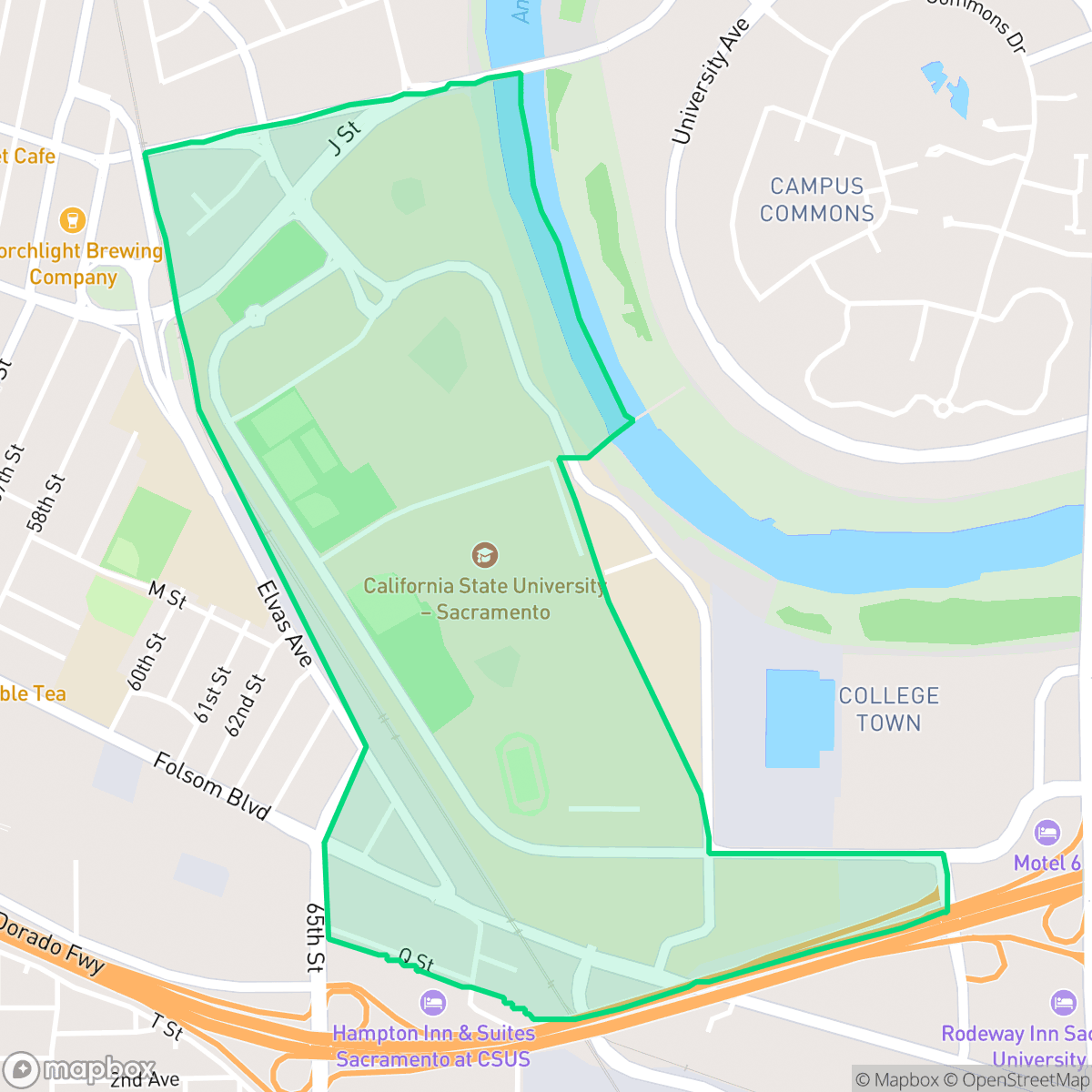
The CSUS neighborhood in Sacramento, California, developed around California State University, Sacramento (Sac State). In 1951, construction of the campus began on a 288-acre site previously dominated by peach orchards and hop fields along the American River. Opening in 1953, the area transformed from a muddy floodplain into a lush urban forest, aided by the planting of thousands of trees and the establishment of the University Arboretum in 1958. The neighborhood is a rich cultural and historical hub; in 1967, Martin Luther King Jr. delivered a landmark speech on campus, and in 1970, students and faculty founded the influential Royal Chicano Air Force art collective. Additionally, in 1971, the university became the first in the nation to offer a degree in Women's Studies, cementing the neighborhood's progressive legacy.
The area functions as a distinct extension of the university, characterized by a mix of multi-story institutional buildings and medium-density residential complexes. It maintains a high degree of pedestrian connectivity, making it simple for residents to navigate between housing, academic facilities, and local recreational trails. The atmosphere remains generally quiet, with limited local dining and retail options, reflecting its primary role as a support hub for the university community. According to available data, the neighborhood maintains a progressive social climate and high rates of health insurance coverage among its residents.
Prospective residents should consider the trade-offs between the area's high walkability and its acoustic environment, as road traffic noise is a consistent factor. While the neighborhood provides strong access to outdoor amenities, it is served by a school district currently facing significant fiscal and administrative challenges. The housing density is high, often resulting in limited private outdoor space, though the proximity to the American River provides a significant natural buffer for those seeking recreation.
Neighborhood Scores Across 15 Qualities
Residential structures feature mixed spacing with some buffer between neighbors, though density increases near the river and campus. This level of privacy is slightly higher than the Sacramento average according to iHuus data.
Pedestrian connectivity is exceptionally high due to continuous sidewalks and ample crossings. This area offers superior walkability compared to the Sacramento average, according to iHuus data.
Standard tract housing and large apartment complexes define the landscape, offering a visual experience that is slightly below the Sacramento average. Most properties feature boxy rooflines and tidy but small yards, according to iHuus data.
Abundant green spaces near the river and campus provide extensive trails and wide parkways for walking pets. This level of access to open areas is significantly higher than the Sacramento average, according to iHuus data.
Large university buildings and medium-density residential complexes create a suburban atmosphere that is very similar to the Sacramento average. This area features a mix of institutional structures and multi-family housing rather than open farmland.
Primarily comprised of industrial and suburban blocks, this area offers a calm atmosphere with limited walking options for amenities. According to iHuus data, the level of activity and social vibrancy is below the Sacramento city average.
Frequent noise from nearby railroad tracks and heavy freeway traffic makes this area louder than the Sacramento average. According to iHuus data, residents can expect significant acoustic disturbances throughout the day.
Air quality in this area fluctuates between acceptable and unhealthy levels, which may present occasional concerns for sensitive groups. According to iHuus data, these conditions are roughly in line with the Sacramento city average.
A combination of institutional campus space and active utility infrastructure, such as a wastewater treatment plant, defines the area. This presence of light industrial and commercial use is notably higher than the Sacramento average.
Health insurance access among residents is notably higher than the Sacramento average, according to iHuus data.
Voting patterns and census indicators show a highly liberal leaning, which is slightly more pronounced than the Sacramento average according to iHuus data.
Young adults make up the vast majority of the population here, creating a demographic that is notably younger than the Sacramento average. According to iHuus data, the area has a limited presence of families or older residents.
Flood risk in this area remains difficult to assess because FEMA has not yet finished a detailed study for this specific location. According to iHuus data, the risk level is roughly comparable to the average found across Sacramento.
Address-Level Insights for CSUS


iHuus Neighborhood Intelligence Insights
Get address-level neighborhood insights for CSUS
- Street-level scores — see how individual blocks compare, not just neighborhood averages
- Micro-zone boundaries — identify quiet pockets, flood boundaries, and walkable clusters before you visit
- 15 dimensions in full — walkability, noise, air quality, school quality, insurance coverage, population age profile, urban/rural index, and more
- Boundary risk alerts — know if your address sits near a block boundary where scores drop, the kind of detail no listing will ever mention
- School insights — individual school ratings and insights, not just district-level data
- Compare before you commit — side-by-side data across neighborhoods, down to block precision
No credit card required
Compare with Any Neighborhood
| Dimension | CSUS | Airport |
|---|---|---|
| 🚶 Walkabilityavg 8.5 | ||
| 🔊 Acoustic Comfortavg 3.22 | ||
| 🤫 Privacy Indexavg 5.34 | ||
| 🎨 Visual Appealavg 6.3 | ||
| 🐕 Dog Friendlinessavg 6.98 | ||
| 🗺️ Urban-Rural Indexavg 6.57 | ||
| ✨ Neighborhood Vibeavg 4.66 | ||
| 🏥 Health Insurance Coverageavg 7.4 | ||
| 🌿 Air Qualityavg 6.12 | ||
| 🏭 Industrial Proximityavg 8.32 | ||
| 🌊 Flood Safetyavg 6.04 | ||
| 🗳️ Ideological Leanavg 9.49 | ||
| 👥 Population Age Profileavg 4.75 | ||
| 🔥 Fire Safetyavg 0 | ||
| 🏫 School Quality |
CSUS Rankings
School Districts Serving CSUS
School Insights for CSUS
Below average outcomes; significant attendance and academic challenges.
School Insights
See what's really behind every school rating near CSUS
- Individual school ratings — each school's own score with outcome context, not just a district average
- Enrollment & class size data — student-to-teacher ratio and how it compares to the state average
- Full demographics breakdown — ethnicity and gender composition for every school in the enrollment zone
- Every school in the district — all schools within the enrollment boundary ranked by rating, not just the closest one
- Grade levels & benchmarks — elementary through high school, with below/above state-average flags
No credit card required