Colonial Village, Sacramento
Updated · 3,638 residents
Colonial Village is a quiet, residential neighborhood in southeast Sacramento defined by its mid-century tract housing and consistent, walkable street grid. While the area offers a serene environment with access to local green spaces like Earl Warren Park, residents should be aware of elevated noise levels from nearby road traffic.
Key Highlights
About Colonial Village
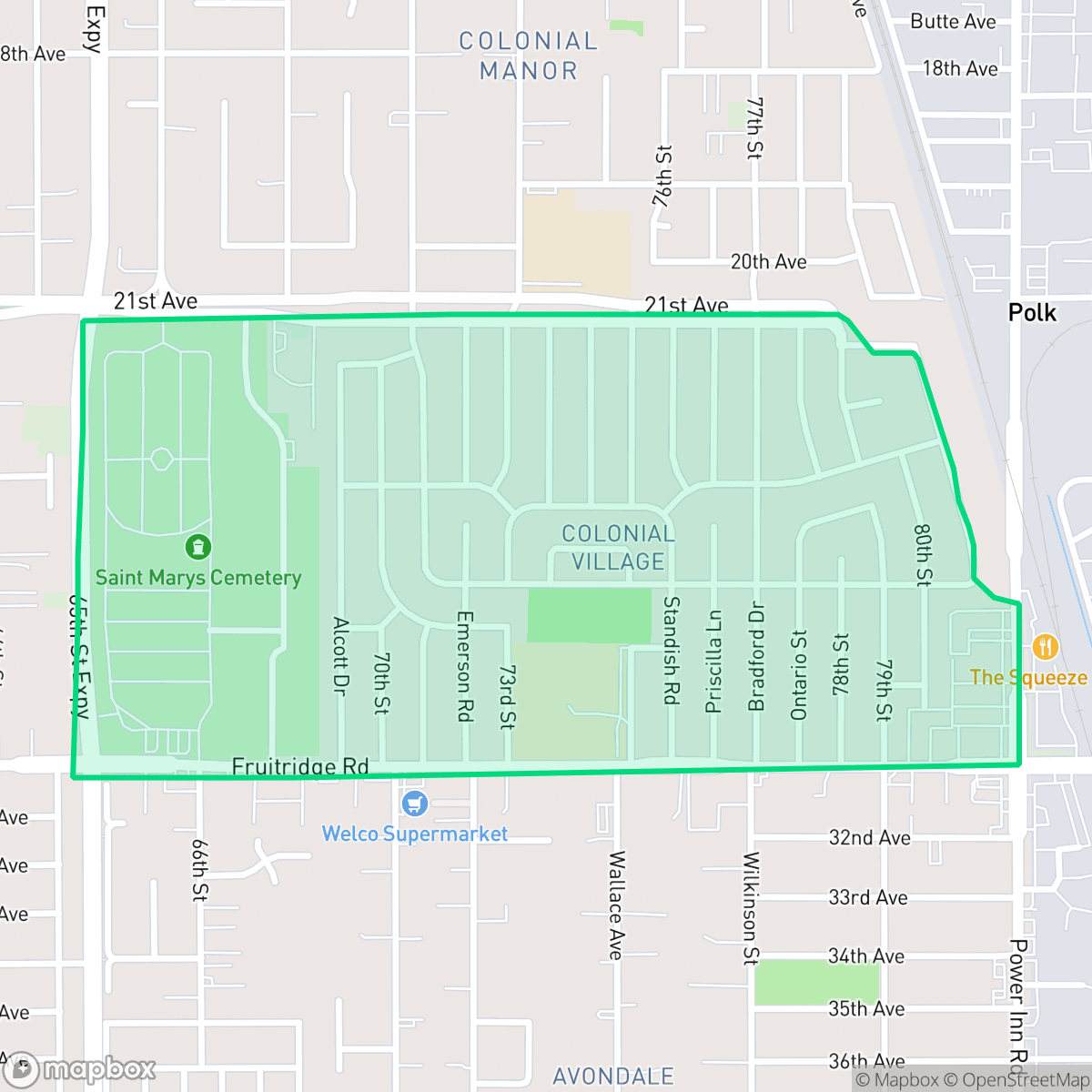
Located in southeast Sacramento, Colonial Village is a well-established residential neighborhood that experienced its primary development during the post-World War II housing boom. The neighborhood is characterized by mid-century tract housing, with the vast majority of its single-family homes and duplexes constructed between 1940 and 1969 to accommodate returning GIs and their families. Colonial Village includes portions of the historic Colonial Acres subdivision, mapped out in the mid-20th century. Bordered by major thoroughfares like Fruitridge Road and the 65th Street Expressway, the neighborhood serves as a quiet pocket of mid-century Americana, retaining its classic suburban feel and architectural character from the baby boom era.
The neighborhood functions as a dense suburban enclave with a layout focused on residential convenience. While the area lacks a high density of commercial businesses, it maintains a walkable infrastructure with sidewalks on both sides of most streets. The presence of Earl Warren Park and local school facilities serves as a focal point for the community, providing necessary recreational space within a compact, uniform housing environment.
Prospective residents should weigh the benefits of a quiet, established community against specific environmental factors. The area experiences notable noise from surrounding road traffic and has proximity to an EPA Superfund site, which may be a consideration for those concerned about environmental health. The neighborhood is best suited for those prioritizing a stable residential setting over proximity to urban amenities or nightlife.
Neighborhood Scores Across 15 Qualities
Residential spacing is consistent with typical suburban layouts, offering slightly more separation between neighbors than the Sacramento average. Houses are situated relatively close to one another, though backyard fencing is common throughout the area.
Sidewalks and marked crosswalks are available throughout most residential streets, though the area is slightly less walkable than the Sacramento average. The street patterns include cul-de-sacs and thinner paths that facilitate safe movement within the neighborhood.
Standard tract housing with uniform rooflines and modest yards defines the area. This residential landscape is slightly below the Sacramento average for visual variety and private amenities.
Wide sidewalks and accessible green spaces in the northwest quadrant offer decent walking routes for pets, though overall access to amenities is slightly below the Sacramento average. Large open fields and continuous grassy verges provide useful areas for exercise, according to iHuus data.
Residential areas feature a classic suburban layout with single-family homes and scattered commercial clusters. This level of openness is roughly in line with the Sacramento average.
Suburban streets and green spaces create a serene environment, but a lack of nearby businesses makes the area more car-oriented than the Sacramento average. According to iHuus data, while some local dining options are accessible, most daily errands will require a vehicle.
Frequent noise from nearby freeway and railroad traffic defines the acoustic environment. This level of disturbance is significantly higher than the Sacramento average, according to iHuus data.
Air quality fluctuates between acceptable and unhealthy levels, presenting occasional concerns for sensitive groups. This status is largely in line with the typical conditions found across Sacramento.
Light commercial activity and industrial units are integrated into the residential landscape, resulting in a higher presence of industrial proximity than the Sacramento average. Residents should be aware that a nearby EPA Superfund site exists within the broader area, which may involve concerns regarding soil or groundwater contaminants according to iHuus data.
Health insurance accessibility is slightly above the Sacramento average, according to iHuus data. This indicates a high rate of coverage among the resident population.
Voting patterns and census indicators show a predominantly liberal political lean, which is consistent with the city average.
A varied demographic of young adults, families, and seniors lives here. According to iHuus data, this age distribution is largely comparable to the broader Sacramento area.
Residual flood risk exists within the 500-year floodplain, though safety levels remain notably higher than the Sacramento average according to iHuus data.
Address-Level Insights for Colonial Village


iHuus Neighborhood Intelligence Insights
Get address-level neighborhood insights for Colonial Village
- Street-level scores — see how individual blocks compare, not just neighborhood averages
- Micro-zone boundaries — identify quiet pockets, flood boundaries, and walkable clusters before you visit
- 15 dimensions in full — walkability, noise, air quality, school quality, insurance coverage, population age profile, urban/rural index, and more
- Boundary risk alerts — know if your address sits near a block boundary where scores drop, the kind of detail no listing will ever mention
- School insights — individual school ratings and insights, not just district-level data
- Compare before you commit — side-by-side data across neighborhoods, down to block precision
No credit card required
Compare with Any Neighborhood
| Dimension | Colonial Village | Airport |
|---|---|---|
| 🚶 Walkabilityavg 8.5 | ||
| 🔊 Acoustic Comfortavg 3.22 | ||
| 🤫 Privacy Indexavg 5.34 | ||
| 🎨 Visual Appealavg 6.3 | ||
| 🐕 Dog Friendlinessavg 6.98 | ||
| 🗺️ Urban-Rural Indexavg 6.57 | ||
| ✨ Neighborhood Vibeavg 4.66 | ||
| 🏥 Health Insurance Coverageavg 7.4 | ||
| 🌿 Air Qualityavg 6.12 | ||
| 🏭 Industrial Proximityavg 8.32 | ||
| 🌊 Flood Safetyavg 6.04 | ||
| 🗳️ Ideological Leanavg 9.49 | ||
| 👥 Population Age Profileavg 4.75 | ||
| 🔥 Fire Safetyavg 0 | ||
| 🏫 School Quality |
Colonial Village Rankings
School Districts Serving Colonial Village
School Insights for Colonial Village
Below average outcomes; significant attendance and academic challenges.
School Insights
See what's really behind every school rating near Colonial Village
- Individual school ratings — each school's own score with outcome context, not just a district average
- Enrollment & class size data — student-to-teacher ratio and how it compares to the state average
- Full demographics breakdown — ethnicity and gender composition for every school in the enrollment zone
- Every school in the district — all schools within the enrollment boundary ranked by rating, not just the closest one
- Grade levels & benchmarks — elementary through high school, with below/above state-average flags
No credit card required