Colonial Heights, Sacramento
Updated · 2,234 residents
Colonial Heights is a dense, historic streetcar suburb characterized by its grid layout and proximity to local parks. While the area offers high walkability and strong community health insurance coverage, residents often experience significant noise from road traffic and limited privacy due to closely spaced housing.
Key Highlights
About Colonial Heights
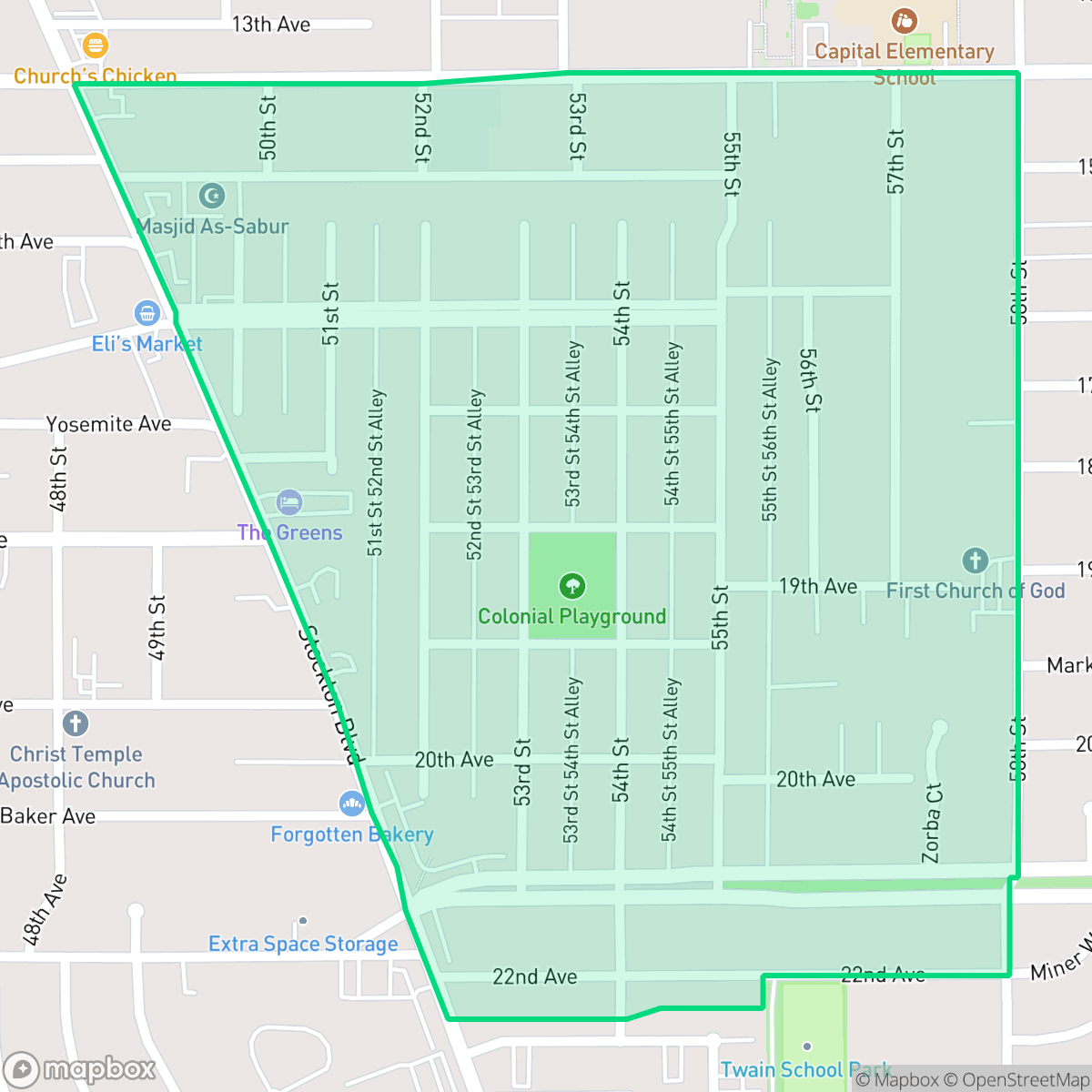
Established in 1910 as "Sacramento's Ideal Subdivision," Colonial Heights developed as a classic early 20th-century streetcar suburb. Bounded by Stockton Boulevard, 14th Avenue, 22nd Avenue, and 58th Street, the neighborhood was originally connected to downtown by the Central California Traction Company's electric streetcar line. At its core lies Colonial Park, while its defining planning landmark is San Francisco Boulevard. This six-block stretch is a prominent example of "City Beautiful" infrastructure, featuring parallel median strips, side park lawns, and iconic palm trees. Other historic neighborhood fixtures include the Wesley United Methodist Church on 15th Avenue and the site of the original Fransinetti's restaurant.
The neighborhood maintains a consistent suburban feel, defined by its traditional residential blocks and proximity to major commercial corridors on its western edge. According to iHuus data, the community benefits from a well-connected grid system that makes local transit and pedestrian travel accessible. While the area features established green spaces, the presence of larger industrial and warehouse structures nearby contributes to a distinct urban-suburban mix that balances residential life with commercial activity.
Potential residents should note that the area experiences elevated noise levels, primarily driven by road traffic. Housing density is high, which results in smaller yards and reduced privacy between properties. Although the neighborhood is well-served by public health infrastructure, those considering the area should be aware of the broader challenges facing the local school district, which currently struggles with fiscal instability and significant operational turnover.
Neighborhood Scores Across 15 Qualities
Residential structures are situated with moderate spacing and some buffer between neighbors. This level of density is consistent with the city average for Sacramento.
Low-traffic residential grids and a structured sidewalk network make walking through the neighborhood safe and efficient. These walking conditions are largely comparable to the rest of Sacramento.
Standard tract housing with uniform rooflines and small yards defines the area, which is slightly below the Sacramento average for visual variety. According to iHuus data, the landscape is characterized by tidy but modest lots with very few private pools.
Walking areas for pets are limited by narrow grass verges, though large school fields and central park spaces provide usable options. According to iHuus data, these amenities are less abundant here than in the broader Sacramento area.
Standard single-family housing and dense suburban layouts define the area, which maintains a level of development very similar to the Sacramento average. Most blocks consist of low-rise homes on small plots with occasional commercial structures interspersed throughout.
Suburban streets and green spaces provide a steady rhythm of residential life with a moderate selection of local dining and services. According to iHuus data, the neighborhood offers a slightly more active atmosphere than the Sacramento average due to various local social hubs and amenities.
Persistent noise from nearby busy thoroughfares is a common feature here. According to iHuus data, this level of acoustic activity is slightly more noticeable than the average for Sacramento.
Air quality levels here are generally acceptable, though residents may experience occasional periods of concern during certain seasons. According to iHuus data, the air quality in Colonial Heights is roughly in line with the Sacramento city average.
Heavy industry and large warehouses are virtually absent from this area, though some light commercial activity and storage facilities are present on the neighborhood edges. This lack of industrial presence is consistent with the broader Sacramento area.
Health insurance accessibility is strong in this area, performing slightly above the Sacramento average according to iHuus data.
Voting patterns and census indicators reflect a deeply liberal political leaning that is even more pronounced than the Sacramento average, according to iHuus data.
Residents experience a diverse demographic spread of young adults, families, and older individuals. This age distribution is slightly more varied than the average found across Sacramento.
Flood risk levels in this area are comparable to the Sacramento average, though a lack of detailed federal studies means the precise level of vulnerability remains undetermined. According to iHuus data, the area falls into a category where updated hydrological assessments are still needed.
Address-Level Insights for Colonial Heights


iHuus Neighborhood Intelligence Insights
Get address-level neighborhood insights for Colonial Heights
- Street-level scores — see how individual blocks compare, not just neighborhood averages
- Micro-zone boundaries — identify quiet pockets, flood boundaries, and walkable clusters before you visit
- 15 dimensions in full — walkability, noise, air quality, school quality, insurance coverage, population age profile, urban/rural index, and more
- Boundary risk alerts — know if your address sits near a block boundary where scores drop, the kind of detail no listing will ever mention
- School insights — individual school ratings and insights, not just district-level data
- Compare before you commit — side-by-side data across neighborhoods, down to block precision
No credit card required
Compare with Any Neighborhood
| Dimension | Colonial Heights | Airport |
|---|---|---|
| 🚶 Walkabilityavg 8.5 | ||
| 🔊 Acoustic Comfortavg 3.22 | ||
| 🤫 Privacy Indexavg 5.34 | ||
| 🎨 Visual Appealavg 6.3 | ||
| 🐕 Dog Friendlinessavg 6.98 | ||
| 🗺️ Urban-Rural Indexavg 6.57 | ||
| ✨ Neighborhood Vibeavg 4.66 | ||
| 🏥 Health Insurance Coverageavg 7.4 | ||
| 🌿 Air Qualityavg 6.12 | ||
| 🏭 Industrial Proximityavg 8.32 | ||
| 🌊 Flood Safetyavg 6.04 | ||
| 🗳️ Ideological Leanavg 9.49 | ||
| 👥 Population Age Profileavg 4.75 | ||
| 🔥 Fire Safetyavg 0 | ||
| 🏫 School Quality |
Colonial Heights Rankings
School Districts Serving Colonial Heights
School Insights for Colonial Heights
Below average outcomes; significant attendance and academic challenges.
School Insights
See what's really behind every school rating near Colonial Heights
- Individual school ratings — each school's own score with outcome context, not just a district average
- Enrollment & class size data — student-to-teacher ratio and how it compares to the state average
- Full demographics breakdown — ethnicity and gender composition for every school in the enrollment zone
- Every school in the district — all schools within the enrollment boundary ranked by rating, not just the closest one
- Grade levels & benchmarks — elementary through high school, with below/above state-average flags
No credit card required