College-Glen, Sacramento
Updated · 8,178 residents
College-Glen is a residential enclave in eastern Sacramento known for its proximity to California State University and the American River Bike Trail. Residents benefit from high walkability and well-maintained suburban aesthetics, though the area experiences significant noise levels due to its location near Highway 50.
Key Highlights
About College-Glen
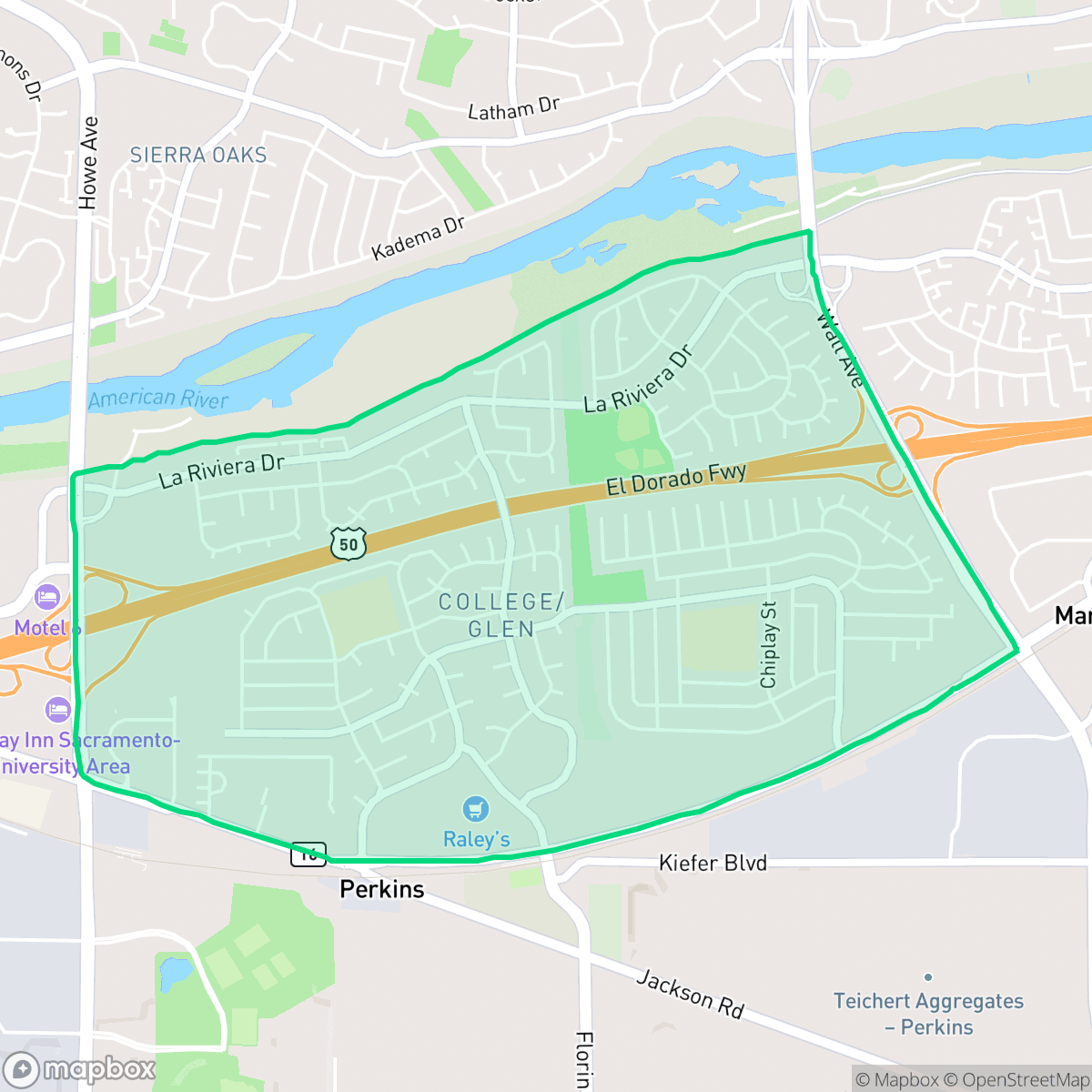
Located in eastern Sacramento along the American River, the College-Glen neighborhood developed between 1961 and 1973. Its name is a portmanteau of its two distinct mid-century subdivisions: College Greens on the west and Glenbrook on the east, which are physically divided by electrical power lines. Originally planned with wood-shake roofs and front-yard Modesto Ash trees, the neighborhood predates Highway 50, which was completed in 1971 and now bisects the area, connected by the Occidental Drive Bridge. College-Glen is defined by its proximity to California State University, Sacramento, and the American River Bike Trail. Local landmarks include Oki Park, Glenbrook Park, and the private College Greens Cabana Club, while La Riviera Drive serves as one of the neighborhood's most prominent thoroughfares.
The area offers a blend of mid-century suburban character and modern convenience, characterized by quiet streets and abundant green space. According to iHuus data, the neighborhood maintains a strong sense of community through its local parks and accessible pedestrian infrastructure. Residents enjoy a high level of health insurance coverage and a clean, residential environment with minimal industrial hazards, creating a stable atmosphere for those who value established suburban living.
Prospective residents should be aware of the acoustic environment, as the proximity to major thoroughfares results in elevated road noise. While the neighborhood is highly walkable and dog-friendly, those considering the area should weigh the convenience of its central location against the noise profile. The local school landscape is varied, featuring both high-performing options and district-wide challenges, making it a neighborhood best suited for those who value outdoor access and an established suburban atmosphere over absolute silence.
Neighborhood Scores Across 15 Qualities
Residential spacing offers a balanced level of separation between homes, providing more distance between neighbors than the Sacramento average. Most properties are detached houses with standard suburban buffering.
Wide sidewalks and frequent pedestrian crossings are available throughout the residential streets, making this area slightly more walkable than the Sacramento average.
Well-maintained yards and private amenities like pools contribute to a visual landscape that is more polished than the Sacramento average. Large driveways and manicured greenery are common features throughout this area, according to iHuus data.
Continuous sidewalk verges and access to a central park area offer ample space for pet walking. This neighborhood is more dog friendly than the Sacramento average due to interconnected green spaces and paths that are largely separated from traffic.
A combination of residential tracts, multi-family housing, and commercial zones creates a landscape that is consistent with the Sacramento average. Large-scale utility infrastructure and commercial parking lots are interspersed among the housing units, according to iHuus data.
Suburban blocks and industrial zones create a calm, steady atmosphere that is slightly more subdued than the Sacramento average. While local dining and small social hubs are accessible, the landscape is characterized by significant green space and a more tranquil pace of life.
Frequent sounds from nearby freeway and railroad activity characterize this area. According to iHuus data, acoustic levels are significantly higher than the Sacramento average.
Air quality levels in College-Glen fluctuate between acceptable and unhealthy, appearing roughly in line with the Sacramento average. Residents or sensitive groups may experience occasional concern during periods of poor air quality, according to iHuus data.
Industrial presence is minimal, as the area consists mostly of residential streets and light retail. While some nearby utility infrastructure and a wastewater treatment plant are visible, the neighborhood is slightly more industrial than the Sacramento average.
Health insurance accessibility is notably higher here than the Sacramento average, according to iHuus data. Most residents in this area maintain active health coverage.
Voting patterns and census indicators reflect a strong liberal leaning that is very similar to the broader Sacramento area.
Residents live alongside a balanced mix of young adults, families, and older individuals. According to iHuus data, the age distribution in this area is consistent with the Sacramento average.
Residual flood risk exists within this area as it sits within a 500-year floodplain; however, safety levels are higher than the Sacramento city average according to iHuus data.
Address-Level Insights for College-Glen


iHuus Neighborhood Intelligence Insights
Get address-level neighborhood insights for College-Glen
- Street-level scores — see how individual blocks compare, not just neighborhood averages
- Micro-zone boundaries — identify quiet pockets, flood boundaries, and walkable clusters before you visit
- 15 dimensions in full — walkability, noise, air quality, school quality, insurance coverage, population age profile, urban/rural index, and more
- Boundary risk alerts — know if your address sits near a block boundary where scores drop, the kind of detail no listing will ever mention
- School insights — individual school ratings and insights, not just district-level data
- Compare before you commit — side-by-side data across neighborhoods, down to block precision
No credit card required
Compare with Any Neighborhood
| Dimension | College-Glen | Airport |
|---|---|---|
| 🚶 Walkabilityavg 8.5 | ||
| 🔊 Acoustic Comfortavg 3.22 | ||
| 🤫 Privacy Indexavg 5.34 | ||
| 🎨 Visual Appealavg 6.3 | ||
| 🐕 Dog Friendlinessavg 6.98 | ||
| 🗺️ Urban-Rural Indexavg 6.57 | ||
| ✨ Neighborhood Vibeavg 4.66 | ||
| 🏥 Health Insurance Coverageavg 7.4 | ||
| 🌿 Air Qualityavg 6.12 | ||
| 🏭 Industrial Proximityavg 8.32 | ||
| 🌊 Flood Safetyavg 6.04 | ||
| 🗳️ Ideological Leanavg 9.49 | ||
| 👥 Population Age Profileavg 4.75 | ||
| 🔥 Fire Safetyavg 0 | ||
| 🏫 School Quality |
College-Glen Rankings
School Districts Serving College-Glen
School Insights for College-Glen
Below average outcomes; significant attendance and academic challenges.
School Insights
See what's really behind every school rating near College-Glen
- Individual school ratings — each school's own score with outcome context, not just a district average
- Enrollment & class size data — student-to-teacher ratio and how it compares to the state average
- Full demographics breakdown — ethnicity and gender composition for every school in the enrollment zone
- Every school in the district — all schools within the enrollment boundary ranked by rating, not just the closest one
- Grade levels & benchmarks — elementary through high school, with below/above state-average flags
No credit card required