Campus Commons, Sacramento
Updated · 3,275 residents
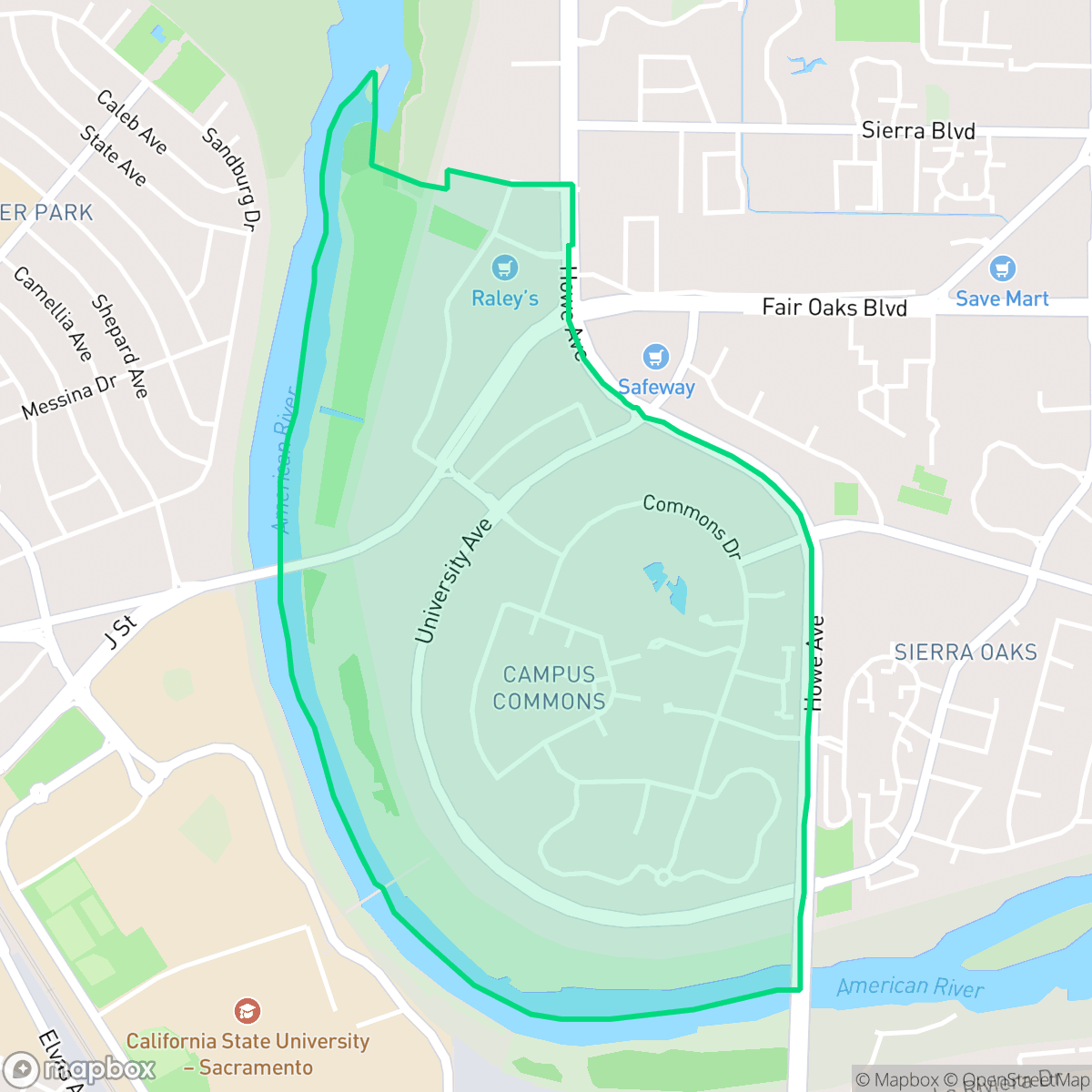
Campus Commons is a master-planned residential community in Sacramento, celebrated for its extensive greenbelts, mature landscaping, and exceptional pedestrian access. According to iHuus data, the neighborhood offers a highly walkable environment and is notably dog-friendly, though residents should anticipate consistent road traffic noise.
Key Highlights
About Campus Commons
Before its annexation to Sacramento in 1965, the 680-acre Campus Commons area was known as the Horst Hop Ranch, which grew hops until a devastating 1950 flood breached local levees. The neighborhood's development became viable only after the construction of the Folsom Dam and improved levee systems. In the early 1970s, prominent local developer Robert C. Powell and the Teichert Land Company transformed the land into a highly acclaimed, 1,160-home master-planned community, completing construction in 1979. Designed as a resort-style Planned Unit Development, Campus Commons is characterized by its distinctive 1970s architecture, manicured greenbelts, and winding footpaths. Today, the neighborhood is divided into the Villages of Campus Commons and the Nepenthe Association, offering residents immediate access to the adjacent American River Parkway, the Guy West Footbridge, and Sacramento State University.
Campus Commons is a master-planned community situated along the American River Parkway, characterized by a resort-like atmosphere with abundant shared green spaces and recreational facilities. The neighborhood features a mix of townhomes, condominiums, and detached residences, all integrated into a network of paved walking paths that encourage a pedestrian-focused lifestyle. Its location provides immediate access to the American River and the Jedediah Smith Memorial Bike Trail, making it a primary destination for those who prioritize outdoor recreation and proximity to nature.
While the area is highly regarded for its livability and community-oriented design, prospective residents should note that it experiences persistent road traffic noise. The neighborhood is well-suited for individuals and families who value a tranquil, managed environment with significant amenities, such as swimming pools and tennis courts. Although the area is exceptionally dog-friendly and maintains high levels of health insurance coverage, the acoustic environment remains a notable trade-off for its central location and urban accessibility.
Neighborhood Scores Across 15 Qualities
Building spacing provides a moderate level of separation between neighbors. According to iHuus data, this area offers slightly more buffer between structures than the Sacramento average.
Pedestrian-friendly infrastructure, including wide sidewalks and frequent crossings, makes navigating the area easy on foot. This level of accessibility is slightly above the Sacramento average according to iHuus data.
Spacious driveways and frequent high-end amenities contribute to a visual landscape that is slightly more polished than the Sacramento average, according to iHuus data.
Extensive access to large parks, trails, and open spaces makes this area significantly more accommodating for dogs than the Sacramento average, according to iHuus data.
Largely characterized by a dense suburban mix of institutional buildings and multi-family housing, this area feels very similar to the broader Sacramento urban landscape. According to iHuus data, the presence of large-scale utility infrastructure and commercial centers provides a level of development comparable to the city average.
Suburban streets and green spaces provide a calm atmosphere, though the selection of local amenities is more limited than the Sacramento average. Most social and leisure spots are reachable via walkable paths, but the area remains somewhat car-oriented.
Frequent noise from nearby freeway and railroad traffic characterizes this area. According to iHuus data, acoustic comfort levels are lower than the Sacramento city average.
Air quality in this area fluctuates between acceptable and unhealthy levels. According to iHuus data, conditions are roughly in line with the Sacramento city average, though sensitive groups may experience occasional concern.
The area is predominantly residential with only occasional light commercial use and some municipal utility infrastructure. While a wastewater treatment plant is located nearby, the neighborhood lacks the heavy industrial presence found in other parts of Sacramento.
Health insurance access is exceptionally high for residents in this area, significantly outperforming the Sacramento city average according to iHuus data.
Voting patterns and census indicators reflect a highly liberal political leaning that aligns with the broader Sacramento average, according to iHuus data.
Residents will encounter a balanced demographic of young professionals, families, and seniors. This age distribution is slightly more varied than the average found across Sacramento.
Flood risk levels in this area are slightly higher than the Sacramento average. According to iHuus data, a detailed flood study has not yet been completed for this specific location.
Address-Level Insights for Campus Commons


iHuus Neighborhood Intelligence Insights
Get address-level neighborhood insights for Campus Commons
- Street-level scores — see how individual blocks compare, not just neighborhood averages
- Micro-zone boundaries — identify quiet pockets, flood boundaries, and walkable clusters before you visit
- 15 dimensions in full — walkability, noise, air quality, school quality, insurance coverage, population age profile, urban/rural index, and more
- Boundary risk alerts — know if your address sits near a block boundary where scores drop, the kind of detail no listing will ever mention
- School insights — individual school ratings and insights, not just district-level data
- Compare before you commit — side-by-side data across neighborhoods, down to block precision
No credit card required
Compare with Any Neighborhood
| Dimension | Campus Commons | Airport |
|---|---|---|
| 🚶 Walkabilityavg 8.5 | ||
| 🔊 Acoustic Comfortavg 3.22 | ||
| 🤫 Privacy Indexavg 5.34 | ||
| 🎨 Visual Appealavg 6.3 | ||
| 🐕 Dog Friendlinessavg 6.98 | ||
| 🗺️ Urban-Rural Indexavg 6.57 | ||
| ✨ Neighborhood Vibeavg 4.66 | ||
| 🏥 Health Insurance Coverageavg 7.4 | ||
| 🌿 Air Qualityavg 6.12 | ||
| 🏭 Industrial Proximityavg 8.32 | ||
| 🌊 Flood Safetyavg 6.04 | ||
| 🗳️ Ideological Leanavg 9.49 | ||
| 👥 Population Age Profileavg 4.75 | ||
| 🔥 Fire Safetyavg 0 | ||
| 🏫 School Quality |
Campus Commons Rankings
School Districts Serving Campus Commons
School Insights for Campus Commons
Below average outcomes; significant attendance and academic challenges.
School Insights
See what's really behind every school rating near Campus Commons
- Individual school ratings — each school's own score with outcome context, not just a district average
- Enrollment & class size data — student-to-teacher ratio and how it compares to the state average
- Full demographics breakdown — ethnicity and gender composition for every school in the enrollment zone
- Every school in the district — all schools within the enrollment boundary ranked by rating, not just the closest one
- Grade levels & benchmarks — elementary through high school, with below/above state-average flags
No credit card required