Boulevard Park, Sacramento
Updated · 2,621 residents
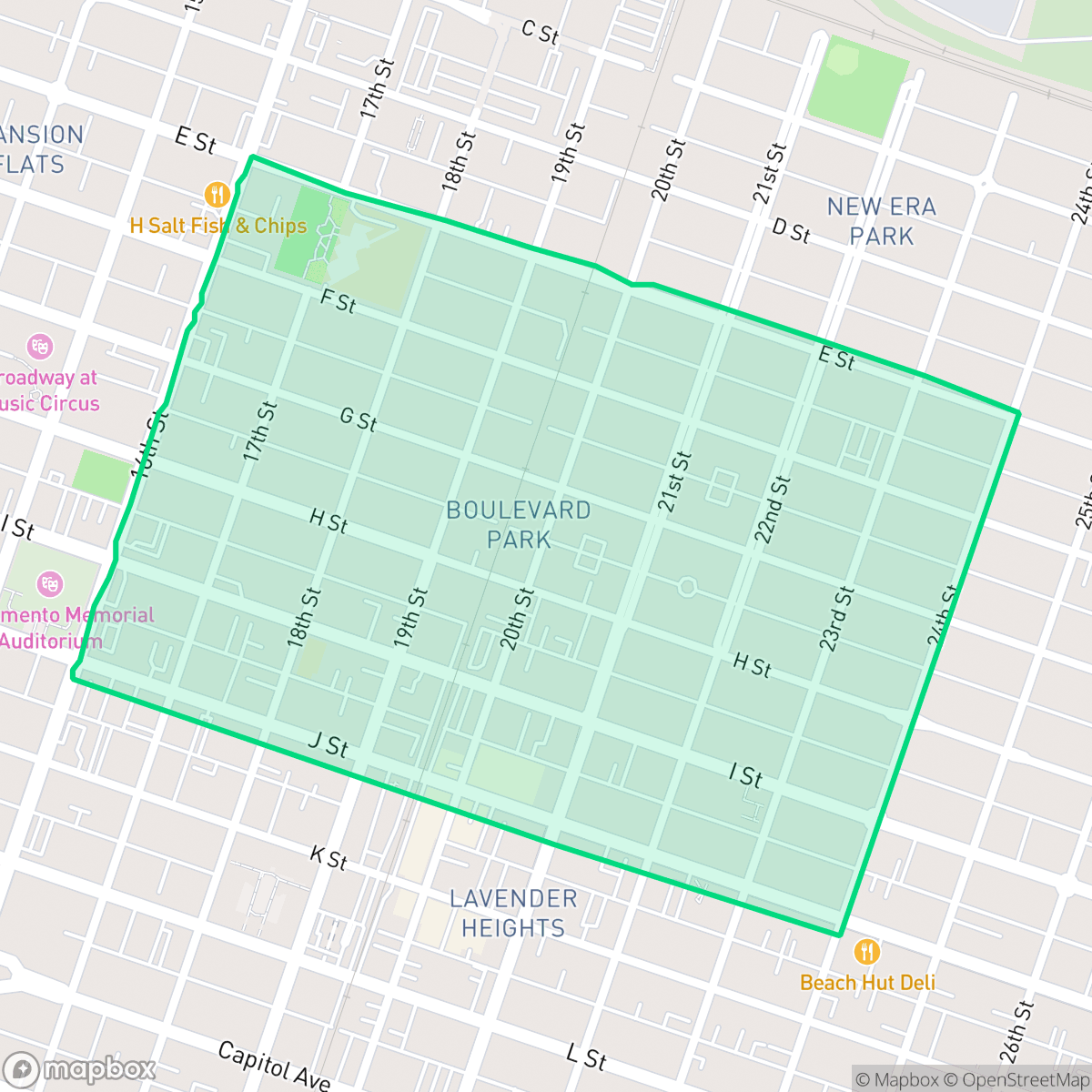
Boulevard Park is a historic district in Sacramento defined by its early 20th-century architecture and tree-lined streets. While the area offers a lively atmosphere with diverse dining options, residents experience higher noise levels from road traffic and nearby rail lines. The neighborhood maintains a dense urban character with limited private outdoor space.
Key Highlights
About Boulevard Park
Established in 1905, Sacramento’s Boulevard Park neighborhood was developed on the former site of Agricultural Park, which hosted the California State Fair and its racetrack from 1861 to 1904. Designed under the influence of the "City Beautiful" movement, the subdivision features wide, tree-lined boulevards along 21st and 22nd streets with lush, landscaped central medians and unique shared "center block parks". The neighborhood boasts a cohesive collection of early 20th-century residential architecture, primarily built between 1905 and 1915, including Craftsman, Classic Box (Foursquare), Prairie, and Colonial Revival styles. After transitioning into a working-class boarding house district post-World War II, grass-roots restoration efforts in the 1970s revitalized the area. Today, Boulevard Park is recognized as Sacramento’s largest historic district listed on the National Register of Historic Places.
The neighborhood serves as a dense, historic enclave that bridges the gap between residential charm and urban convenience. Residents benefit from close proximity to Midtown dining and cultural hubs, contributing to an active, high-energy environment. According to iHuus data, the area features a structured grid layout that supports moderate walkability, though the presence of major roads and nearby rail infrastructure impacts the overall acoustic environment.
Living here involves trade-offs regarding privacy and noise, as homes are situated closely together with minimal distance between structures. Families should note that the local school district is currently navigating significant fiscal instability, which may affect educational resources. This neighborhood is best suited for individuals who value historic preservation and central access to city amenities over the quiet, low-density environment found in suburban settings.
Neighborhood Scores Across 15 Qualities
Residential structures are closely spaced with narrow gaps between neighbors, resulting in less privacy than the Sacramento average according to iHuus data.
Frequent pedestrian crossings and a dense grid system make navigating the area on foot easy, though sidewalks can be partially obscured by tree cover in certain sections. According to iHuus data, the walkability in this neighborhood is largely comparable to the Sacramento average.
Uniform housing structures and dense lot layouts characterize the area, offering less visual variety than the Sacramento average. According to iHuus data, the landscape consists primarily of consistent roof geometries and limited private green space.
Access to dedicated green spaces for dogs is below the Sacramento average. While street trees are consistent throughout the area, public park access is limited to specific pockets of the neighborhood.
Residential streets and green spaces are balanced with industrial and commercial utility, though the area feels slightly less urban than the Sacramento average according to iHuus data.
Local social and dining hubs are notably more concentrated here than in the rest of Sacramento. Residents can find a diverse mix of cafes, eateries, and urban spaces that create a more vibrant atmosphere than the city average.
Steady traffic sounds from nearby busy streets are a common feature here, though acoustic levels remain slightly more peaceful than the Sacramento average.
Air quality in this area remains mostly clean with rare instances of elevated readings, performing better than the Sacramento average according to iHuus data.
Heavy industrial presence is minimal throughout the area, though some residents may encounter noise or visual impacts from a nearby electrical substation and railway tracks. According to iHuus data, the neighborhood is slightly more prone to industrial proximity than the Sacramento average due to these specific utility features.
A significant majority of residents are covered by health insurance, though the coverage rate in Boulevard Park sits slightly below the Sacramento city average according to iHuus data.
Voting patterns and census indicators reflect a predominantly liberal political landscape, which is slightly more pronounced than the Sacramento average according to iHuus data.
A varied demographic of young professionals, families, and seniors resides here, representing a slightly more balanced age distribution than the Sacramento average according to iHuus data.
Residual flood risk exists within this area as it is located inside a 500-year floodplain, though safety levels remain notably higher than the Sacramento city average according to iHuus data.
Address-Level Insights for Boulevard Park


iHuus Neighborhood Intelligence Insights
Get address-level neighborhood insights for Boulevard Park
- Street-level scores — see how individual blocks compare, not just neighborhood averages
- Micro-zone boundaries — identify quiet pockets, flood boundaries, and walkable clusters before you visit
- 15 dimensions in full — walkability, noise, air quality, school quality, insurance coverage, population age profile, urban/rural index, and more
- Boundary risk alerts — know if your address sits near a block boundary where scores drop, the kind of detail no listing will ever mention
- School insights — individual school ratings and insights, not just district-level data
- Compare before you commit — side-by-side data across neighborhoods, down to block precision
No credit card required
Compare with Any Neighborhood
| Dimension | Boulevard Park | Airport |
|---|---|---|
| 🚶 Walkabilityavg 8.5 | ||
| 🔊 Acoustic Comfortavg 3.22 | ||
| 🤫 Privacy Indexavg 5.34 | ||
| 🎨 Visual Appealavg 6.3 | ||
| 🐕 Dog Friendlinessavg 6.98 | ||
| 🗺️ Urban-Rural Indexavg 6.57 | ||
| ✨ Neighborhood Vibeavg 4.66 | ||
| 🏥 Health Insurance Coverageavg 7.4 | ||
| 🌿 Air Qualityavg 6.12 | ||
| 🏭 Industrial Proximityavg 8.32 | ||
| 🌊 Flood Safetyavg 6.04 | ||
| 🗳️ Ideological Leanavg 9.49 | ||
| 👥 Population Age Profileavg 4.75 | ||
| 🔥 Fire Safetyavg 0 | ||
| 🏫 School Quality |
Boulevard Park Rankings
School Districts Serving Boulevard Park
School Insights for Boulevard Park
Below average outcomes; significant attendance and academic challenges.
School Insights
See what's really behind every school rating near Boulevard Park
- Individual school ratings — each school's own score with outcome context, not just a district average
- Enrollment & class size data — student-to-teacher ratio and how it compares to the state average
- Full demographics breakdown — ethnicity and gender composition for every school in the enrollment zone
- Every school in the district — all schools within the enrollment boundary ranked by rating, not just the closest one
- Grade levels & benchmarks — elementary through high school, with below/above state-average flags
No credit card required