Ben Ali, Sacramento
Updated · 1,600 residents
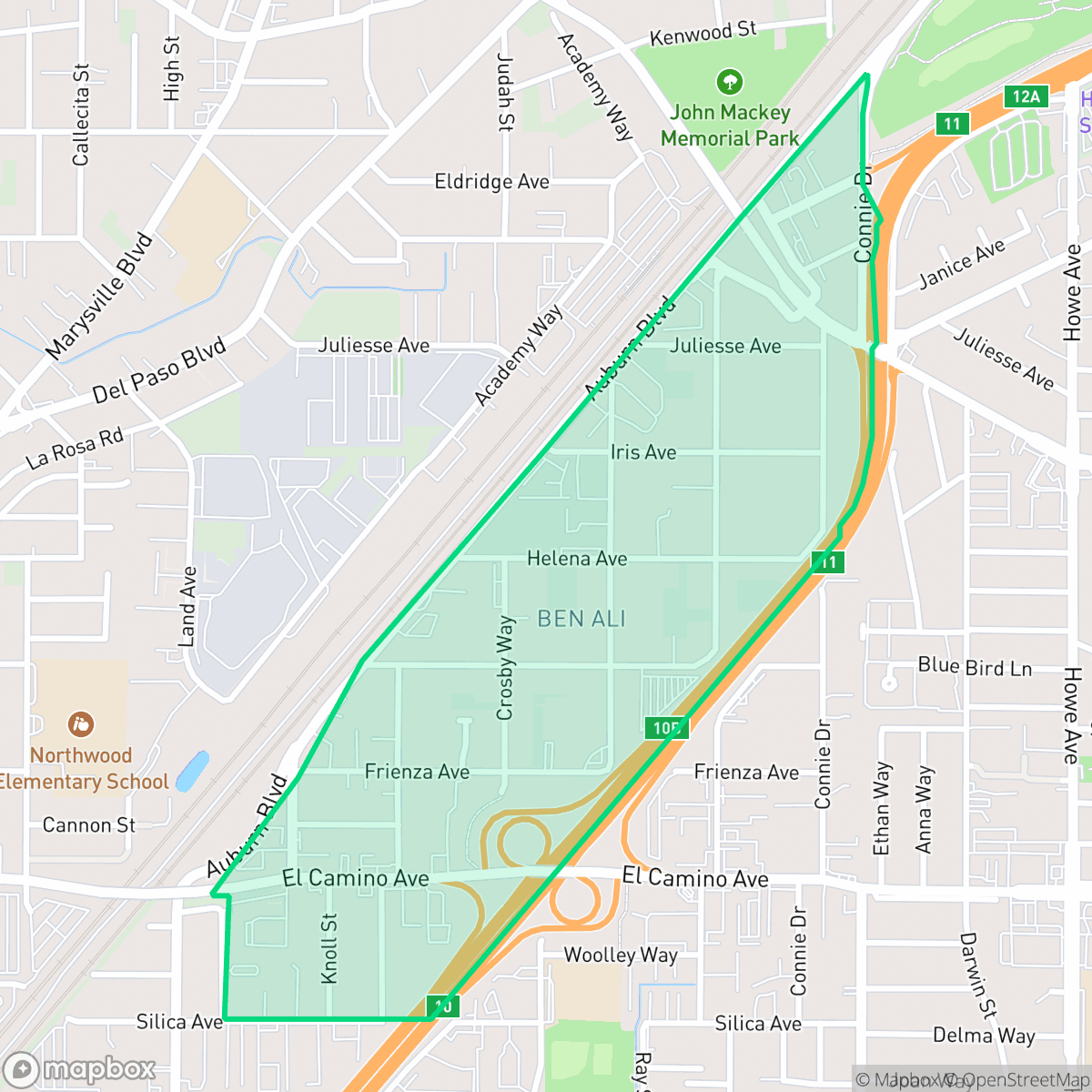
Ben Ali is a quiet, industrial-suburban neighborhood characterized by a mix of residential housing and large-scale logistics facilities. The area experiences significant noise from nearby highway traffic and rail infrastructure, resulting in limited walkability for residents.
Key Highlights
About Ben Ali
The Ben Ali neighborhood in Sacramento, California, originated as part of Rancho Del Paso, a massive 44,000-acre land tract in the 19th century. In 1859, the property was purchased by James Ben Ali Haggin—a prominent horse breeder—and his brother-in-law Lloyd Tevis. The neighborhood derives its name from Haggin, who utilized the land's mild climate to raise racehorses. As regional growth surged and interest in horse racing declined, the ranch was sold in 1910 to the Sacramento Valley Colonization Company, which subdivided the vast estate into residential streets. Historic local landmarks include the Ben Ali School, built around 1935 on Plover Street. The neighborhood was officially annexed into the City of Sacramento in 1963.
The neighborhood functions as a logistics and industrial hub within Sacramento. It features a dense layout where residential streets sit adjacent to sprawling warehouse complexes and major freight corridors. This proximity to transit infrastructure defines the daily environment, creating a landscape dominated by industrial activity rather than traditional neighborhood amenities or social spaces. According to iHuus data, the area maintains a distinct character shaped by its history as a transit-oriented zone.
Prospective residents should note that the area presents specific trade-offs regarding acoustic comfort and accessibility. Due to the high volume of road and rail traffic, the neighborhood is notably loud, and the lack of local commerce makes it less suitable for those prioritizing a pedestrian-friendly lifestyle. It remains a functional option for those who prioritize proximity to industrial employment centers and major transportation routes over quiet, walkable residential streets.
Neighborhood Scores Across 15 Qualities
Residential spacing varies throughout the area, with some sections featuring closely packed houses and minimal buffers between neighbors. This level of privacy is generally in line with the city average, according to iHuus data.
Quiet streets facilitate walking in certain sections, but the presence of a major freeway and lack of sidewalks in many areas make the neighborhood significantly less walkable than the Sacramento average. According to iHuus data, the highway acts as a major barrier to easy pedestrian movement throughout the neighborhood.
Standard tract housing and multi-family units define the local landscape, offering a more utilitarian aesthetic than the Sacramento average. Streetscapes are characterized by modest yards and simple rooflines, according to iHuus data.
Narrow sidewalks and a lack of direct public park access make it less ideal for dog owners compared to the Sacramento average. Most available green space in this area is private and fenced, according to iHuus data.
Large warehouses, rail yards, and dense residential clusters create a landscape that is comparable to the broader Sacramento area in its balance of developed and open space. This mix of light industrial zones and housing units provides an urban fringe atmosphere according to iHuus data.
Low levels of commercial activity and proximity to industrial corridors make this a primarily quiet, vehicle-dependent area. According to iHuus data, the lack of social hubs and retail density is notably lower than the Sacramento average.
Persistent noise from nearby airport runways and heavy rail infrastructure makes this area significantly louder than the Sacramento average. Residents should expect frequent disruptions from aircraft and train activity according to iHuus data.
Air quality in Ben Ali remains largely comparable to the Sacramento average, though residents may encounter days with unhealthy levels that could affect sensitive groups. According to iHuus data, the area experiences a mix of acceptable and concerning atmospheric conditions.
Large-scale logistics hubs, rail yards, and extensive warehouse complexes are common throughout the area. This concentration of light industrial and commercial activity is notably higher than the Sacramento average, according to iHuus data.
Health insurance coverage among residents is notably lower than the Sacramento average, according to iHuus data. This indicates a higher proportion of uninsured individuals living in the area compared to most parts of the city.
Political leanings in this area are predominantly liberal, though they are slightly less pronounced than the city average according to iHuus data.
Residents live alongside a balanced mix of young adults, families, and seniors. According to iHuus data, this demographic spread is largely consistent with the broader Sacramento area.
Flood risk in this area is higher than the Sacramento average due to its location within a 500-year floodplain. According to iHuus data, residents may encounter some residual flood risk during extreme weather events.
Address-Level Insights for Ben Ali


iHuus Neighborhood Intelligence Insights
Get address-level neighborhood insights for Ben Ali
- Street-level scores — see how individual blocks compare, not just neighborhood averages
- Micro-zone boundaries — identify quiet pockets, flood boundaries, and walkable clusters before you visit
- 15 dimensions in full — walkability, noise, air quality, school quality, insurance coverage, population age profile, urban/rural index, and more
- Boundary risk alerts — know if your address sits near a block boundary where scores drop, the kind of detail no listing will ever mention
- School insights — individual school ratings and insights, not just district-level data
- Compare before you commit — side-by-side data across neighborhoods, down to block precision
No credit card required
Compare with Any Neighborhood
| Dimension | Ben Ali | Airport |
|---|---|---|
| 🚶 Walkabilityavg 8.5 | ||
| 🔊 Acoustic Comfortavg 3.22 | ||
| 🤫 Privacy Indexavg 5.34 | ||
| 🎨 Visual Appealavg 6.3 | ||
| 🐕 Dog Friendlinessavg 6.98 | ||
| 🗺️ Urban-Rural Indexavg 6.57 | ||
| ✨ Neighborhood Vibeavg 4.66 | ||
| 🏥 Health Insurance Coverageavg 7.4 | ||
| 🌿 Air Qualityavg 6.12 | ||
| 🏭 Industrial Proximityavg 8.32 | ||
| 🌊 Flood Safetyavg 6.04 | ||
| 🗳️ Ideological Leanavg 9.49 | ||
| 👥 Population Age Profileavg 4.75 | ||
| 🔥 Fire Safetyavg 0 | ||
| 🏫 School Quality |
Ben Ali Rankings
School Districts Serving Ben Ali
School Insights for Ben Ali
Below average outcomes; significant attendance and academic challenges.
School Insights
See what's really behind every school rating near Ben Ali
- Individual school ratings — each school's own score with outcome context, not just a district average
- Enrollment & class size data — student-to-teacher ratio and how it compares to the state average
- Full demographics breakdown — ethnicity and gender composition for every school in the enrollment zone
- Every school in the district — all schools within the enrollment boundary ranked by rating, not just the closest one
- Grade levels & benchmarks — elementary through high school, with below/above state-average flags
No credit card required