Alhambra Triangle, Sacramento
Updated · 659 residents
Alhambra Triangle is a compact Sacramento enclave defined by early 20th-century architecture and its immediate proximity to major transit corridors. While the area offers a central location, residents should be prepared for significant noise from the adjacent Highway 50 and a landscape that balances residential charm with busy commercial traffic.
Key Highlights
About Alhambra Triangle
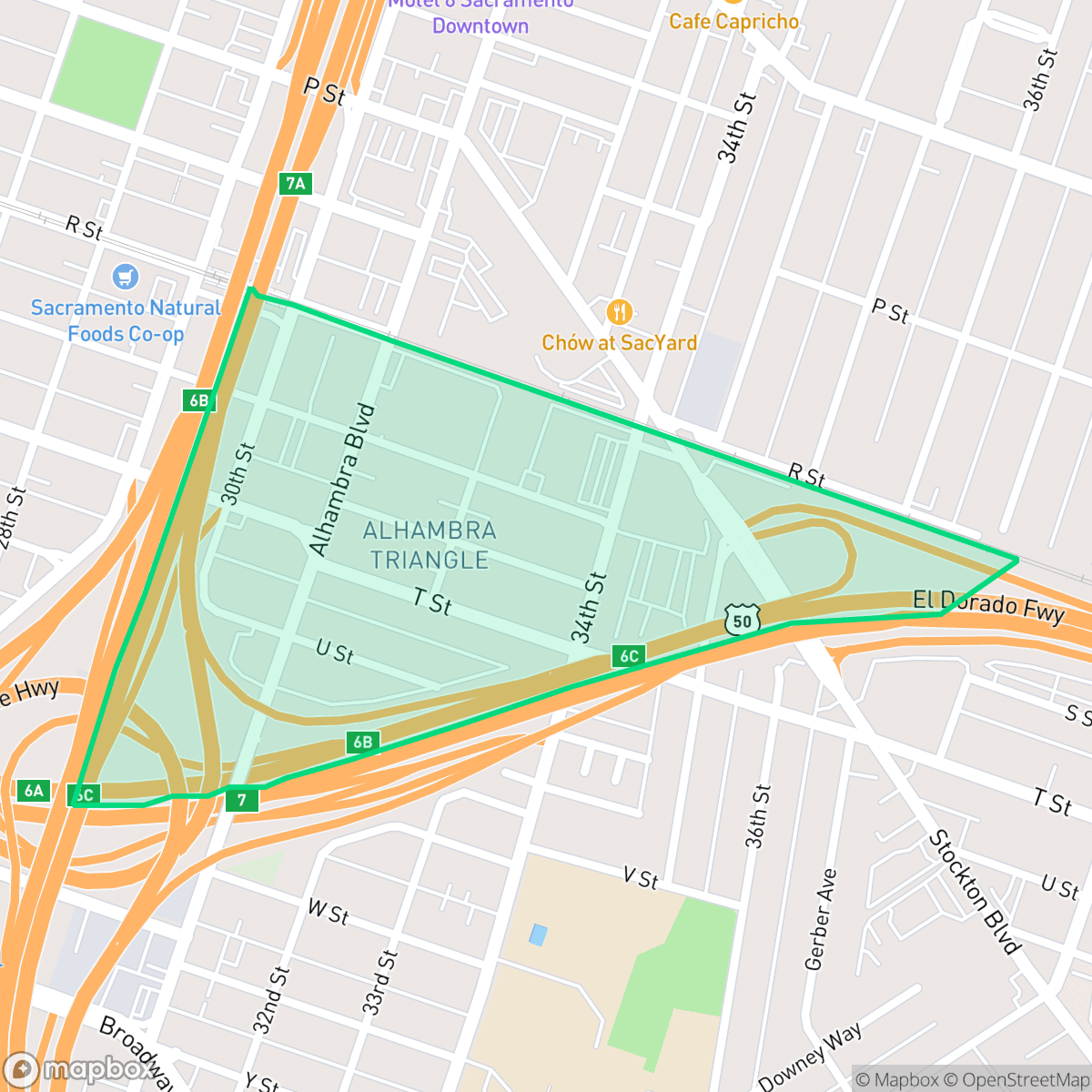
The Alhambra Triangle is a compact, distinct neighborhood in Sacramento, California, bounded by R Street to the north, Highway 50 to the south, 30th Street to the west, and 34th Street to the east. Represented alongside Poverty Ridge and Newton Booth by the Newton Booth Neighborhoods Association, this pocket neighborhood is historically characterized by its unique triangular footprint and a charming collection of early 20th-century Arts and Crafts-era homes. The enclave's modern character has been heavily shaped by mid-century infrastructure developments, particularly the construction of the adjacent US Route 50 freeway, which borders its southern edge. Today, the neighborhood retains its historic residential charm while actively engaging in community-led advocacy for environmental protections and navigating contemporary urban infill projects.
The area serves as a dense, urban-adjacent pocket that maintains a distinct identity through its historic housing stock and local social hubs like Broadway Donuts and the Golden Dragon Chinese Restaurant. According to iHuus data, the neighborhood experiences a notable blend of residential and commercial activity, creating a vibrant but active atmosphere that differs from the quieter surrounding districts. The local environment is characterized by mixed-use streets where daily residential life intersects with consistent daytime commercial movement.
Prospective residents should weigh the benefits of its central position against specific livability trade-offs. The neighborhood faces substantial noise levels primarily due to consistent road traffic from the nearby freeway, and the local school district is currently navigating significant fiscal instability. It is best suited for individuals who prioritize central accessibility and historic character over acoustic privacy or quiet suburban living, as noted by iHuus research on local environmental factors.
Neighborhood Scores Across 15 Qualities
Residential spacing offers a moderate level of separation between neighbors; this density is slightly higher than the Sacramento average according to iHuus data.
Sidewalks are available on one side of the streets alongside safe crossings, though pedestrian accessibility is lower than the Sacramento average. According to iHuus data, most local trips are manageable on foot but may require more planning than in more highly walkable parts of the city.
Large residential properties and frequent upscale amenities contribute to a visual landscape that is more polished than the Sacramento average. According to iHuus data, the area features spacious driveways and well-maintained surroundings.
Access to wide green verges and public parks for pets is below the Sacramento average. Pet owners may find fewer immediate opportunities for off-leash exercise within the immediate vicinity.
Residential streets and green spaces are distributed in nearly equal measure. This area is slightly less densely urbanized than the Sacramento average.
Diverse dining and social hubs create a more active atmosphere than most parts of Sacramento. While certain pockets offer a calm suburban feel near light industrial zones, many blocks feature high-energy mid-rise developments and accessible amenities.
Constant noise from nearby airport runways and heavy rail lines creates significant acoustic disruption. This level of sound exposure is considerably higher than the Sacramento average, according to iHuus data.
Air quality levels are generally acceptable, though residents may encounter occasional days with pollutants that could affect sensitive groups. According to iHuus data, conditions in this area are roughly in line with the Sacramento average.
Residential life is largely uninterrupted by heavy industry, though some light commercial activity contributes to daytime traffic. According to iHuus data, this area has more industrial proximity than the Sacramento average.
Health insurance access is very high among Alhambra Triangle residents, significantly exceeding the Sacramento average according to iHuus data.
Voting patterns and census indicators show a deeply liberal political leaning that is even more pronounced than the Sacramento average, according to iHuus data.
Residents live alongside a balanced mix of young adults, families, and older individuals. This demographic spread is consistent with the broader Sacramento area, according to iHuus data.
Residual flood risk exists within the area as it sits within the 500-year floodplain, though safety levels remain higher than the Sacramento average according to iHuus data.
Address-Level Insights for Alhambra Triangle


iHuus Neighborhood Intelligence Insights
Get address-level neighborhood insights for Alhambra Triangle
- Street-level scores — see how individual blocks compare, not just neighborhood averages
- Micro-zone boundaries — identify quiet pockets, flood boundaries, and walkable clusters before you visit
- 15 dimensions in full — walkability, noise, air quality, school quality, insurance coverage, population age profile, urban/rural index, and more
- Boundary risk alerts — know if your address sits near a block boundary where scores drop, the kind of detail no listing will ever mention
- School insights — individual school ratings and insights, not just district-level data
- Compare before you commit — side-by-side data across neighborhoods, down to block precision
No credit card required
Compare with Any Neighborhood
| Dimension | Alhambra Triangle | Airport |
|---|---|---|
| 🚶 Walkabilityavg 8.5 | ||
| 🔊 Acoustic Comfortavg 3.22 | ||
| 🤫 Privacy Indexavg 5.34 | ||
| 🎨 Visual Appealavg 6.3 | ||
| 🐕 Dog Friendlinessavg 6.98 | ||
| 🗺️ Urban-Rural Indexavg 6.57 | ||
| ✨ Neighborhood Vibeavg 4.66 | ||
| 🏥 Health Insurance Coverageavg 7.4 | ||
| 🌿 Air Qualityavg 6.12 | ||
| 🏭 Industrial Proximityavg 8.32 | ||
| 🌊 Flood Safetyavg 6.04 | ||
| 🗳️ Ideological Leanavg 9.49 | ||
| 👥 Population Age Profileavg 4.75 | ||
| 🔥 Fire Safetyavg 0 | ||
| 🏫 School Quality |
Alhambra Triangle Rankings
School Districts Serving Alhambra Triangle
School Insights for Alhambra Triangle
Below average outcomes; significant attendance and academic challenges.
School Insights
See what's really behind every school rating near Alhambra Triangle
- Individual school ratings — each school's own score with outcome context, not just a district average
- Enrollment & class size data — student-to-teacher ratio and how it compares to the state average
- Full demographics breakdown — ethnicity and gender composition for every school in the enrollment zone
- Every school in the district — all schools within the enrollment boundary ranked by rating, not just the closest one
- Grade levels & benchmarks — elementary through high school, with below/above state-average flags
No credit card required