Airport, Sacramento
Updated · 3,367 residents
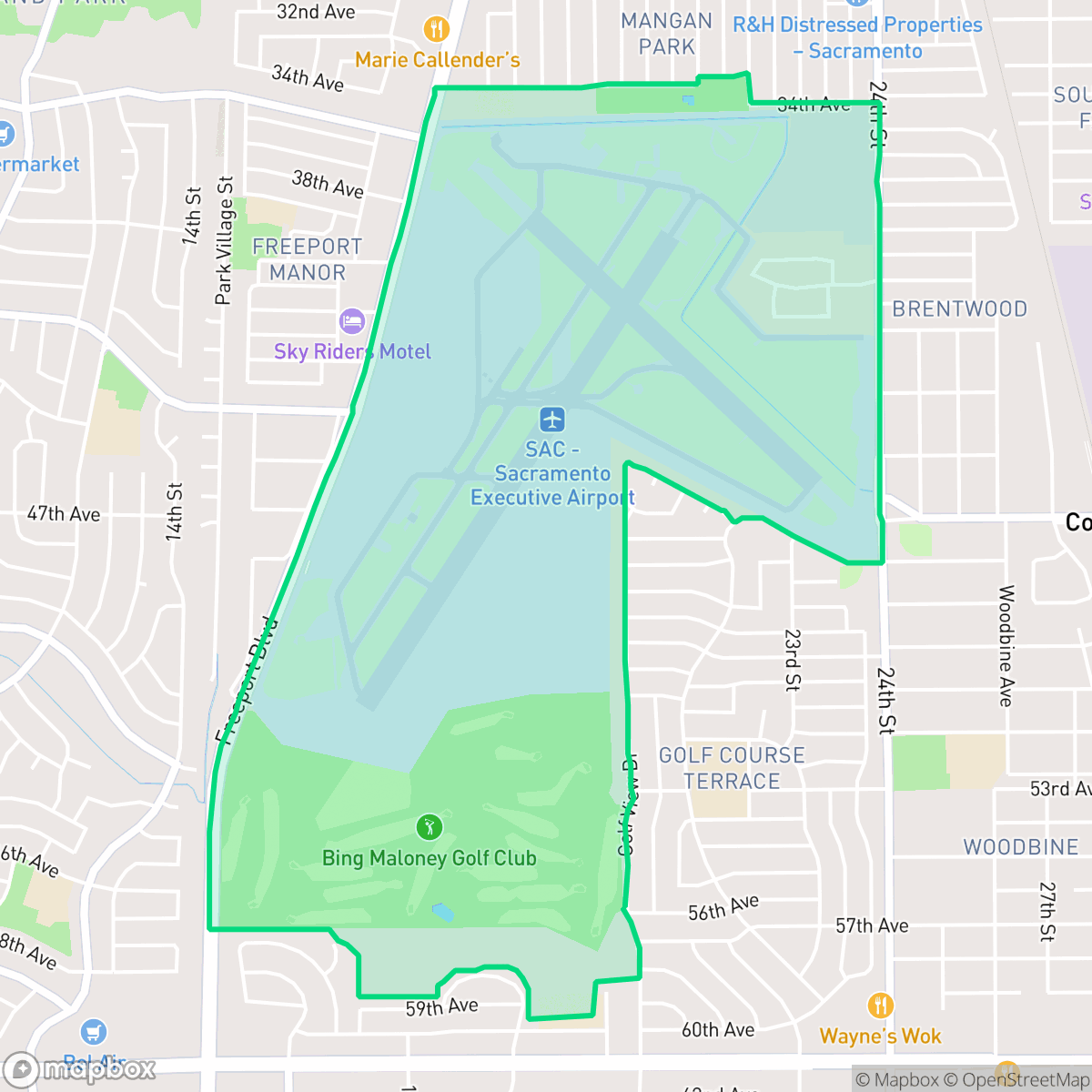
The Airport neighborhood offers a unique blend of semi-rural character and high walkability, defined by its proximity to the historic Sacramento Executive Airport. While the area features upscale residential properties and a consistent sidewalk grid, residents should be prepared for significant noise levels from nearby flight paths and transit corridors.
Key Highlights
About Airport
The Airport neighborhood, centered around the Sacramento Executive Airport, holds significant historical importance as the city's original municipal airport. Established in 1930, it served as Sacramento’s primary aviation hub for decades before the opening of Sacramento International Airport in 1967. The area is defined by its proximity to the historic airfield, which remains a key landmark for general aviation and flight training. The surrounding residential development reflects mid-century expansion, characterized by post-World War II architecture that grew alongside the facility's operations. While the neighborhood has transitioned from a major commercial aviation center to a general aviation hub, it retains a distinct character tied to its long-standing role in the city's aviation history and its ongoing influence on local land use and regional transport development.
This area is defined by a distinct semi-rural atmosphere, characterized by open land and a mix of spacious homes that often include private amenities like pools. The neighborhood maintains a strong sense of visual appeal, with well-maintained residential streets that offer more privacy than typical urban settings. Its layout is notably pedestrian-friendly, featuring a consistent grid of wide sidewalks that make local streets easy to navigate on foot.
Living here involves certain trade-offs, particularly regarding acoustic comfort, as the proximity to active flight paths, railways, and major freeways creates a consistently loud environment. While the streets are easy to walk, the area remains quiet and car-dependent for daily errands, as local businesses are scattered. Prospective families should also consider the current status of the Sacramento City Unified School District, which faces significant fiscal instability and administrative challenges that impact the broader educational experience in the region.
Neighborhood Scores Across 15 Qualities
Detached houses feature modest side-yard buffers between structures. This level of spacing provides slightly more separation between neighbors than the Sacramento average, according to iHuus data.
Pedestrian-friendly infrastructure, including wide sidewalks on both sides of streets and frequent crossings, makes navigating this area on foot easier than in most of Sacramento. According to iHuus data, the consistent sidewalk grid and low-traffic residential streets provide high levels of safety for walkers.
Large homes and frequent upscale amenities like private pools contribute to a visual quality that is slightly above the Sacramento average. According to iHuus data, the area features a mix of affluent estates and standard tract housing.
Large green parks and wide residential verges offer ample space for pets. According to iHuus data, the area provides comparable levels of dog friendliness to the rest of Sacramento.
Open land and scattered homes create a setting that is slightly more rural than the Sacramento average. Residential areas range from dense suburban grids to more wooded layouts near industrial zones, according to iHuus data.
Low levels of activity and limited walking access to businesses define this area, which feels less lively than the Sacramento average. Most residents will find the setting quiet and suburban, though daily errands typically require a vehicle due to the scattered nature of local dining and services.
Frequent noise from nearby flight paths, railroads, and major freeways makes this area significantly louder than the Sacramento average. Residents can expect consistent auditory disturbances throughout the day.
Air quality levels fluctuate between acceptable and unhealthy, presenting occasional concerns for sensitive groups. According to iHuus data, these conditions are roughly in line with the Sacramento city average.
Residential life remains largely undisturbed by heavy industry, though some light commercial warehouses and an active railway line are present on the eastern edge of the neighborhood. This level of industrial proximity is roughly in line with the Sacramento average, according to iHuus data.
Health insurance enrollment is notably higher here than the Sacramento average, according to iHuus data. This indicates a well-covered population with greater access to medical services.
Voting patterns and census indicators show a predominantly liberal leaning that is slightly more pronounced than the Sacramento average, according to iHuus data.
Residents live alongside a balanced mix of young adults, families, and older populations. This demographic spread is slightly more varied than the Sacramento average, according to iHuus data.
Residual flood risk exists due to the area being within a 500-year floodplain; however, safety levels are higher than the Sacramento average according to iHuus data.
Address-Level Insights for Airport


iHuus Neighborhood Intelligence Insights
Get address-level neighborhood insights for Airport
- Street-level scores — see how individual blocks compare, not just neighborhood averages
- Micro-zone boundaries — identify quiet pockets, flood boundaries, and walkable clusters before you visit
- 15 dimensions in full — walkability, noise, air quality, school quality, insurance coverage, population age profile, urban/rural index, and more
- Boundary risk alerts — know if your address sits near a block boundary where scores drop, the kind of detail no listing will ever mention
- School insights — individual school ratings and insights, not just district-level data
- Compare before you commit — side-by-side data across neighborhoods, down to block precision
No credit card required
Compare with Any Neighborhood
| Dimension | Airport | Alhambra Triangle |
|---|---|---|
| 🚶 Walkabilityavg 8.5 | ||
| 🔊 Acoustic Comfortavg 3.22 | ||
| 🤫 Privacy Indexavg 5.34 | ||
| 🎨 Visual Appealavg 6.3 | ||
| 🐕 Dog Friendlinessavg 6.98 | ||
| 🗺️ Urban-Rural Indexavg 6.57 | ||
| ✨ Neighborhood Vibeavg 4.66 | ||
| 🏥 Health Insurance Coverageavg 7.4 | ||
| 🌿 Air Qualityavg 6.12 | ||
| 🏭 Industrial Proximityavg 8.32 | ||
| 🌊 Flood Safetyavg 6.04 | ||
| 🗳️ Ideological Leanavg 9.49 | ||
| 👥 Population Age Profileavg 4.75 | ||
| 🔥 Fire Safetyavg 0 | ||
| 🏫 School Quality |
Airport Rankings
School Districts Serving Airport
School Insights for Airport
Below average outcomes; significant attendance and academic challenges.
School Insights
See what's really behind every school rating near Airport
- Individual school ratings — each school's own score with outcome context, not just a district average
- Enrollment & class size data — student-to-teacher ratio and how it compares to the state average
- Full demographics breakdown — ethnicity and gender composition for every school in the enrollment zone
- Every school in the district — all schools within the enrollment boundary ranked by rating, not just the closest one
- Grade levels & benchmarks — elementary through high school, with below/above state-average flags
No credit card required