Woodcreek Oaks, Roseville
Updated · 7,564 residents
Woodcreek Oaks is a master-planned suburban community in West Roseville characterized by its integration of residential development with extensive natural preservation and recreational amenities like the Woodcreek Golf Club. The area offers high walkability through a comprehensive network of pedestrian paths and sidewalks, alongside a quiet, affluent atmosphere featuring spacious homes and private pools. It is an ideal setting for residents who prioritize suburban tranquility, access to high-performing schools, and proximity to regional parks.
Key Highlights
About Woodcreek Oaks
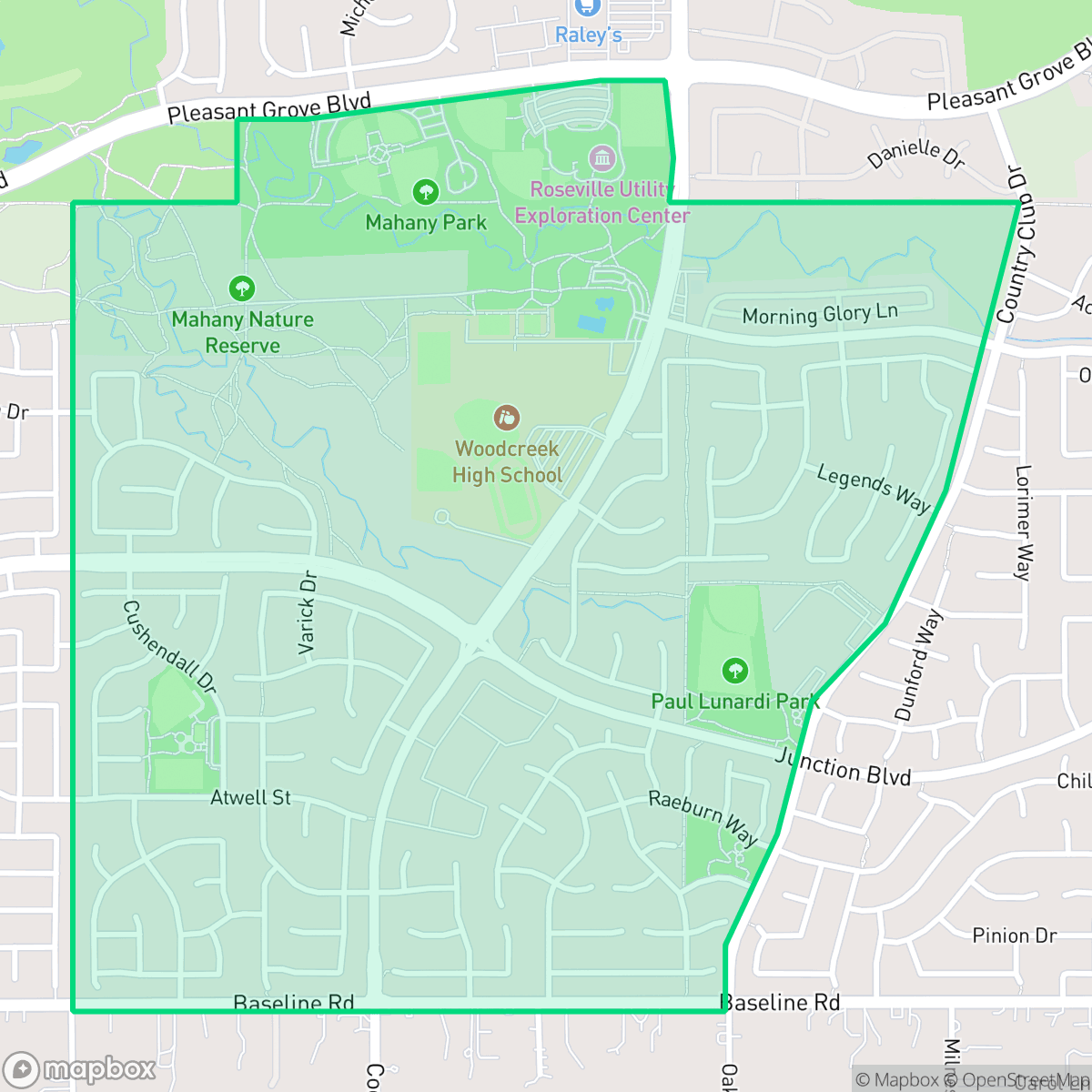
Located in West Roseville, California, the Woodcreek Oaks neighborhood transitioned from historic agricultural grazing land, once owned by local ranching families like the Garinos, into a master-planned suburban community during the late 1990s and early 2000s. The neighborhood is defined by its integration of residential development with extensive natural preservation. Notable local landmarks include the Woodcreek Golf Club, an 18-hole public championship course designed by Robert Muir Graves in 1995, and the expansive Mahany Regional Park. Mahany Park serves as a central hub for the community, housing the Roseville Aquatics Complex, the Roseville Sports Center, and the modern, two-story Martha Riley Community Library. The neighborhood's primary thoroughfare, Woodcreek Oaks Boulevard, connects these recreational amenities and preserves mature valley oak trees within its central medians.
The neighborhood maintains a distinct suburban character defined by its affluent visual appeal, featuring large single-family homes, well-maintained landscaping, and a high concentration of private backyard pools. Residents benefit from a layout that is entirely residential and recreational, with no industrial activity or warehouses present. The community is well-connected by a robust sidewalk system that links quiet residential cul-de-sacs to major local hubs like Mahany Regional Park, providing a seamless transition between private living spaces and public green belts. While the area excels in residential comfort and safety, it maintains a quiet, low-key vibe with limited commercial activity within its immediate borders. Prospective residents should note that while the environment is calm, the proximity to major thoroughfares contributes to moderate road traffic noise. The neighborhood is particularly well-suited for families and professionals who value academic consistency, as it is served by the highly-regarded Roseville Joint Union High School District, and those seeking a peaceful, pedestrian-friendly environment away from urban density.
Neighborhood Scores Across 15 Qualities
Residential density varies across the neighborhood, ranging from closely spaced modern suburban lots to larger, more buffered rural-residential plots. This provides a slightly higher level of privacy than the typical Roseville average.
Extensive sidewalk networks on both sides of residential streets and clear pedestrian crossings provide excellent connectivity to local parks. This level of walkability is notably higher than the Roseville average, according to iHuus data.
Large modern homes, manicured landscaping, and a high density of private backyard pools define this area. This neighborhood offers a more polished visual environment than the Roseville average according to iHuus data.
Extensive greenbelts, wide grass verges, and a large community park provide ample room for walking pets. According to iHuus data, these connected open spaces offer higher accessibility for dog owners than the Roseville average.
Residential density varies across the area, transitioning from structured suburban tracts in the north to more spacious, lower-density lots in the south. This layout is consistent with the broader Roseville area, blending planned single-family homes with accessible open spaces.
Low-density residential blocks and green spaces define this area, offering a tranquil atmosphere that is slightly below the Roseville average for activity. While local parks and occasional service spots provide a steady rhythm, most commercial businesses are not within easy walking distance.
Steady noise from nearby thoroughfares is a notable feature, though acoustic levels remain slightly more tranquil than the Roseville average.
Air quality in this area typically fluctuates between acceptable and unhealthy levels. According to iHuus data, these conditions are consistent with the average levels found throughout Roseville.
Industrial activity and warehouses are entirely absent from this area, offering a more residential environment than the Roseville average. According to iHuus data, the neighborhood consists exclusively of residential and recreational land use with no detected hazardous sites.
Health insurance access is widespread among residents, sitting well above the Roseville average according to iHuus data.
Conservative voters form a majority in this area, though a modest opposing presence exists. This political leaning is slightly more conservative than the Roseville average, according to iHuus data.
Residents live alongside a balanced blend of young professionals, families, and seniors. According to iHuus data, this demographic distribution is slightly more varied than the Roseville city average.
Residual flood risks exist within this area as it sits within a 500-year floodplain, though safety levels remain higher than the Roseville average according to iHuus data.
Address-Level Insights for Woodcreek Oaks


iHuus Neighborhood Intelligence Insights
Get address-level neighborhood insights for Woodcreek Oaks
- Street-level scores — see how individual blocks compare, not just neighborhood averages
- Micro-zone boundaries — identify quiet pockets, flood boundaries, and walkable clusters before you visit
- 15 dimensions in full — walkability, noise, air quality, school quality, insurance coverage, population age profile, urban/rural index, and more
- Boundary risk alerts — know if your address sits near a block boundary where scores drop, the kind of detail no listing will ever mention
- School insights — individual school ratings and insights, not just district-level data
- Compare before you commit — side-by-side data across neighborhoods, down to block precision
No credit card required
Compare with Any Neighborhood
| Dimension | Woodcreek Oaks | Blue Oaks |
|---|---|---|
| 🚶 Walkabilityavg 8.87 | ||
| 🔊 Acoustic Comfortavg 4.32 | ||
| 🤫 Privacy Indexavg 5.7 | ||
| 🎨 Visual Appealavg 7.58 | ||
| 🐕 Dog Friendlinessavg 7.74 | ||
| 🗺️ Urban-Rural Indexavg 6.82 | ||
| ✨ Neighborhood Vibeavg 4.77 | ||
| 🏥 Health Insurance Coverageavg 8.58 | ||
| 🌿 Air Qualityavg 6 | ||
| 🏭 Industrial Proximityavg 8.8 | ||
| 🌊 Flood Safetyavg 5.72 | ||
| 🗳️ Ideological Leanavg 3.68 | ||
| 👥 Population Age Profileavg 5.05 | ||
| 🔥 Fire Safetyavg 0.15 | ||
| 🏫 School Quality |
Woodcreek Oaks Rankings
School Districts Serving Woodcreek Oaks
School Insights for Woodcreek Oaks
Below average outcomes; significant attendance and academic challenges.
School Insights
See what's really behind every school rating near Woodcreek Oaks
- Individual school ratings — each school's own score with outcome context, not just a district average
- Enrollment & class size data — student-to-teacher ratio and how it compares to the state average
- Full demographics breakdown — ethnicity and gender composition for every school in the enrollment zone
- Every school in the district — all schools within the enrollment boundary ranked by rating, not just the closest one
- Grade levels & benchmarks — elementary through high school, with below/above state-average flags
No credit card required