South Cirby, Roseville
Updated · 3,055 residents
South Cirby is a quiet, highly walkable suburban enclave defined by its orderly residential tracts and expansive green spaces. The neighborhood offers a peaceful, well-maintained environment with excellent pedestrian infrastructure, making it a stable choice for those prioritizing ease of movement and a low-key atmosphere.
Key Highlights
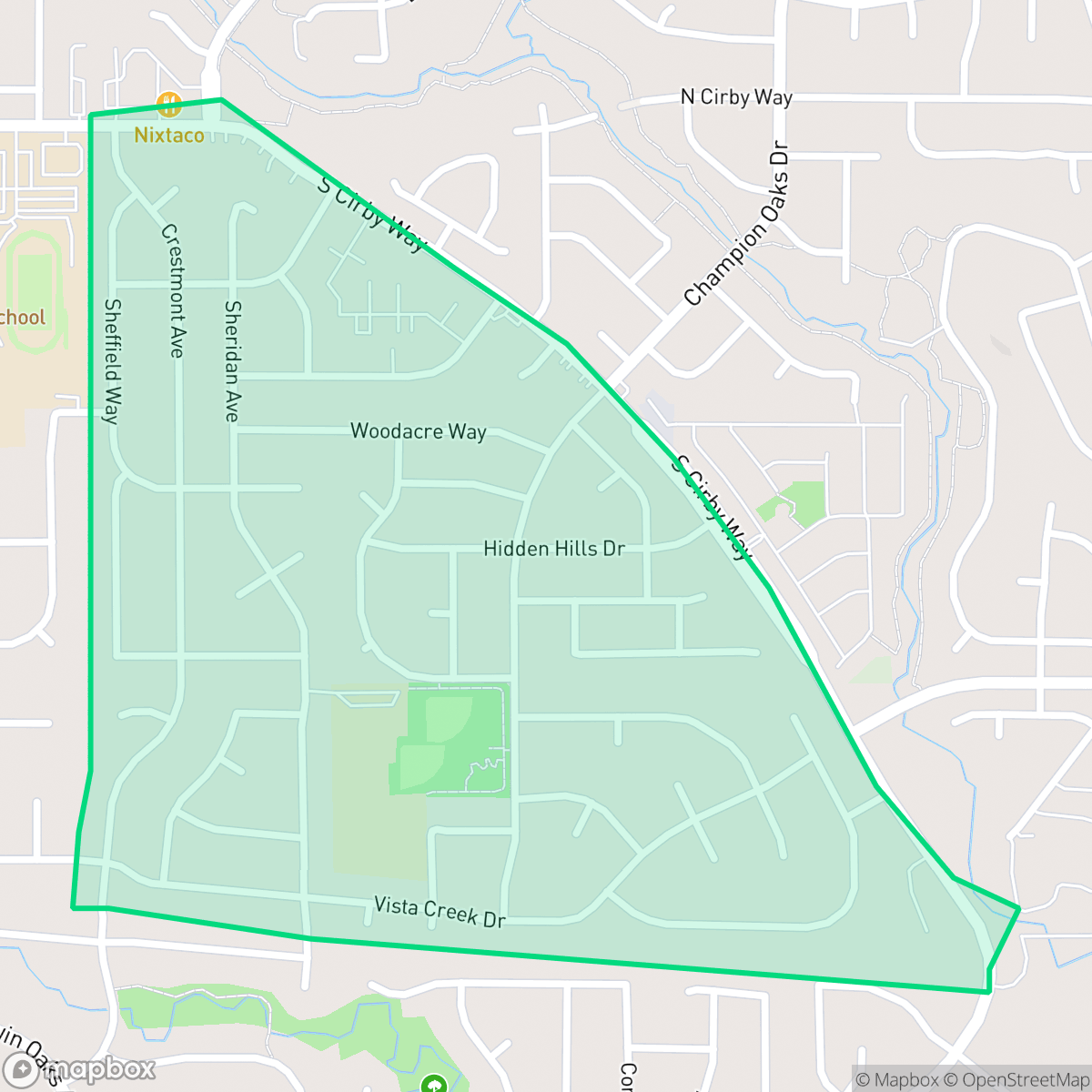
About South Cirby
The South Cirby neighborhood in Roseville, California, is named after George Kirk Cirby, a prominent 1860s pioneer who operated the 800-acre High Sierra View Ranch and a large dairy business in the area. Historically, the juncture of today’s South Cirby Way and Old Auburn Road was home to the Half Way House (or 18 Mile House), a vital stagecoach and express stop on the Sacramento-Auburn Road during the post-Gold Rush era. The historic ranch lands were later transformed into suburban housing tracts built primarily between 1970 and 1999. Today, the neighborhood's historical footprint is marked by Oakmont High School, which sits on the former Cirby ranch site, and the nearby George K. Cirby Elementary School.
The neighborhood is characterized by a classic suburban layout featuring single-family homes, manicured driveways, and a notable absence of industrial hazards. According to iHuus data, the area boasts a high walkability score, supported by comprehensive sidewalk networks and pedestrian-friendly intersections that connect the community to local parks and residential amenities. Residents enjoy a tranquil environment with minimal noise pollution, as acoustic levels remain steady at approximately 54 decibels.
While the area provides a high degree of visual appeal and residential comfort, it maintains a low-key vibe with limited nightlife or entertainment options. It is best suited for families and individuals who value a quiet, predictable setting over high-density commercial activity. With reliable access to local schools and a focus on community-oriented greenbelts, the area serves as a functional, long-term residential base for those seeking a balance between suburban convenience and a slower pace of life.
Neighborhood Scores Across 15 Qualities
Residential spacing provides a moderate level of separation between homes, offering slightly more buffer between neighbors than the Roseville average. Houses typically feature fenced yards with standard suburban spacing according to iHuus data.
Comprehensive sidewalk networks and frequent pedestrian crossings make navigating the area on foot easy. According to iHuus data, the connectivity and pedestrian priority here are notably higher than the Roseville average.
Large homes, private pools, and well-manicured landscapes characterize this area. According to iHuus data, the visual quality of the neighborhood sits above the Roseville average.
Expansive central greenbelts and wide residential parkways provide ample space for pets. According to iHuus data, these connected trails and safe paths offer a higher level of dog friendliness than the Roseville average.
Traditional suburban layouts dominate this area, featuring a mix of single-family homes and residential complexes similar to the broader Roseville area. While some open land remains, the neighborhood primarily consists of established residential and commercial zones.
Suburban streets and green spaces dominate this area, which offers a serene atmosphere but lacks a central commercial hub. According to iHuus data, the local energy is lower than the Roseville average, as most essential services and dining options require driving to reach.
Steady traffic sounds from a nearby busy street are present, though acoustic comfort remains higher than the Roseville average according to iHuus data.
Air quality in this area fluctuates between acceptable and unhealthy levels, mirroring the typical conditions found throughout Roseville. Sensitive groups should remain aware of occasional days when air pollution may pose a concern.
Industrial presence is non-existent here, as the area consists strictly of residential streets and open green spaces. This lack of heavy industry or warehouses makes the neighborhood even more secluded from industrial activity than the Roseville average, according to iHuus data.
Health insurance access is widespread among residents, performing nearly in line with the Roseville average according to iHuus data.
Conservative voters hold a clear majority in this area, representing a more right-leaning political landscape than the Roseville average according to iHuus data.
Residents will find a balanced demographic spread of young adults, families, and older individuals. This age profile is slightly more varied than the average found across Roseville.
Residual flood risks exist within this area due to its location in a 500-year floodplain, though safety levels remain higher than the Roseville average according to iHuus data.
Address-Level Insights for South Cirby


iHuus Neighborhood Intelligence Insights
Get address-level neighborhood insights for South Cirby
- Street-level scores — see how individual blocks compare, not just neighborhood averages
- Micro-zone boundaries — identify quiet pockets, flood boundaries, and walkable clusters before you visit
- 15 dimensions in full — walkability, noise, air quality, school quality, insurance coverage, population age profile, urban/rural index, and more
- Boundary risk alerts — know if your address sits near a block boundary where scores drop, the kind of detail no listing will ever mention
- School insights — individual school ratings and insights, not just district-level data
- Compare before you commit — side-by-side data across neighborhoods, down to block precision
No credit card required
Compare with Any Neighborhood
| Dimension | South Cirby | Blue Oaks |
|---|---|---|
| 🚶 Walkabilityavg 8.87 | ||
| 🔊 Acoustic Comfortavg 4.32 | ||
| 🤫 Privacy Indexavg 5.7 | ||
| 🎨 Visual Appealavg 7.58 | ||
| 🐕 Dog Friendlinessavg 7.74 | ||
| 🗺️ Urban-Rural Indexavg 6.82 | ||
| ✨ Neighborhood Vibeavg 4.77 | ||
| 🏥 Health Insurance Coverageavg 8.58 | ||
| 🌿 Air Qualityavg 6 | ||
| 🏭 Industrial Proximityavg 8.8 | ||
| 🌊 Flood Safetyavg 5.72 | ||
| 🗳️ Ideological Leanavg 3.68 | ||
| 👥 Population Age Profileavg 5.05 | ||
| 🔥 Fire Safetyavg 0.15 | ||
| 🏫 School Quality |
South Cirby Rankings
School Districts Serving South Cirby
School Insights for South Cirby
Below average outcomes; significant attendance and academic challenges.
School Insights
See what's really behind every school rating near South Cirby
- Individual school ratings — each school's own score with outcome context, not just a district average
- Enrollment & class size data — student-to-teacher ratio and how it compares to the state average
- Full demographics breakdown — ethnicity and gender composition for every school in the enrollment zone
- Every school in the district — all schools within the enrollment boundary ranked by rating, not just the closest one
- Grade levels & benchmarks — elementary through high school, with below/above state-average flags
No credit card required