Sierra Vista, Roseville
Updated · 1,678 residents
Sierra Vista is a historic residential neighborhood in Roseville known for its high walkability and active community atmosphere. Residents enjoy proximity to local parks and schools, all balanced within a setting that maintains a distinct suburban character.
Key Highlights
About Sierra Vista
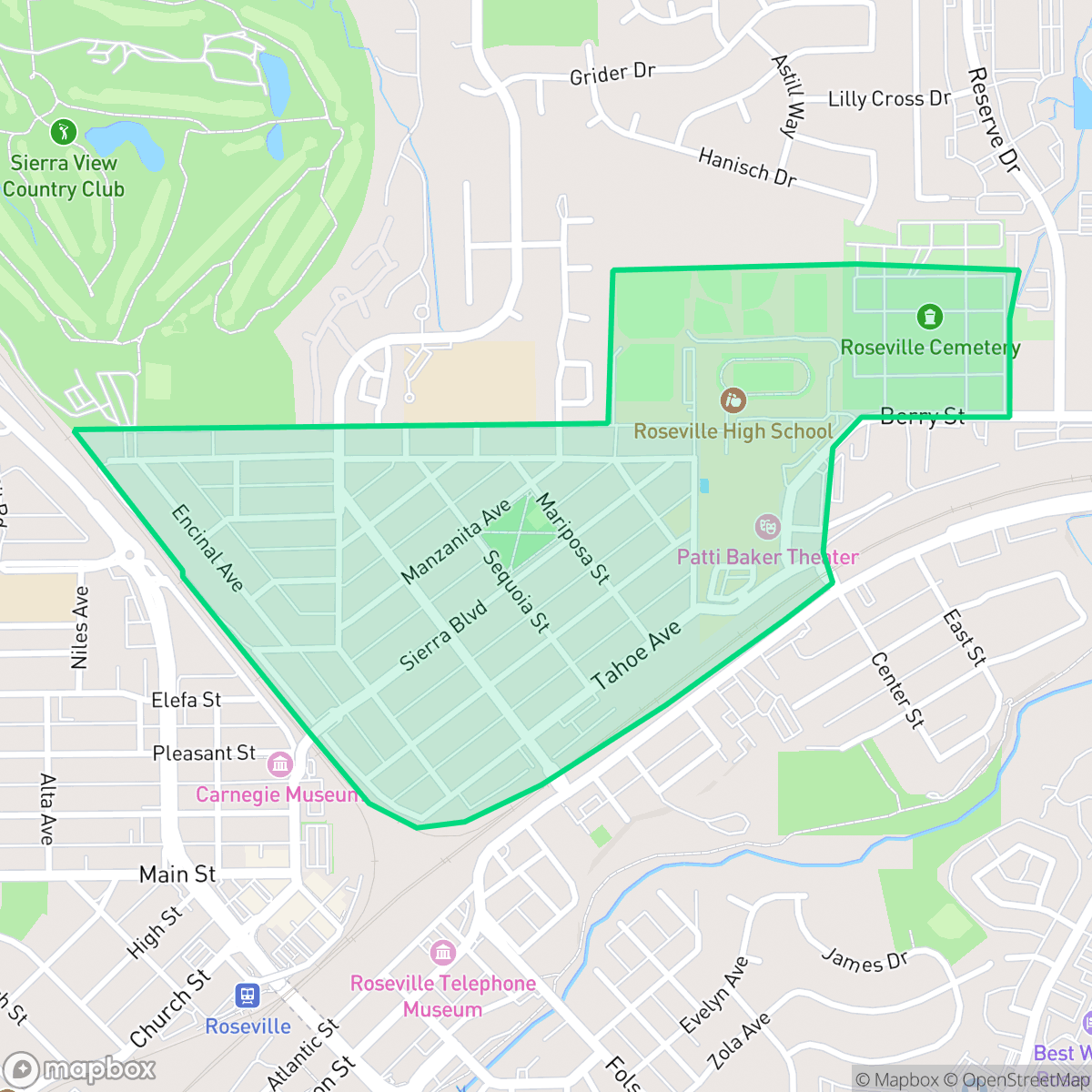
Sierra Vista is one of Roseville’s oldest residential neighborhoods, originally established as a subdivision to house workers for the nearby Southern Pacific Railroad yards. The neighborhood’s connection to the historic downtown was solidified in 1907 with a wooden footbridge, which was replaced in 1929 by the concrete Sierra Vista Bridge (locally known as the “Crooked Bridge” or “Rainbow Bridge”). The neighborhood is characterized by its historic housing stock, including 1930s Mission-style homes, and is home to Roseville High School, which has served as a cornerstone of the local community for generations.
The neighborhood functions as a central residential hub, characterized by a blend of established housing and accessible green spaces such as Woodbridge Park. It maintains a moderate level of activity, supported by local social institutions and a layout that encourages pedestrian movement. While the area offers convenient access to essential services and community gathering spots, it retains a residential feel that distinguishes it from the more commercialized parts of the city.
Prospective residents should note that the area experiences moderate noise levels, primarily due to road traffic and nearby railway operations. While the community benefits from robust educational options through the local school districts, homeowners should be aware of the specific environmental risks, particularly regarding fire safety. The neighborhood is well-suited for those who value a central location with a strong sense of history and community engagement.
Neighborhood Scores Across 15 Qualities
Residential spacing is slightly higher than the Roseville average, though some areas feature closely packed homes with small setbacks. According to iHuus data, neighbors are separated by moderate buffers.
Sidewalks and clear pedestrian crossings are available on residential streets, though the area is slightly less walkable than the Roseville average. According to iHuus data, the network of paths is consistent but less comprehensive than other parts of the city.
Residential views primarily consist of standard middle-class housing with small yards and occasional backyard pools. This level of visual variety is below the Roseville average.
Continuous sidewalks with grassy verges and proximity to the Roebbelen Center grounds provide safe walking routes. According to iHuus data, the area offers slightly fewer connected green spaces than the Roseville average.
Open land and scattered greenery are present alongside suburban developments, though the area is slightly less rural than the Roseville average. Residents will find a mix of dense residential clusters and nearby utility or industrial zones.
A variety of local dining, arts, and parks create a more active atmosphere than the Roseville average. While the area features social hubs and amenities, the car-dependent layout means most destinations require driving.
Steady noise from nearby busy streets is present, though acoustic levels remain more tranquil than the average found across Roseville. According to iHuus data, the area experiences a consistent hum of local traffic.
Air quality in this area fluctuates between acceptable and unhealthy levels, presenting occasional concerns for sensitive groups. This level of air quality is consistent with the average found across Roseville.
Light commercial activity and nearby logistics yards are present, making industrial proximity higher than the Roseville average. Residents may encounter occasional traffic and noise from nearby electrical substations and highway interchanges, according to iHuus data.
Health insurance access is lower in this area compared to the Roseville average, according to iHuus data.
Political leanings in this area are evenly split between conservative and liberal residents, mirroring the broader Roseville area. According to iHuus data, no single ideological group holds a significant majority.
Residents will experience a demographic blend of young adults, families, and seniors. This age distribution is roughly in line with the average found across Roseville.
Flood risk levels in this area are slightly above the Roseville average, though a lack of detailed FEMA studies means specific vulnerabilities remain undetermined. Residents should note that according to iHuus data, the area lacks a comprehensive flood study for precise risk assessment.
Address-Level Insights for Sierra Vista


iHuus Neighborhood Intelligence Insights
Get address-level neighborhood insights for Sierra Vista
- Street-level scores — see how individual blocks compare, not just neighborhood averages
- Micro-zone boundaries — identify quiet pockets, flood boundaries, and walkable clusters before you visit
- 15 dimensions in full — walkability, noise, air quality, school quality, insurance coverage, population age profile, urban/rural index, and more
- Boundary risk alerts — know if your address sits near a block boundary where scores drop, the kind of detail no listing will ever mention
- School insights — individual school ratings and insights, not just district-level data
- Compare before you commit — side-by-side data across neighborhoods, down to block precision
No credit card required
Compare with Any Neighborhood
| Dimension | Sierra Vista | Blue Oaks |
|---|---|---|
| 🚶 Walkabilityavg 8.87 | ||
| 🔊 Acoustic Comfortavg 4.32 | ||
| 🤫 Privacy Indexavg 5.7 | ||
| 🎨 Visual Appealavg 7.58 | ||
| 🐕 Dog Friendlinessavg 7.74 | ||
| 🗺️ Urban-Rural Indexavg 6.82 | ||
| ✨ Neighborhood Vibeavg 4.77 | ||
| 🏥 Health Insurance Coverageavg 8.58 | ||
| 🌿 Air Qualityavg 6 | ||
| 🏭 Industrial Proximityavg 8.8 | ||
| 🌊 Flood Safetyavg 5.72 | ||
| 🗳️ Ideological Leanavg 3.68 | ||
| 👥 Population Age Profileavg 5.05 | ||
| 🔥 Fire Safetyavg 0.15 | ||
| 🏫 School Quality |
Sierra Vista Rankings
School Districts Serving Sierra Vista
School Insights for Sierra Vista
Below average outcomes; significant attendance and academic challenges.
School Insights
See what's really behind every school rating near Sierra Vista
- Individual school ratings — each school's own score with outcome context, not just a district average
- Enrollment & class size data — student-to-teacher ratio and how it compares to the state average
- Full demographics breakdown — ethnicity and gender composition for every school in the enrollment zone
- Every school in the district — all schools within the enrollment boundary ranked by rating, not just the closest one
- Grade levels & benchmarks — elementary through high school, with below/above state-average flags
No credit card required