Lead Hill, Roseville
Updated · 1,275 residents
Lead Hill is a primary commercial and medical hub in Roseville, defined by its dense retail corridors and convenient access to major transit routes. While the area offers a wide variety of dining options and high-quality local services, residents should expect significant road noise and a car-dependent environment.
Key Highlights
About Lead Hill
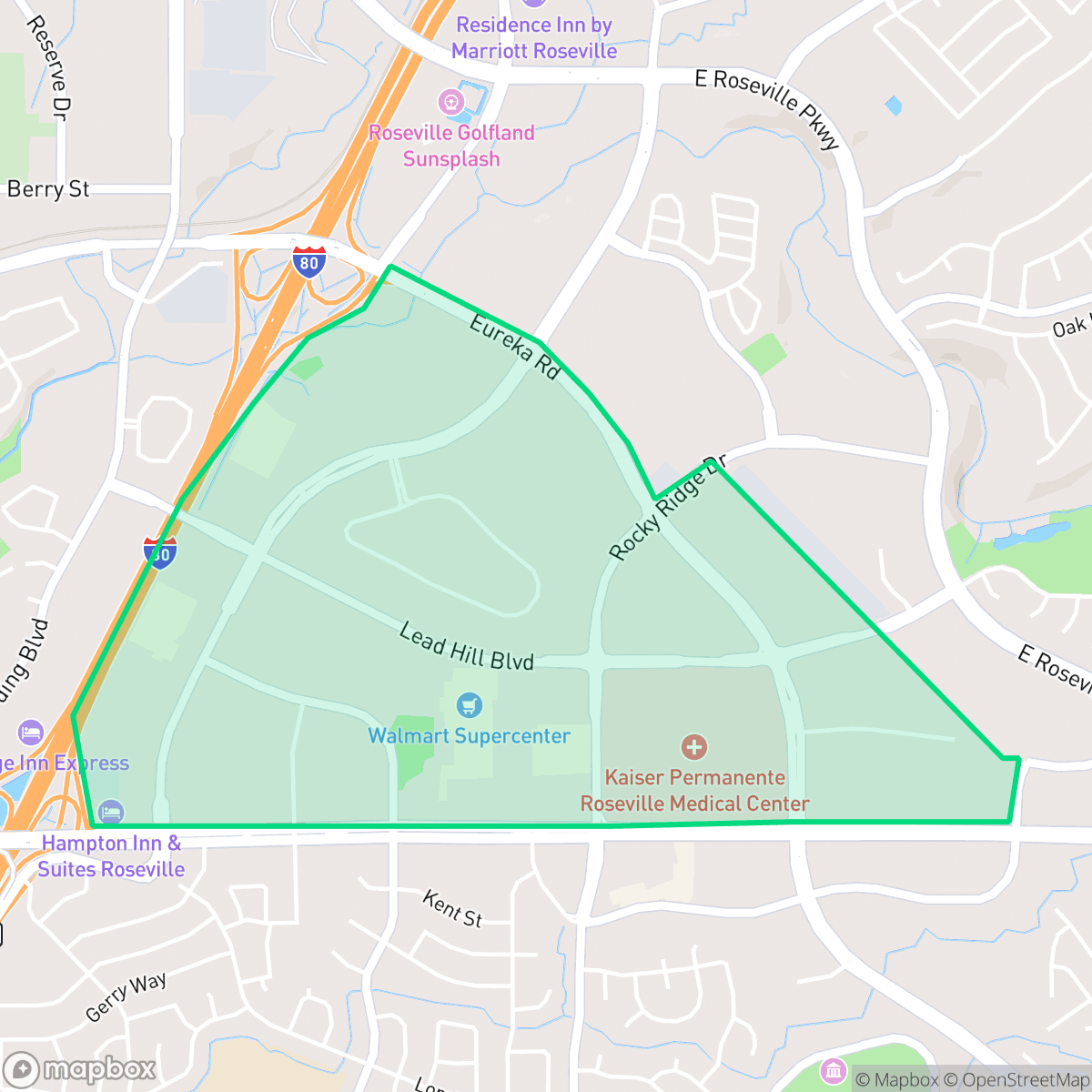
Once part of the vast Johnson family sheep ranch east of Interstate 80, the Lead Hill neighborhood in Roseville, California, transitioned from rural open space to a major commercial corridor. Historically, the area was a popular local spot for hunting dove, quail, and pheasants. Lead Hill Road itself earned its name because residents frequently used the hillside to sight their rifles, a practice banned in the 1960s as suburban growth began. Early development faced a major obstacle when builders hit a massive underground lava cap. Standard blasting was prohibited by the city, but developer Bill Stranch bypassed the issue by clearing the stubborn rock using an 80-ton tractor—the largest of its era. Today, Lead Hill has evolved into a premier retail and medical office hub along the Douglas Boulevard corridor.
The area serves as a central node for commerce and healthcare along the Douglas Boulevard corridor. It features a high concentration of big-box retail, light industrial spaces, and professional offices that draw significant daytime traffic. Despite the intensity of its commercial activity, the neighborhood remains a practical choice for those prioritizing access to essential services and employment centers over quiet, residential seclusion.
Living here requires a reliance on personal vehicles, as the layout is designed for automotive traffic rather than pedestrian movement. According to iHuus data, the area experiences elevated noise levels primarily from nearby highway activity, which is a key trade-off for its central location. However, families benefit from proximity to top-tier school districts, and the community maintains high levels of health insurance coverage, making it a stable environment for professionals and those seeking proximity to regional amenities.
Neighborhood Scores Across 15 Qualities
Residential spacing provides a moderate level of separation between neighbors, which is slightly higher than the Roseville average according to iHuus data.
Sidewalks are available on one side of the street and safe crossings are accessible, though the area is slightly less walkable than the Roseville average.
Large residential lots and frequent upscale amenities contribute to a high level of visual interest. According to iHuus data, the area's aesthetic quality is slightly above the Roseville average.
Connected green spaces and wide, traffic-safe paths make this area slightly more dog friendly than the Roseville average, according to iHuus data.
Open land and scattered homes amidst woodlands define much of the area, though some sections feature dense commercial sprawl and large-scale retail structures. This landscape is slightly less rural than the Roseville average according to iHuus data.
Concentrated pockets of social activity and diverse dining options provide a much more active atmosphere than the Roseville average. While these local destinations offer a vibrant energy, much of the area remains car-dependent for accessing various restaurants and shops.
Frequent noise from nearby freeway and railroad corridors makes this area significantly louder than the Roseville average. Residents may experience more frequent auditory disturbances than those living in quieter parts of the city.
Air quality levels in Lead Hill typically fluctuate between acceptable and unhealthy, presenting occasional concerns for sensitive groups. This consistency with the Roseville average means residents can expect similar atmospheric conditions to the rest of the city.
Industrial activity is nonexistent in this area, providing a cleaner environment than the Roseville average. Residents can expect a lack of heavy warehouses, logistics hubs, or hazardous industrial sites near their homes.
Health insurance access among residents is notably lower than the Roseville average, according to iHuus data.
Political views within this area are relatively balanced between conservative and liberal leaning residents, representing a slightly more even split than the Roseville average according to iHuus data.
Residents live among a varied demographic of young adults, families, and seniors. This age distribution is slightly more concentrated around middle-aged groups than the Roseville average, according to iHuus data.
Properties in this area are situated within a designated floodplain, which presents a higher risk of flooding than the Roseville average. According to iHuus data, residents may find that flood insurance is a typical requirement for homes in this neighborhood.
Address-Level Insights for Lead Hill


iHuus Neighborhood Intelligence Insights
Get address-level neighborhood insights for Lead Hill
- Street-level scores — see how individual blocks compare, not just neighborhood averages
- Micro-zone boundaries — identify quiet pockets, flood boundaries, and walkable clusters before you visit
- 15 dimensions in full — walkability, noise, air quality, school quality, insurance coverage, population age profile, urban/rural index, and more
- Boundary risk alerts — know if your address sits near a block boundary where scores drop, the kind of detail no listing will ever mention
- School insights — individual school ratings and insights, not just district-level data
- Compare before you commit — side-by-side data across neighborhoods, down to block precision
No credit card required
Compare with Any Neighborhood
| Dimension | Lead Hill | Blue Oaks |
|---|---|---|
| 🚶 Walkabilityavg 8.87 | ||
| 🔊 Acoustic Comfortavg 4.32 | ||
| 🤫 Privacy Indexavg 5.7 | ||
| 🎨 Visual Appealavg 7.58 | ||
| 🐕 Dog Friendlinessavg 7.74 | ||
| 🗺️ Urban-Rural Indexavg 6.82 | ||
| ✨ Neighborhood Vibeavg 4.77 | ||
| 🏥 Health Insurance Coverageavg 8.58 | ||
| 🌿 Air Qualityavg 6 | ||
| 🏭 Industrial Proximityavg 8.8 | ||
| 🌊 Flood Safetyavg 5.72 | ||
| 🗳️ Ideological Leanavg 3.68 | ||
| 👥 Population Age Profileavg 5.05 | ||
| 🔥 Fire Safetyavg 0.15 | ||
| 🏫 School Quality |
Lead Hill Rankings
School Districts Serving Lead Hill
School Insights for Lead Hill
Below average outcomes; significant attendance and academic challenges.
School Insights
See what's really behind every school rating near Lead Hill
- Individual school ratings — each school's own score with outcome context, not just a district average
- Enrollment & class size data — student-to-teacher ratio and how it compares to the state average
- Full demographics breakdown — ethnicity and gender composition for every school in the enrollment zone
- Every school in the district — all schools within the enrollment boundary ranked by rating, not just the closest one
- Grade levels & benchmarks — elementary through high school, with below/above state-average flags
No credit card required