Johnson Ranch, Roseville
Updated · 5,374 residents
Johnson Ranch is a well-established Roseville community defined by its blend of Mediterranean-style homes and extensive pedestrian infrastructure. Residents benefit from high walkability and proximity to significant green spaces, making it a functional choice for those prioritizing outdoor access and suburban convenience.
Key Highlights
About Johnson Ranch
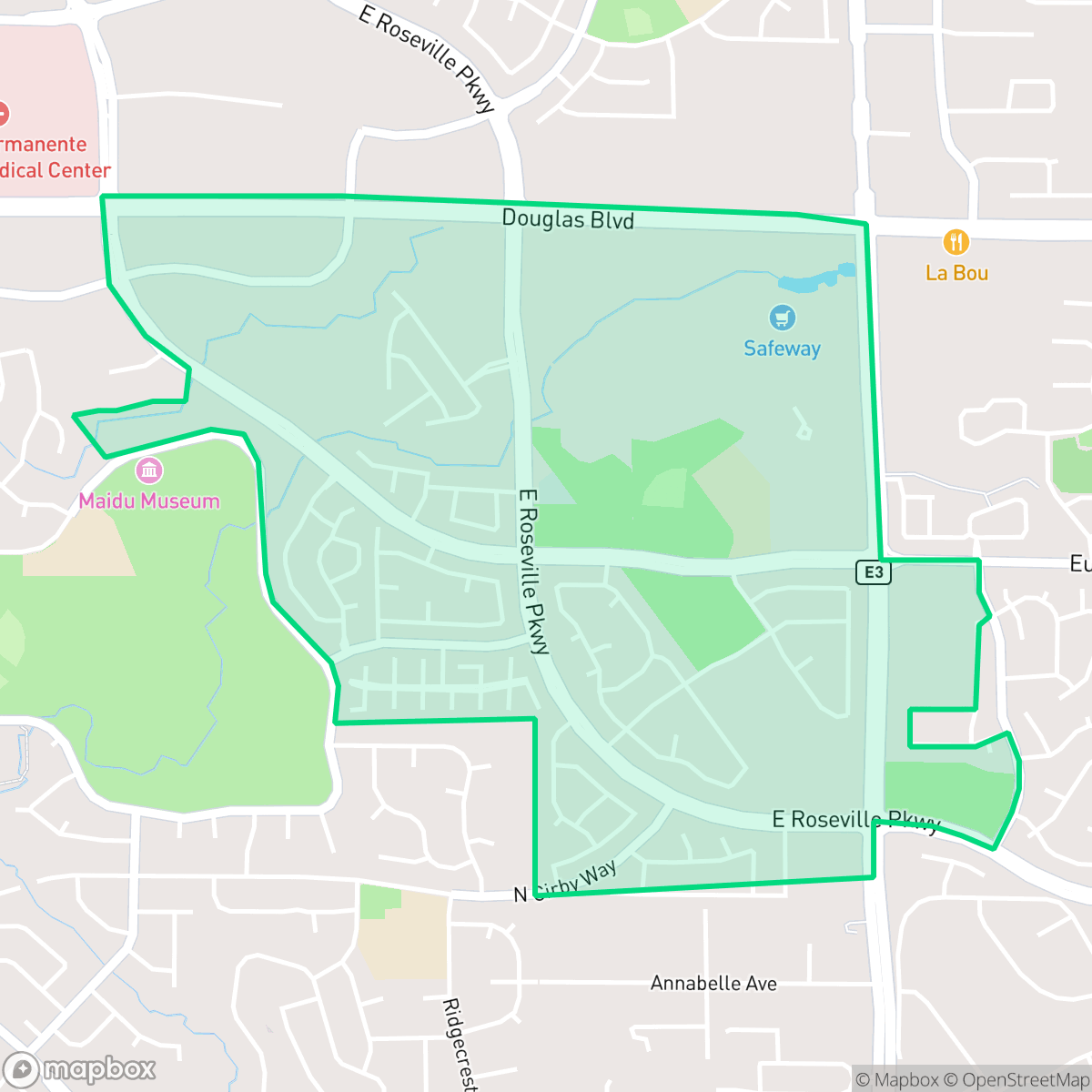
The Johnson Ranch neighborhood in Roseville, California, traces its origins to a massive 2,000-acre sheep ranch established in 1905 by William Johnson, a former Mormon Island miner. Over the decades, the ranch expanded to encompass much of what is now the busy Douglas Boulevard corridor. Developed into a master-planned community in the mid-1990s, the neighborhood features single-family homes, many built in bungalow and Mediterranean styles. A defining cultural and historical anchor of the area is Maidu Regional Park, built adjacent to ancient historic sites where Maidu Native Americans lived thousands of years ago, featuring preserved petroglyphs, historic trails, and the Maidu Museum & Historic Site. Today, the neighborhood's modern character is also defined by the prominent Johnson Ranch Racquet Club, a sprawling 24-acre fitness and tennis facility.
The area maintains a dense suburban character, characterized by single-family homes and integrated commercial corridors that provide residents with daily necessities. The neighborhood layout features consistent sidewalks and pedestrian paths, facilitating easy access to local retail and fitness facilities. With abundant greenbelts and proximity to regional recreational sites, the environment supports an active lifestyle for residents who value well-connected suburban living, according to iHuus data.
While the neighborhood offers high walkability, prospective residents should consider that the area experiences moderate noise levels from road traffic, which is a common feature of its suburban placement. Privacy varies by location, as homes are situated in relatively close proximity to one another. The area is well-suited for families and professionals who prioritize access to highly-rated local school districts and a balanced, activity-oriented community environment.
Neighborhood Scores Across 15 Qualities
Residential spacing varies between single-family homes with small yards and denser apartment clusters. According to iHuus data, this level of separation is slightly higher than the Roseville average.
Extensive sidewalks and clear pedestrian paths connect residential streets to local commercial centers. According to iHuus data, this area offers more accessible routes for pedestrians than the Roseville average.
Large homes featuring private pools, multi-car garages, and extensive tennis facilities characterize the area. This high level of visual polish and amenity density sits above the Roseville average, according to iHuus data.
Extensive greenbelts and wide, grassy verges provide safe, continuous paths for exercise. According to iHuus data, these connected open spaces offer a higher level of pet-friendly infrastructure than the Roseville average.
Open land and scattered homes provide a semi-rural feel that is slightly less developed than the typical Roseville landscape. According to iHuus data, the area features a mix of woodland and field settings integrated with suburban elements.
A noticeable concentration of social and leisure hubs provides more activity than the typical Roseville neighborhood. Residents can access various dining and wellness destinations via walkable paths through a mix of residential streets and green spaces.
Local traffic from a nearby busy street creates a continuous background noise. This level of acoustic activity is slightly higher than the average found across Roseville.
Air quality levels typically fluctuate between acceptable and unhealthy periods, which may cause occasional concern for sensitive groups. According to iHuus data, these conditions are consistent with the average found throughout Roseville.
Residential and recreational uses dominate the area with an absence of warehouses or heavy machinery. This lack of industrial activity is notably higher than the Roseville average, according to iHuus data.
Health insurance access is widespread among residents, though slightly lower than the average seen across Roseville. According to iHuus data, a significant majority of the population maintains coverage.
Conservative viewpoints represent the majority of the community, though a modest opposing presence exists. This political landscape is largely consistent with the broader Roseville area according to iHuus data.
A diverse range of age groups resides here, offering a more varied demographic spread than the typical Roseville profile. According to iHuus data, the population includes a balanced distribution of young adults, families, and older residents.
Flood risk in this area is slightly above the Roseville average, though a detailed federal study for this specific location has not yet been completed. Residents should remain aware of potential moisture concerns during heavy rain events according to iHuus data.
Address-Level Insights for Johnson Ranch


iHuus Neighborhood Intelligence Insights
Get address-level neighborhood insights for Johnson Ranch
- Street-level scores — see how individual blocks compare, not just neighborhood averages
- Micro-zone boundaries — identify quiet pockets, flood boundaries, and walkable clusters before you visit
- 15 dimensions in full — walkability, noise, air quality, school quality, insurance coverage, population age profile, urban/rural index, and more
- Boundary risk alerts — know if your address sits near a block boundary where scores drop, the kind of detail no listing will ever mention
- School insights — individual school ratings and insights, not just district-level data
- Compare before you commit — side-by-side data across neighborhoods, down to block precision
No credit card required
Compare with Any Neighborhood
| Dimension | Johnson Ranch | Blue Oaks |
|---|---|---|
| 🚶 Walkabilityavg 8.87 | ||
| 🔊 Acoustic Comfortavg 4.32 | ||
| 🤫 Privacy Indexavg 5.7 | ||
| 🎨 Visual Appealavg 7.58 | ||
| 🐕 Dog Friendlinessavg 7.74 | ||
| 🗺️ Urban-Rural Indexavg 6.82 | ||
| ✨ Neighborhood Vibeavg 4.77 | ||
| 🏥 Health Insurance Coverageavg 8.58 | ||
| 🌿 Air Qualityavg 6 | ||
| 🏭 Industrial Proximityavg 8.8 | ||
| 🌊 Flood Safetyavg 5.72 | ||
| 🗳️ Ideological Leanavg 3.68 | ||
| 👥 Population Age Profileavg 5.05 | ||
| 🔥 Fire Safetyavg 0.15 | ||
| 🏫 School Quality |
Johnson Ranch Rankings
School Districts Serving Johnson Ranch
School Insights for Johnson Ranch
Below average outcomes; significant attendance and academic challenges.
School Insights
See what's really behind every school rating near Johnson Ranch
- Individual school ratings — each school's own score with outcome context, not just a district average
- Enrollment & class size data — student-to-teacher ratio and how it compares to the state average
- Full demographics breakdown — ethnicity and gender composition for every school in the enrollment zone
- Every school in the district — all schools within the enrollment boundary ranked by rating, not just the closest one
- Grade levels & benchmarks — elementary through high school, with below/above state-average flags
No credit card required