Galleria, Roseville
Updated · 473 residents
The Galleria neighborhood serves as a primary retail and residential destination in Roseville, defined by its high-density commercial corridors and suburban housing. While it offers immediate access to major shopping centers, the area is notably loud due to road traffic and remains heavily dependent on personal vehicles for daily errands.
Key Highlights
About Galleria
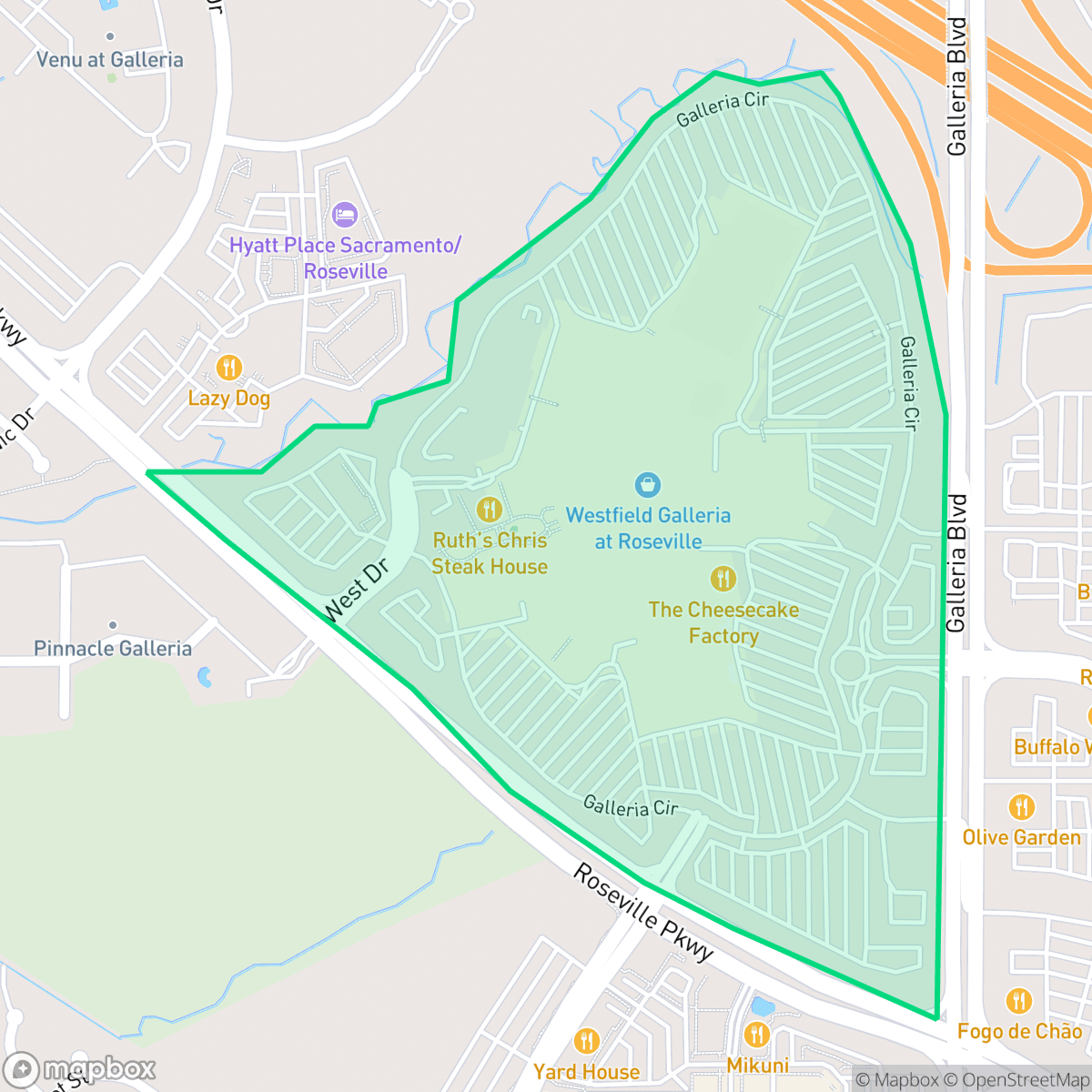
Centering on the Westfield Galleria at Roseville, the Galleria neighborhood transformed from open land into a premier regional retail and residential hub at the turn of the 21st century. Originally envisioned for neighboring Rocklin, plans for the massive shopping complex were approved by Roseville in 1995, culminating in the mall's grand opening on August 25, 2000. This milestone catalyzed rapid suburban development, with a significant portion of the neighborhood’s residential housing stock—primarily single-family homes and luxury condominiums like the Villages of the Galleria—constructed during the 1990s and 2000s. Today, the neighborhood is defined by its walkable, high-end commercial corridors, including the adjacent outdoor shopping center, The Fountains at Roseville, which hosts local community events and weekly farmers' markets.
The area functions as a central hub for regional commerce, blending modern residential developments with extensive retail infrastructure. Residents benefit from proximity to major shopping destinations like The Fountains and the Westfield Galleria, which contribute to a lively daytime atmosphere. According to iHuus data, the neighborhood maintains a moderate level of visual appeal and provides a stable environment for those prioritizing convenience over quiet seclusion.
Living here involves specific trade-offs, particularly regarding acoustic comfort and transit independence. The area experiences elevated noise levels from road traffic, and its walkability is lower than the Roseville city average, making it a car-centric environment. While it offers excellent access to top-tier schools within the Roseville Joint Union High School District, prospective residents should note the lower scores for dog friendliness and health insurance coverage. It is best suited for individuals who value proximity to amenities and retail services over a traditional, quiet suburban lifestyle.
Neighborhood Scores Across 15 Qualities
Residential spacing offers a moderate level of separation between neighbors, which is slightly higher than the Roseville average according to iHuus data.
Quiet streets allow for casual walking, but the lack of sidewalks makes this area significantly less walkable than the Roseville average, according to iHuus data.
Large residential lots and frequent upscale amenities define the area, though the overall visual appeal sits slightly below the Roseville average according to iHuus data.
Limited access to public parks and a lack of wide green verges make this area less ideal for dog owners compared to the Roseville average. According to iHuus data, walking pets within the neighborhood offers fewer natural recreational opportunities.
Large-scale retail corridors and expansive parking lots are interspersed with pockets of open land, making the area slightly less rural than the Roseville average according to iHuus data.
A diverse range of dining options and social hubs creates a more active environment than the Roseville average. While many areas feature a mix of green space and amenities, much of the neighborhood remains car-dependent.
Constant noise from nearby freeway and railroad traffic defines the acoustic environment here. This level of disturbance is significantly higher than the Roseville average, according to iHuus data.
Air quality in Galleria fluctuates between acceptable and unhealthy levels. According to iHuus data, these conditions are consistent with the average levels found throughout Roseville.
Light industrial and heavy truck-related retail are present alongside residential areas, making the industrial presence higher than the Roseville average. Residents may encounter more daytime commercial traffic and visual noise from nearby utility infrastructure, according to iHuus data.
Health insurance access in this area is notably lower than the Roseville average, according to iHuus data.
Political perspectives in this area are split relatively evenly between conservative and liberal leanings. This creates a more moderate ideological landscape than the broader Roseville average, according to iHuus data.
Residents live alongside a varied mix of young adults, families, and seniors. According to iHuus data, this population distribution is slightly less balanced than the Roseville city average.
Flood risk in this area is notably higher than the Roseville average due to a lack of detailed FEMA flood studies for this specific location. Residents should consider this undetermined risk when evaluating property long-term stability, according to iHuus data.
Address-Level Insights for Galleria


iHuus Neighborhood Intelligence Insights
Get address-level neighborhood insights for Galleria
- Street-level scores — see how individual blocks compare, not just neighborhood averages
- Micro-zone boundaries — identify quiet pockets, flood boundaries, and walkable clusters before you visit
- 15 dimensions in full — walkability, noise, air quality, school quality, insurance coverage, population age profile, urban/rural index, and more
- Boundary risk alerts — know if your address sits near a block boundary where scores drop, the kind of detail no listing will ever mention
- School insights — individual school ratings and insights, not just district-level data
- Compare before you commit — side-by-side data across neighborhoods, down to block precision
No credit card required
Compare with Any Neighborhood
| Dimension | Galleria | Blue Oaks |
|---|---|---|
| 🚶 Walkabilityavg 8.87 | ||
| 🔊 Acoustic Comfortavg 4.32 | ||
| 🤫 Privacy Indexavg 5.7 | ||
| 🎨 Visual Appealavg 7.58 | ||
| 🐕 Dog Friendlinessavg 7.74 | ||
| 🗺️ Urban-Rural Indexavg 6.82 | ||
| ✨ Neighborhood Vibeavg 4.77 | ||
| 🏥 Health Insurance Coverageavg 8.58 | ||
| 🌿 Air Qualityavg 6 | ||
| 🏭 Industrial Proximityavg 8.8 | ||
| 🌊 Flood Safetyavg 5.72 | ||
| 🗳️ Ideological Leanavg 3.68 | ||
| 👥 Population Age Profileavg 5.05 | ||
| 🔥 Fire Safetyavg 0.15 | ||
| 🏫 School Quality |
Galleria Rankings
School Districts Serving Galleria
School Insights for Galleria
Below average outcomes; significant attendance and academic challenges.
School Insights
See what's really behind every school rating near Galleria
- Individual school ratings — each school's own score with outcome context, not just a district average
- Enrollment & class size data — student-to-teacher ratio and how it compares to the state average
- Full demographics breakdown — ethnicity and gender composition for every school in the enrollment zone
- Every school in the district — all schools within the enrollment boundary ranked by rating, not just the closest one
- Grade levels & benchmarks — elementary through high school, with below/above state-average flags
No credit card required