Fiddyment Farm, Roseville
Updated · 3,643 residents
Fiddyment Farm is a highly walkable suburban community in Roseville characterized by its dense residential tracts and abundant open green spaces. The area offers a quiet, family-oriented atmosphere with excellent access to local schools and parks, though it maintains a limited commercial footprint.
Key Highlights
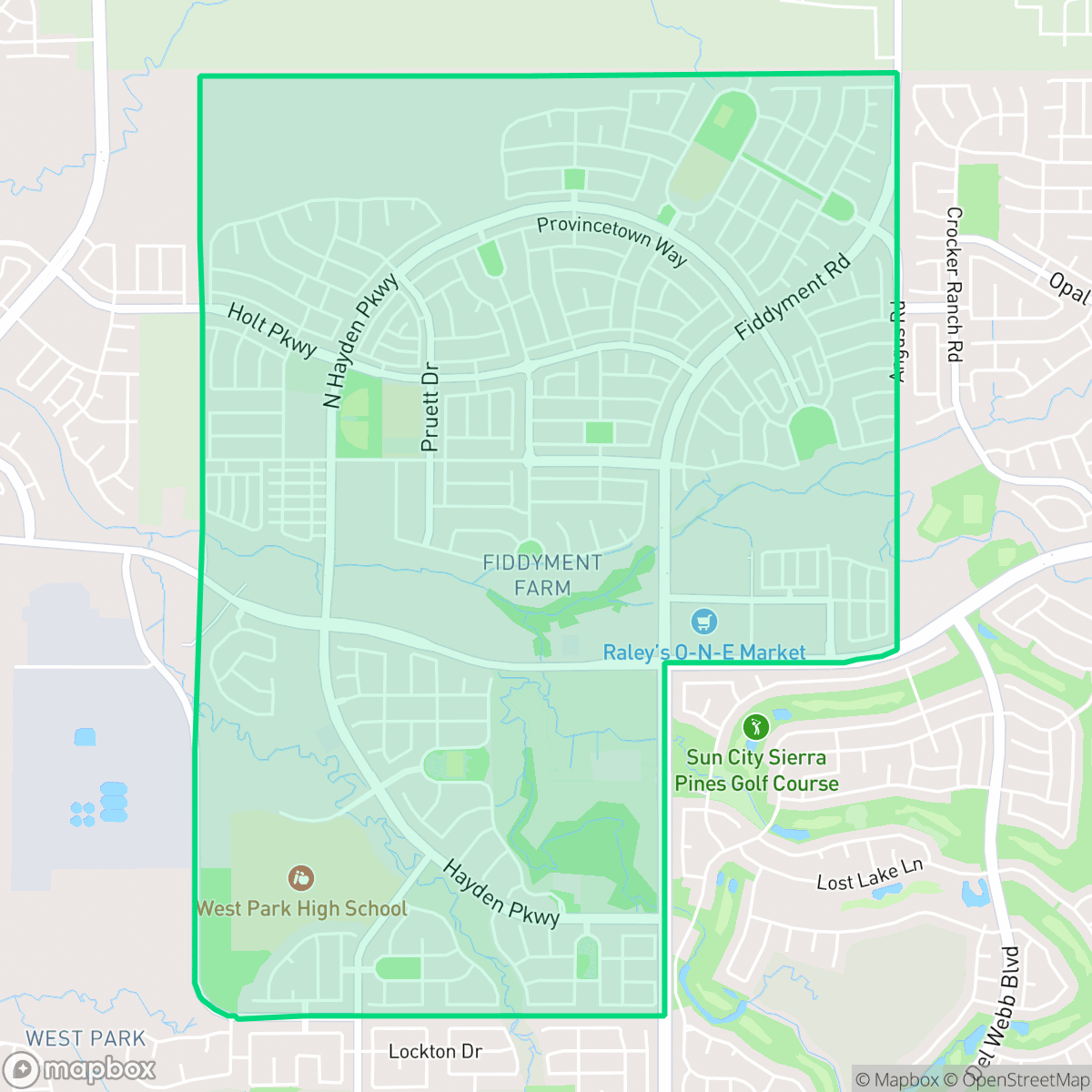
About Fiddyment Farm
The Fiddyment Farm neighborhood in Roseville is built on the historic Fiddyment Ranch, established in the 1850s by pioneer Elizabeth Jane Fiddyment. Her son, Walter Fiddyment Jr., expanded the holdings and, in 1879, constructed the ranch house with his father-in-law, master mason Augustus E. Bond. This homestead also features a historic brick cooler and smokehouse. For generations, the ranch was a major agricultural hub, producing grain, sheep, cattle, and commercial turkeys until the land was sold for suburban development in 2004. Today, the 0.85-acre Fiddyment Homestead site on Panther Place is listed on the National Register of Historic Places. The City of Roseville and the Roseville Historical Society are preserving the site to serve as a public park and living history museum.
Fiddyment Farm is a dense suburban community defined by its uniform residential tracts and expansive recreational infrastructure. The neighborhood prioritizes pedestrian access, with high walkability scores according to iHuus data, making it easy for residents to navigate between homes, schools, and local parks like Nichols Park. The environment is largely residential and institutional, focusing on family-oriented living rather than commercial density, which helps maintain a consistent, quiet atmosphere throughout the area.
While the area provides a serene setting, residents should note the limited local business presence, which results in a less active social scene. The neighborhood experiences low levels of ambient noise, though its suburban design means that essential services are often clustered or require short trips to reach. It is well-suited for those who value consistent school performance and a quiet environment, provided they are comfortable with the trade-offs of a lower commercial profile and specific regional fire safety considerations.
Neighborhood Scores Across 15 Qualities
Residential spacing is mixed, providing some buffer between neighbors. According to iHuus data, privacy levels in this area are consistent with the Roseville average.
Pedestrian infrastructure is exceptionally well-developed here, featuring wide sidewalks on both sides of the street and ample crossings. According to iHuus data, the area offers superior walkability compared to the Roseville average.
Large residential properties and frequent upscale amenities contribute to a landscape that is more visually polished than the Roseville average. According to iHuus data, the area features spacious driveways and well-maintained surroundings.
Connected green spaces and wide, low-traffic paths make this area more accommodating for dog owners than the Roseville average. According to iHuus data, the neighborhood provides safe environments for pet exercise and walking.
Frequent open land and scattered homes among fields or woodlands provide a semi-rural feel that is consistent with the Roseville average. Residents will find a mix of dense suburban tracts and larger open buffer zones throughout the area.
Primarily residential and serene, this area offers a low-density landscape with few commercial hubs. While some essential dining options are accessible, the neighborhood lacks the active social character found in more central parts of Roseville.
Continuous noise from nearby busy streets is a common feature here, which is consistent with the typical acoustic levels found throughout Roseville.
Air quality in this area is consistent with the Roseville average, though residents may experience occasional days with-unhealthy levels that could affect sensitive groups.
Industrial activity is virtually nonexistent here, providing a cleaner environment than the Roseville average. Residents will find only residential and institutional land uses, though minor utility structures like water tanks and a small substation are present.
Health insurance access is exceptionally high among residents here, significantly surpassing the Roseville average according to iHuus data.
Political leanings in this area are evenly split between conservative and liberal perspectives. This represents a more balanced ideological landscape than the broader Roseville area, according to iHuus data.
Residents experience a varied demographic mix of young adults, families, and seniors. According to iHuus data, the age distribution is more varied than the Roseville average.
Some residual flood risk exists within the area as it is situated in a 500-year floodplain, though this level of risk is higher than the Roseville average according to iHuus data.
Significant fire hazards exist within this area, representing a much higher risk level than the Roseville average. Residents should prioritize enhanced mitigation and preparedness measures according to iHuus data.
Address-Level Insights for Fiddyment Farm


iHuus Neighborhood Intelligence Insights
Get address-level neighborhood insights for Fiddyment Farm
- Street-level scores — see how individual blocks compare, not just neighborhood averages
- Micro-zone boundaries — identify quiet pockets, flood boundaries, and walkable clusters before you visit
- 15 dimensions in full — walkability, noise, air quality, school quality, insurance coverage, population age profile, urban/rural index, and more
- Boundary risk alerts — know if your address sits near a block boundary where scores drop, the kind of detail no listing will ever mention
- School insights — individual school ratings and insights, not just district-level data
- Compare before you commit — side-by-side data across neighborhoods, down to block precision
No credit card required
Compare with Any Neighborhood
| Dimension | Fiddyment Farm | Blue Oaks |
|---|---|---|
| 🚶 Walkabilityavg 8.87 | ||
| 🔊 Acoustic Comfortavg 4.32 | ||
| 🤫 Privacy Indexavg 5.7 | ||
| 🎨 Visual Appealavg 7.58 | ||
| 🐕 Dog Friendlinessavg 7.74 | ||
| 🗺️ Urban-Rural Indexavg 6.82 | ||
| ✨ Neighborhood Vibeavg 4.77 | ||
| 🏥 Health Insurance Coverageavg 8.58 | ||
| 🌿 Air Qualityavg 6 | ||
| 🏭 Industrial Proximityavg 8.8 | ||
| 🌊 Flood Safetyavg 5.72 | ||
| 🗳️ Ideological Leanavg 3.68 | ||
| 👥 Population Age Profileavg 5.05 | ||
| 🔥 Fire Safetyavg 0.15 | ||
| 🏫 School Quality |
Fiddyment Farm Rankings
School Districts Serving Fiddyment Farm
School Insights for Fiddyment Farm
Below average outcomes; significant attendance and academic challenges.
School Insights
See what's really behind every school rating near Fiddyment Farm
- Individual school ratings — each school's own score with outcome context, not just a district average
- Enrollment & class size data — student-to-teacher ratio and how it compares to the state average
- Full demographics breakdown — ethnicity and gender composition for every school in the enrollment zone
- Every school in the district — all schools within the enrollment boundary ranked by rating, not just the closest one
- Grade levels & benchmarks — elementary through high school, with below/above state-average flags
No credit card required