Diamond Oaks, Roseville
Updated · 5,044 residents
Diamond Oaks is a serene, suburban community defined by its exceptional acoustic comfort and high walkability. Residents benefit from easy access to local recreational amenities and green spaces, making it a quiet retreat within the greater Roseville area.
Key Highlights
About Diamond Oaks
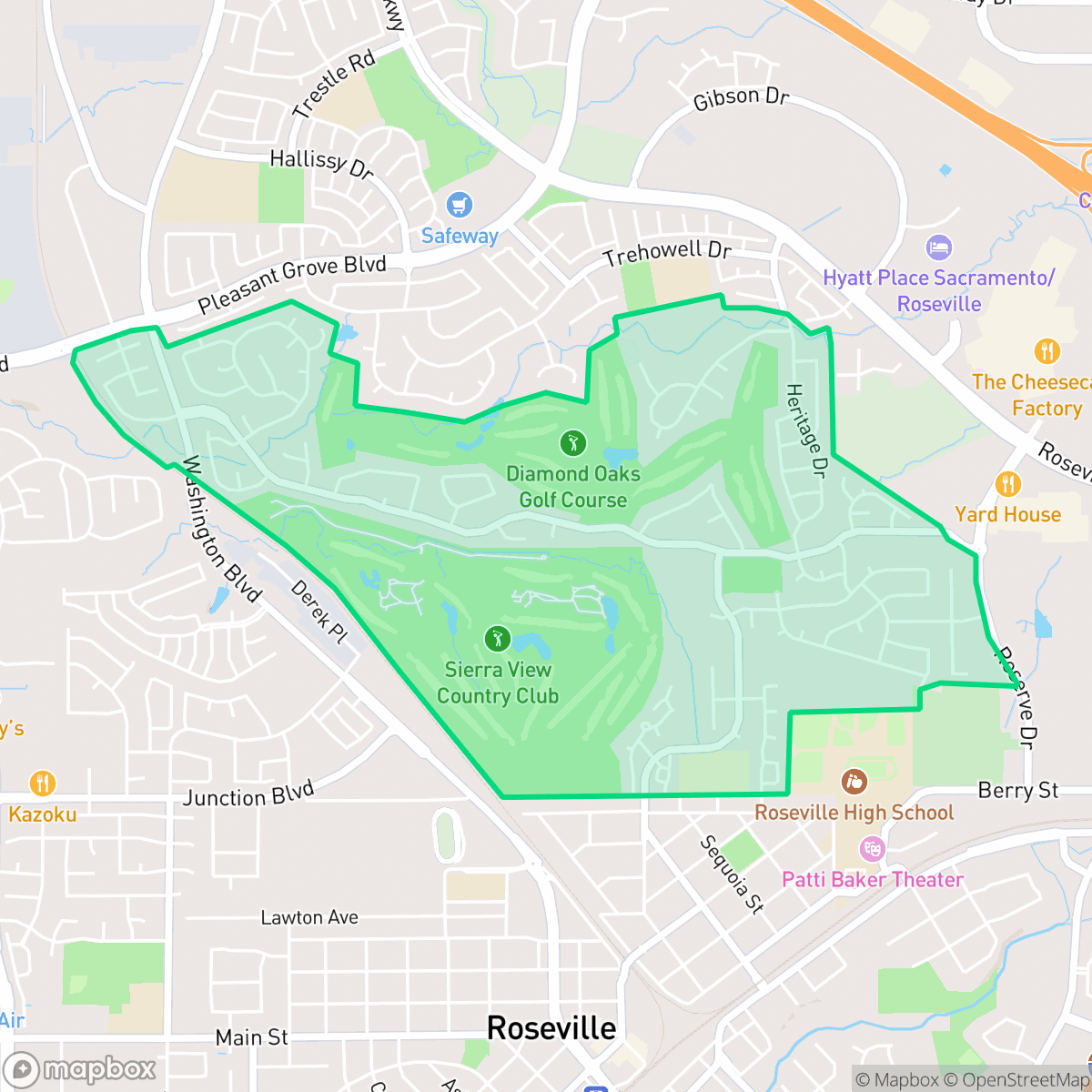
The Diamond Oaks neighborhood in Roseville, California, is a premier residential community centered around the municipal Diamond Oaks Golf Course, which opened in 1963 and was designed by renowned golf course architect Ted Robinson. The surrounding residential neighborhood began developing in the mid-1970s, establishing itself as one of Roseville's most exclusive enclaves of the era. Most homes were built between 1975 and 1985 on spacious custom lots sold individually, resulting in a diverse architectural landscape of custom single-family homes rather than uniform tract housing. Characterized by its rolling terrain, quiet streets, and namesake mature oak trees, the neighborhood maintains a distinct suburban elegance and remains highly sought after for its scenic golf course views and proximity to local landmarks like Diamond Oaks Park.
The area offers a tranquil environment characterized by a remarkably low noise profile, with average sound levels reaching only 48 decibels. According to iHuus data, the neighborhood achieves high marks for walkability and dog friendliness, providing residents with accessible paths that connect quiet residential blocks to local social hubs and parks. The landscape balances residential privacy with light commercial activity, ensuring that daily necessities remain within reach while maintaining a peaceful atmosphere.
Prospective residents will find a stable community supported by high-performing educational institutions, including the top-rated Roseville Joint Union High School District. While the area presents a high standard of living, it is important to consider regional environmental factors such as air quality and fire safety risks. The neighborhood is well-suited for families and individuals who prioritize a quiet, pedestrian-friendly lifestyle in a well-established suburban setting.
Neighborhood Scores Across 15 Qualities
Residential lots feature typical suburban spacing with some homes backing onto open space. This level of privacy is largely consistent with the rest of Roseville.
Sidewalks and clear crossings are readily available throughout the residential streets, though connectivity is slightly lower than the Roseville average according to iHuus data.
Large homes with private pools and manicured landscaping characterize much of this area, though the overall visual appeal sits slightly below the Roseville average according to iHuus data.
Abundant greenbelts, continuous sidewalks, and proximity to the Roebbelen Center grounds provide ample space for pets. According to iHuus data, the availability of interconnected open fields and parklands is on par with the Roseville average.
Planned residential tracts and commercial strips define the area, offering a suburban character that is very similar to the broader Roseville average.
A balanced mix of residential streets, light industrial units, and local dining establishments provides a consistent atmosphere that is nearly identical to the Roseville average. While some social hubs and parks are accessible via walkable paths, certain parts of the area remain car-dependent due to the proximity of railway corridors and warehouses.
Steady sounds from nearby busy streets are present, though acoustic levels remain more tranquil than the Roseville average.
Air quality in this area typically fluctuates between acceptable and unhealthy levels. According to iHuus data, these conditions are consistent with the average seen across Roseville.
Residential life is largely undisturbed by heavy industry, though the area features more commercial and logistics activity than many other parts of Roseville. Most streets remain primarily residential, even though some proximity to utility substations and business clusters exists.
Health insurance coverage among residents is high, though slightly below the Roseville city average according to iHuus data.
Political leanings in this area align closely with the broader Roseville average, featuring a conservative majority alongside a modest presence of opposing viewpoints.
Residents live alongside a balanced range of young adults, families, and seniors. This demographic distribution is largely consistent with the broader Roseville area according to iHuus data.
Flood risk in this area is slightly above the Roseville average, though a detailed FEMA study has not yet been completed for this specific location. Residents should note that according to iHuus data, the precise level of vulnerability remains undetermined.
Address-Level Insights for Diamond Oaks


iHuus Neighborhood Intelligence Insights
Get address-level neighborhood insights for Diamond Oaks
- Street-level scores — see how individual blocks compare, not just neighborhood averages
- Micro-zone boundaries — identify quiet pockets, flood boundaries, and walkable clusters before you visit
- 15 dimensions in full — walkability, noise, air quality, school quality, insurance coverage, population age profile, urban/rural index, and more
- Boundary risk alerts — know if your address sits near a block boundary where scores drop, the kind of detail no listing will ever mention
- School insights — individual school ratings and insights, not just district-level data
- Compare before you commit — side-by-side data across neighborhoods, down to block precision
No credit card required
Compare with Any Neighborhood
| Dimension | Diamond Oaks | Blue Oaks |
|---|---|---|
| 🚶 Walkabilityavg 8.87 | ||
| 🔊 Acoustic Comfortavg 4.32 | ||
| 🤫 Privacy Indexavg 5.7 | ||
| 🎨 Visual Appealavg 7.58 | ||
| 🐕 Dog Friendlinessavg 7.74 | ||
| 🗺️ Urban-Rural Indexavg 6.82 | ||
| ✨ Neighborhood Vibeavg 4.77 | ||
| 🏥 Health Insurance Coverageavg 8.58 | ||
| 🌿 Air Qualityavg 6 | ||
| 🏭 Industrial Proximityavg 8.8 | ||
| 🌊 Flood Safetyavg 5.72 | ||
| 🗳️ Ideological Leanavg 3.68 | ||
| 👥 Population Age Profileavg 5.05 | ||
| 🔥 Fire Safetyavg 0.15 | ||
| 🏫 School Quality |
Diamond Oaks Rankings
School Districts Serving Diamond Oaks
School Insights for Diamond Oaks
Below average outcomes; significant attendance and academic challenges.
School Insights
See what's really behind every school rating near Diamond Oaks
- Individual school ratings — each school's own score with outcome context, not just a district average
- Enrollment & class size data — student-to-teacher ratio and how it compares to the state average
- Full demographics breakdown — ethnicity and gender composition for every school in the enrollment zone
- Every school in the district — all schools within the enrollment boundary ranked by rating, not just the closest one
- Grade levels & benchmarks — elementary through high school, with below/above state-average flags
No credit card required