Cirby Side, Roseville
Updated · 4,077 residents
Cirby Side is a highly walkable residential area defined by its mature landscaping and well-manicured suburban aesthetic. While it offers excellent pedestrian access to local parks and amenities, residents should be aware of the significant noise levels resulting from its proximity to Interstate 80.
Key Highlights
About Cirby Side
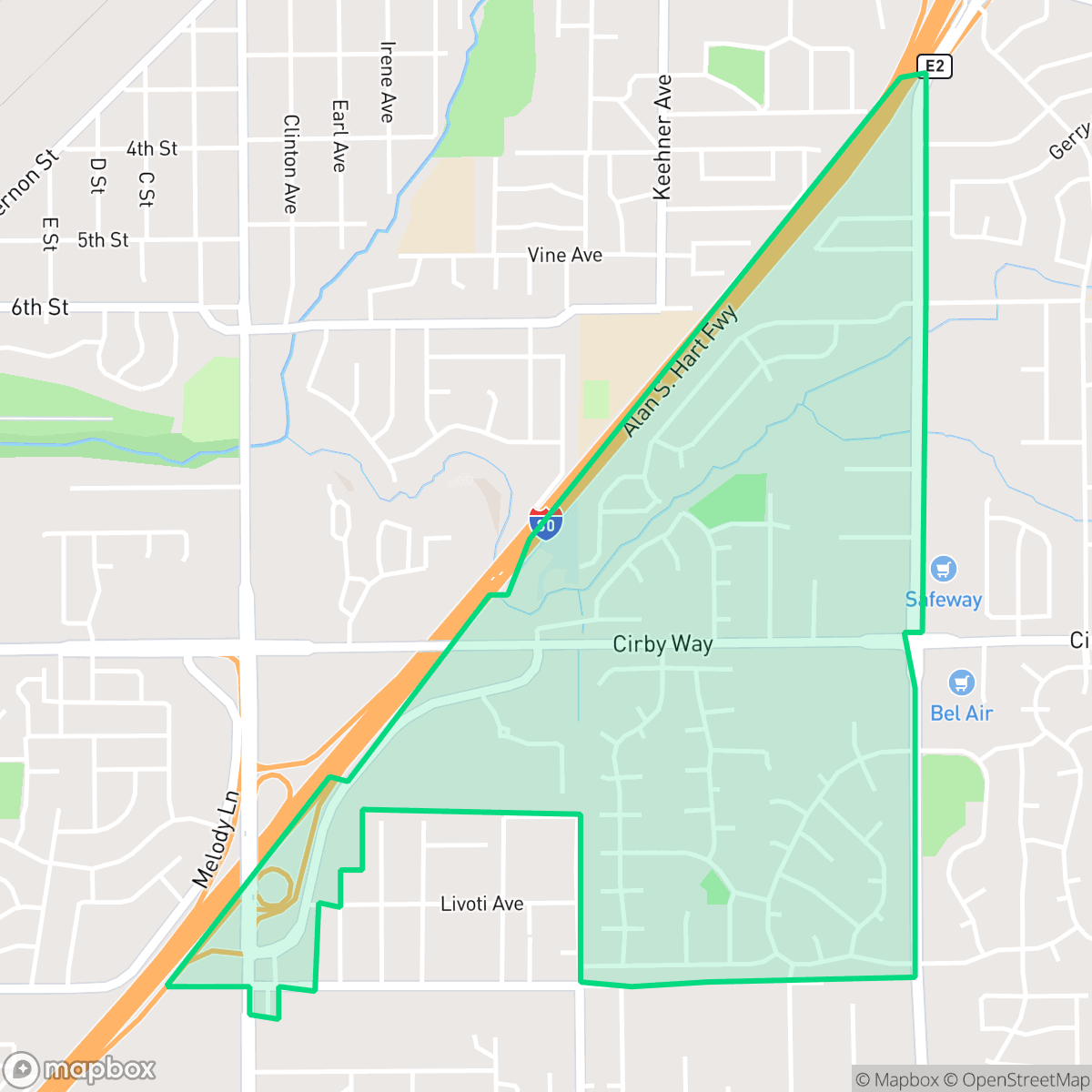
The Cirby Side neighborhood in southeast Roseville, California, is named after Cirby Way, which honors George Kirk Cirby, a prominent 1860s pioneer who operated a dairy farm and served on the local school board. Bounded by Interstate 80 and Sunrise Avenue, the neighborhood developed primarily during the mid-20th-century suburban expansion of Roseville. It is characterized by established single-family homes on generous lots, mature tree canopies, and a traditional suburban layout. The area is represented by the active Cirby Side Neighborhood Association (CSNA), a member of the Roseville Coalition of Neighborhood Associations (RCONA) that fosters community engagement and organizes local events.
The neighborhood is characterized by a traditional suburban layout featuring single-family homes on generous lots and a strong presence of mature tree canopies. It maintains a clean, residential atmosphere with no heavy industrial proximity, providing a quiet visual landscape complemented by well-maintained green spaces such as Kenwood Oaks Park. According to iHuus data, the area benefits from a comprehensive sidewalk network that makes it exceptionally easy to navigate on foot, supporting a lifestyle that balances residential privacy with local connectivity.
Potential residents should consider the acoustic environment, as the proximity to major transit corridors contributes to elevated noise levels. While the area lacks the absolute quiet of more remote suburbs, it offers significant advantages for families and professionals, including access to top-tier educational institutions within the Roseville Joint Union High School District. It is an ideal choice for those who prioritize walkability and community-driven neighborhood associations over a perfectly silent acoustic environment.
Neighborhood Scores Across 15 Qualities
Suburban homes feature private fenced backyards with a level of spacing slightly higher than the Roseville average. Neighboring houses are generally positioned within a moderate distance of one another.
Pedestrian safety is supported by continuous sidewalks on residential streets and marked crosswalks at major intersections. While the area is highly navigable, walkability is slightly lower than the Roseville city average.
Large homes with manicured landscaping and private backyard pools characterize this area, though the overall visual appeal is slightly below the Roseville average according to iHuus data.
Continuous sidewalks with grass verges and a central park area provide reliable routes for pet owners; however, overall dog friendliness is slightly below the Roseville average.
Residential areas feature a dense suburban landscape with single-family homes and accessible commercial retail zones. This mix of housing and shopping hubs is consistent with the broader Roseville area.
A mix of quiet residential streets and active dining pockets creates a vibe slightly more lively than the Roseville average. Residents can access various local eateries and cafes, though much of the area remains a calm, low-density suburban setting.
Frequent noise from nearby freeways and railroad tracks characterizes this area. This level of acoustic disturbance is significantly higher than the average found throughout Roseville, according to iHuus data.
Air quality in this area is consistent with the Roseville average, presenting a mix of acceptable and unhealthy days that may cause occasional concern for sensitive groups.
Industrial presence is virtually non-existent in this area, as the neighborhood consists entirely of residential and commercial retail spaces. According to iHuus data, this lack of warehouses or heavy industry is even more pronounced here than in the broader Roseville area.
Health insurance access among residents is notable, though slightly lower than the Roseville city average according to iHuus data.
Political leanings in this area trend conservative, which is closely aligned with the broader Roseville average according to iHuus data.
Residents live among a balanced distribution of young adults, families, and seniors. This demographic spread is slightly more varied than the average found across Roseville, according to iHuus data.
Flood risk levels in this area are currently undetermined because official studies have not been completed for this specific location. According to iHuus data, the lack of detailed mapping means the neighborhood sits at a higher risk level than the Roseville average.
Address-Level Insights for Cirby Side


iHuus Neighborhood Intelligence Insights
Get address-level neighborhood insights for Cirby Side
- Street-level scores — see how individual blocks compare, not just neighborhood averages
- Micro-zone boundaries — identify quiet pockets, flood boundaries, and walkable clusters before you visit
- 15 dimensions in full — walkability, noise, air quality, school quality, insurance coverage, population age profile, urban/rural index, and more
- Boundary risk alerts — know if your address sits near a block boundary where scores drop, the kind of detail no listing will ever mention
- School insights — individual school ratings and insights, not just district-level data
- Compare before you commit — side-by-side data across neighborhoods, down to block precision
No credit card required
Compare with Any Neighborhood
| Dimension | Cirby Side | Blue Oaks |
|---|---|---|
| 🚶 Walkabilityavg 8.87 | ||
| 🔊 Acoustic Comfortavg 4.32 | ||
| 🤫 Privacy Indexavg 5.7 | ||
| 🎨 Visual Appealavg 7.58 | ||
| 🐕 Dog Friendlinessavg 7.74 | ||
| 🗺️ Urban-Rural Indexavg 6.82 | ||
| ✨ Neighborhood Vibeavg 4.77 | ||
| 🏥 Health Insurance Coverageavg 8.58 | ||
| 🌿 Air Qualityavg 6 | ||
| 🏭 Industrial Proximityavg 8.8 | ||
| 🌊 Flood Safetyavg 5.72 | ||
| 🗳️ Ideological Leanavg 3.68 | ||
| 👥 Population Age Profileavg 5.05 | ||
| 🔥 Fire Safetyavg 0.15 | ||
| 🏫 School Quality |
Cirby Side Rankings
School Districts Serving Cirby Side
School Insights for Cirby Side
Below average outcomes; significant attendance and academic challenges.
School Insights
See what's really behind every school rating near Cirby Side
- Individual school ratings — each school's own score with outcome context, not just a district average
- Enrollment & class size data — student-to-teacher ratio and how it compares to the state average
- Full demographics breakdown — ethnicity and gender composition for every school in the enrollment zone
- Every school in the district — all schools within the enrollment boundary ranked by rating, not just the closest one
- Grade levels & benchmarks — elementary through high school, with below/above state-average flags
No credit card required