Blue Oaks, Roseville
Updated · 8,868 residents
Blue Oaks is a highly walkable suburban community in Roseville characterized by its expansive network of trails and well-maintained green spaces. Residents enjoy a quiet, upscale environment featuring large detached homes and a strong connection to the local natural landscape.
Key Highlights
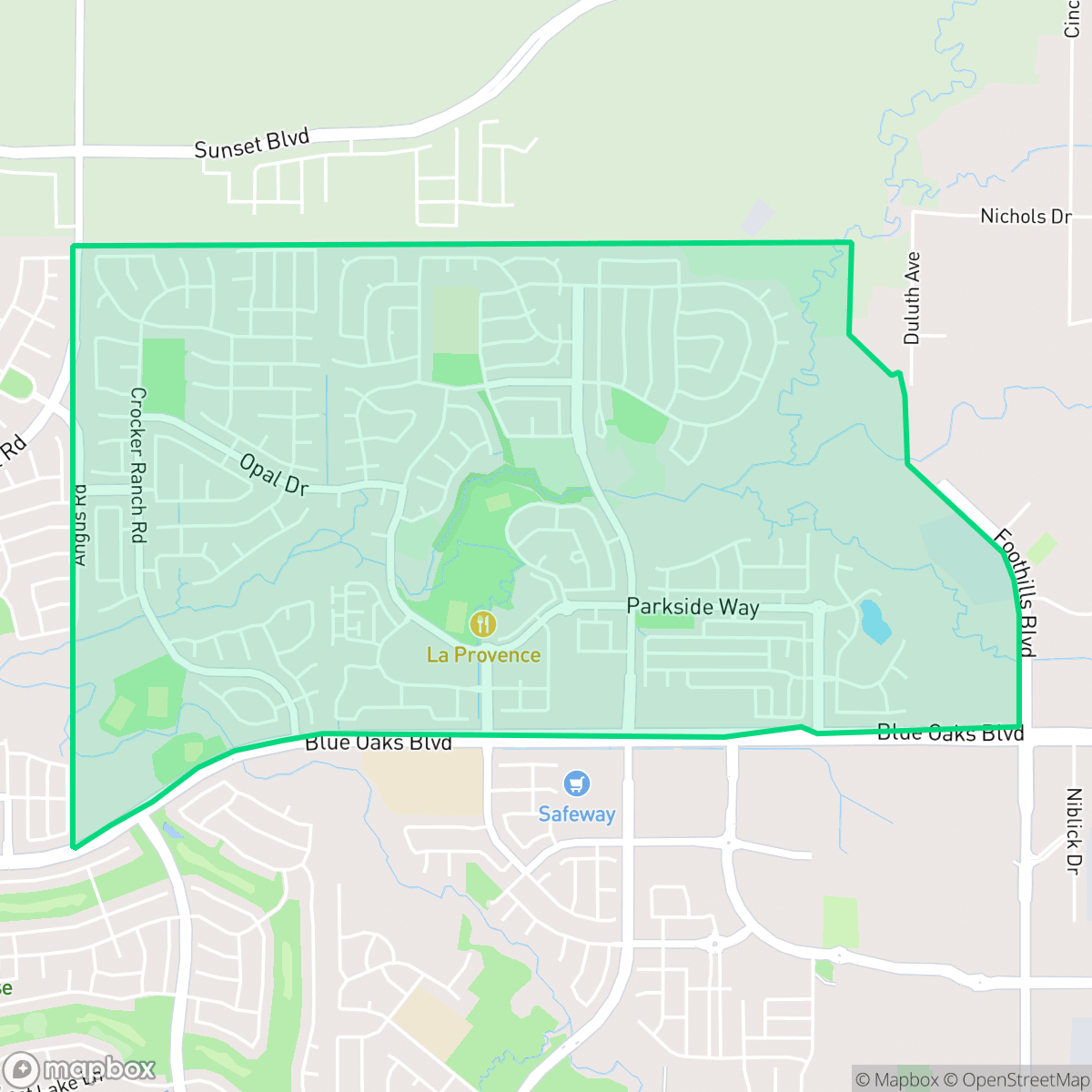
About Blue Oaks
Once a vast expanse of agricultural grazing land, the Blue Oaks neighborhood in northwest Roseville, California, transitioned from ranching to suburban development in the late 20th century. Historically, the area was used for cattle grazing by local families, including the Garinos, who owned the land that eventually became Blue Oaks Park until selling it in the 1970s. Residential construction surged in the early 2000s, led by builders like Woodside Homes and JMC, establishing upscale subdivisions such as the gated Crocker Ranch. The neighborhood is anchored by the 42-acre Blue Oaks Park, which opened in 2008 to preserve a large grove of native valley oak trees. Today, Blue Oaks balances its quiet residential character with proximity to major employment hubs like the historic Hewlett-Packard campus and the newly developed Blue Oaks Commerce Center.
The area features a consistent suburban aesthetic defined by large homes, multi-car driveways, and private backyard pools. With excellent walkability, the neighborhood provides residents with extensive sidewalk access and dedicated trails that connect residential blocks to local parks. The environment remains quiet and low-density, offering a peaceful atmosphere that stands out within the broader Roseville region.
The neighborhood is particularly well-suited for families and professionals who prioritize access to top-tier public education and a secure, residential setting. While the area offers limited commercial density, its proximity to major employment hubs and essential services makes it a convenient choice for daily commuters. Residents benefit from high levels of health insurance coverage and a stable community environment that balances suburban comfort with access to essential regional infrastructure.
Neighborhood Scores Across 15 Qualities
Residential spacing provides a moderate level of separation between homes, which is slightly higher than the Roseville average. Properties feature detached housing with consistent buffers, including some areas that border private parkland.
Continuous sidewalk networks on both sides of residential streets and dedicated park trails ensure excellent pedestrian connectivity. This level of walkability is notably higher than the Roseville average, according to iHuus data.
Large homes with private pools and well-maintained landscaping define this area, which offers a higher level of visual appeal than the Roseville average. Properties frequently feature expansive driveways and manicured grounds, according to iHuus data.
Extensive central parklands and wide walking paths provide ample space for pets. This neighborhood offers more accessible green space and safer walking routes than the Roseville average, according to iHuus data.
Open land and scattered homes create a semi-rural atmosphere that is slightly more tranquil than the typical Roseville suburban landscape. This area features a mix of residential pockets and significant undeveloped space, according to iHuus data.
Varying pockets of activity exist throughout the area, ranging from quiet residential streets to more active social districts containing diverse dining and parks. According to iHuus data, the local energy and access to amenities are slightly more vibrant than the Roseville average.
Acoustic levels are notably lower than the Roseville average, consisting primarily of infrequent distant traffic or passing trains. Residents can expect a peaceful environment with very little localized noise disturbance according to iHuus data.
Air quality in Blue Oaks is consistent with the Roseville average, presenting a mix of acceptable and unhealthy days. Sensitive individuals may occasionally experience concern during periods of poorer air quality, according to iHuus data.
Industrial activity and heavy warehouses are entirely absent from this area, offering a cleaner environment than the Roseville average. Residents can expect a landscape consisting solely of residential and light commercial uses without the presence of logistics hubs or manufacturing hazards.
Health insurance enrollment is exceptionally high among Blue Oaks residents, surpassing the Roseville average according to iHuus data.
Political leanings in Blue Oaks align closely with the broader Roseville area, characterized by a conservative majority and a modest opposing presence.
Residents live alongside a balanced spread of young adults, families, and older populations. This demographic distribution is nearly identical to the Roseville average, according to iHuus data.
Flood risk in this area is generally low, though some residual risk exists within the 500-year floodplain. According to iHuus data, the safety level in Blue Oaks is notably higher than the Roseville city average.
High fire hazards exist within this area, representing a more significant risk level than the Roseville average. According to iHuus data, maximum protection measures and heightened seasonal awareness are necessary for residents.
Address-Level Insights for Blue Oaks


iHuus Neighborhood Intelligence Insights
Get address-level neighborhood insights for Blue Oaks
- Street-level scores — see how individual blocks compare, not just neighborhood averages
- Micro-zone boundaries — identify quiet pockets, flood boundaries, and walkable clusters before you visit
- 15 dimensions in full — walkability, noise, air quality, school quality, insurance coverage, population age profile, urban/rural index, and more
- Boundary risk alerts — know if your address sits near a block boundary where scores drop, the kind of detail no listing will ever mention
- School insights — individual school ratings and insights, not just district-level data
- Compare before you commit — side-by-side data across neighborhoods, down to block precision
No credit card required
Compare with Any Neighborhood
| Dimension | Blue Oaks | Cherry Glen |
|---|---|---|
| 🚶 Walkabilityavg 8.87 | ||
| 🔊 Acoustic Comfortavg 4.32 | ||
| 🤫 Privacy Indexavg 5.7 | ||
| 🎨 Visual Appealavg 7.58 | ||
| 🐕 Dog Friendlinessavg 7.74 | ||
| 🗺️ Urban-Rural Indexavg 6.82 | ||
| ✨ Neighborhood Vibeavg 4.77 | ||
| 🏥 Health Insurance Coverageavg 8.58 | ||
| 🌿 Air Qualityavg 6 | ||
| 🏭 Industrial Proximityavg 8.8 | ||
| 🌊 Flood Safetyavg 5.72 | ||
| 🗳️ Ideological Leanavg 3.68 | ||
| 👥 Population Age Profileavg 5.05 | ||
| 🔥 Fire Safetyavg 0.15 | ||
| 🏫 School Quality |
Blue Oaks Rankings
School Districts Serving Blue Oaks
School Insights for Blue Oaks
Below average outcomes; significant attendance and academic challenges.
School Insights
See what's really behind every school rating near Blue Oaks
- Individual school ratings — each school's own score with outcome context, not just a district average
- Enrollment & class size data — student-to-teacher ratio and how it compares to the state average
- Full demographics breakdown — ethnicity and gender composition for every school in the enrollment zone
- Every school in the district — all schools within the enrollment boundary ranked by rating, not just the closest one
- Grade levels & benchmarks — elementary through high school, with below/above state-average flags
No credit card required