Wood Streets, Riverside
Updated · 8,373 residents
Wood Streets is a highly walkable Riverside neighborhood defined by its historic charm and well-preserved early 20th-century architecture. Residents enjoy a quiet, suburban atmosphere with easy access to local dining and the nearby college campus, though the area experiences moderate noise levels from regional road traffic.
Key Highlights
About Wood Streets
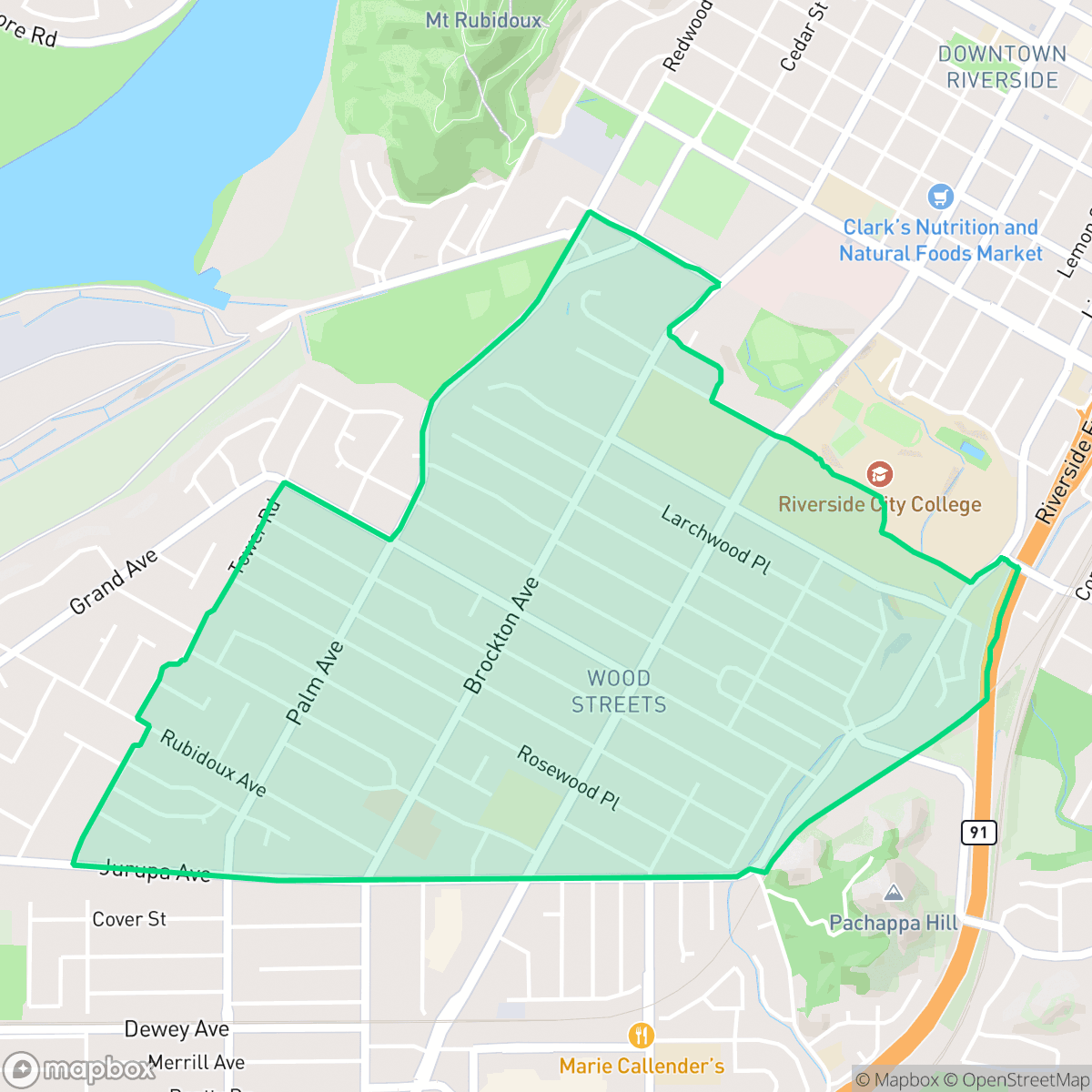
The Wood Streets neighborhood in Riverside, California, was originally blanketed with orange groves until 1913, when the Tequesquite Arroyo was filled to connect Magnolia Avenue with downtown. This infrastructure allowed developer Dr. Edward H. Wood to subdivide the land, naming the first street Homewood Court and establishing a pattern of street names ending in "-wood" (such as Larchwood and Rosewood). Developed primarily between 1913 and 1940, the cohesive historic district is renowned for its intact early 20th-century streetscapes and diverse architectural styles, including Craftsman bungalows, Tudor Revival, and Spanish Colonial Revival homes. The neighborhood's northern edge is anchored by Riverside Community College, featuring its landmark 1924 Italian Renaissance-style Quadrangle building.
The area maintains a distinct residential character marked by a consistent grid layout and high walkability. It serves as a peaceful enclave that balances suburban tranquility with proximity to institutional landmarks like the local community college. While the neighborhood lacks heavy industrial activity, it offers a modest selection of local eateries such as Butch's Grinders and Mission Burgers. The streetscape is characterized by well-manicured properties and a strong sense of community stability that appeals to those seeking an established, historic environment.
Prospective residents should consider that the neighborhood experiences moderate noise levels, primarily due to road traffic. While the area offers excellent access to local schools like the highly-rated Magnolia Elementary, the broader school district presents a mix of high-performing pathways and ongoing challenges. Those moving to the area should also be aware of regional environmental factors, including fire and flood safety considerations, which are consistent with the broader Riverside landscape.
Neighborhood Scores Across 15 Qualities
Residential spacing varies between detached homes with generous side yards and denser housing with shared property lines. This level of privacy is roughly comparable to the average for Riverside.
Continuous sidewalks and a clear grid layout make navigating residential streets easy on foot. This area offers better pedestrian connectivity than the Riverside average, though large nearby arterials can create occasional barriers to movement.
Large, well-manicured properties and a high density of private backyard pools characterize this area. According to iHuus data, the visual landscape remains largely consistent with the Riverside average.
Continuous sidewalks with grassy verges and nearby public parkland offer decent space for walks, though options are slightly below the city average. Some residential pockets feature narrower parkways and fewer large, accessible public green spaces.
Residential layouts feature typical suburban density with a mix of single-family homes and commercial centers. This area feels slightly less developed than the Riverside average, featuring more concentrated pockets of housing compared to more open landscapes.
A diverse selection of dining and local amenities provides a level of activity that is notably higher than the Riverside average. While some blocks offer lively social hubs, other areas remain quiet and more car-dependent near major highways.
Steady traffic noise from a nearby busy street is a common feature of the area. According to iHuus data, acoustic levels are slightly higher than the Riverside average.
Air quality remains mostly clean with infrequent instances of elevated readings, performing nearly in line with the Riverside average according to iHuus data.
Residential and light commercial uses predominate here, with significantly fewer heavy industrial hazards or large warehouses compared to the Riverside average. According to iHuus data, the area lacks the significant warehouse presence and major freight corridors found in other parts of the city.
Health insurance coverage among residents is slightly higher than the Riverside average, according to iHuus data. This level of coverage indicates a relatively stable access to healthcare services for the local population.
Political leanings in Wood Streets trend more liberal than the Riverside average, according to iHuus data.
Residents live alongside a diverse range of generations, including young professionals, families, and seniors. This demographic spread is largely consistent with the broader Riverside area, according to iHuus data.
Address-Level Insights for Wood Streets


iHuus Neighborhood Intelligence Insights
Get address-level neighborhood insights for Wood Streets
- Street-level scores — see how individual blocks compare, not just neighborhood averages
- Micro-zone boundaries — identify quiet pockets, flood boundaries, and walkable clusters before you visit
- 15 dimensions in full — walkability, noise, air quality, school quality, insurance coverage, population age profile, urban/rural index, and more
- Boundary risk alerts — know if your address sits near a block boundary where scores drop, the kind of detail no listing will ever mention
- School insights — individual school ratings and insights, not just district-level data
- Compare before you commit — side-by-side data across neighborhoods, down to block precision
No credit card required
Compare with Any Neighborhood
| Dimension | Wood Streets | Airport |
|---|---|---|
| 🚶 Walkabilityavg 7.91 | ||
| 🔊 Acoustic Comfortavg 4.28 | ||
| 🤫 Privacy Indexavg 5.41 | ||
| 🎨 Visual Appealavg 6.73 | ||
| 🐕 Dog Friendlinessavg 6.29 | ||
| 🗺️ Urban-Rural Indexavg 7.07 | ||
| ✨ Neighborhood Vibeavg 4.37 | ||
| 🏥 Health Insurance Coverageavg 6.35 | ||
| 🌿 Air Qualityavg 8.25 | ||
| 🏭 Industrial Proximityavg 8.09 | ||
| 🌊 Flood Safetyavg 1.24 | ||
| 🗳️ Ideological Leanavg 7.01 | ||
| 👥 Population Age Profileavg 4.57 | ||
| 🔥 Fire Safetyavg 0.35 | ||
| 🏫 School Quality |
Wood Streets Rankings
School Districts Serving Wood Streets
School Insights for Wood Streets
Below average outcomes; significant attendance and academic challenges.
School Insights
See what's really behind every school rating near Wood Streets
- Individual school ratings — each school's own score with outcome context, not just a district average
- Enrollment & class size data — student-to-teacher ratio and how it compares to the state average
- Full demographics breakdown — ethnicity and gender composition for every school in the enrollment zone
- Every school in the district — all schools within the enrollment boundary ranked by rating, not just the closest one
- Grade levels & benchmarks — elementary through high school, with below/above state-average flags
No credit card required