University, Riverside
Updated · 32,318 residents
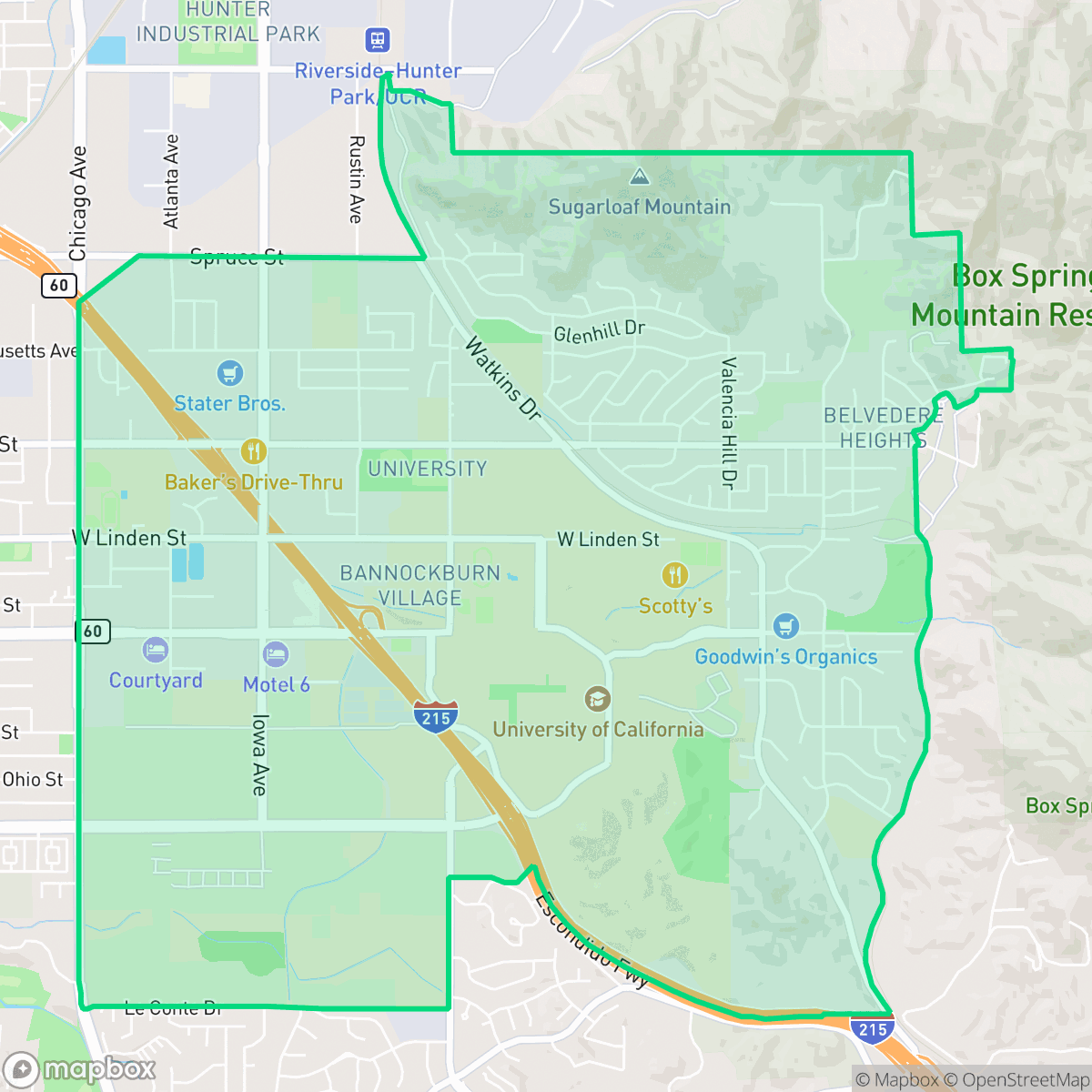
The University neighborhood serves as the academic heart of Riverside, anchored by the University of California, Riverside campus and its iconic botanical landmarks. Residents benefit from high walkability and consistent access to green spaces, though the area experiences moderate noise levels from nearby freeway corridors and dense suburban development.
Key Highlights
About University
The University neighborhood of Riverside, California, serves as the eastern gateway to the University of California, Riverside (UCR). The area's history is deeply tied to the university's origins, starting with the UC Citrus Experiment Station, which moved to the Box Springs site in 1917 and pioneered critical agricultural research. When the UCR campus formally opened in 1954, the neighborhood became the residential choice for pioneering faculty and staff. Today, the neighborhood is defined by landmarks like the 161-foot brutalist Carillon Bell Tower, built in 1966, and the 40-acre UCR Botanic Gardens. Community identity is preserved by the University Neighborhood Association (UNA), one of Riverside's oldest active neighborhood groups, which fosters collaboration among a diverse population of students, faculty, and long-term residents.
The area functions as a dense suburban hub defined by its proximity to educational institutions and a mix of residential housing. It features a high degree of walkability for a suburban setting, with continuous sidewalks connecting residential streets to the campus and local commercial nodes. While the landscape is primarily functional, with standard tract housing and multi-family complexes, the presence of the UCR Botanic Gardens and various campus athletic fields provides substantial open space for recreation and pet owners. Prospective residents should note that the neighborhood experiences moderate noise levels, largely attributed to road traffic and its proximity to major transit arteries. The housing stock offers limited privacy due to high density and shared walls in apartment complexes, making it a better fit for students, faculty, or those prioritizing access to the university over secluded living. Educational options range from highly-rated specialized institutions like the Riverside STEM Academy to schools within the Riverside Unified School District, though families should weigh these against the area's overall density and industrial-adjacent corridors.
Neighborhood Scores Across 15 Qualities
Residential spacing varies significantly throughout the area, ranging from high-density apartment complexes with shared walls to more open agricultural and institutional zones. This level of privacy is roughly in line with the average for Riverside.
Sidewalk networks and clear crosswalks are widely available throughout much of the area, making pedestrian travel comparable to the rest of Riverside. While large blocks and heavy traffic on certain arterial roads can create barriers, many residential zones and campus paths offer continuous walking routes.
Residential views vary from affluent areas with manicured lawns and private pools to more dense, institutional settings featuring large parking lots. This mix of upscale amenities and functional architecture results in a visual appeal that is roughly in line with the Riverside average.
Abundant campus lawns, athletic fields, and local parks provide ample, safe green space for pets. This access to accessible walking areas is slightly above the Riverside average, according to iHuus data.
Open land and scattered residential pockets provide a semi-rural feel that is slightly more prevalent here than in the rest of Riverside. According to iHuus data, the area features a mix of undeveloped hilly terrain and low-density institutional buildings.
A blend of quiet residential blocks and light industrial areas provides a subtle level of activity that is slightly above the Riverside average. While some pockets offer walkable access to local dining and coffee shops, other sections remain car-dependent with limited commercial presence.
Steady traffic sounds from nearby busy streets are common here, which is roughly consistent with the average noise levels found throughout Riverside.
Air quality is consistently good with only rare instances of elevated readings. This level of cleanliness is largely comparable to the rest of Riverside.
Primarily residential and institutional in nature, this area lacks heavy manufacturing or toxic hazards. While some utility facilities and large-scale solar arrays are located near major transit corridors, the industrial footprint is slightly lower than the Riverside average.
Health insurance access in this area is slightly lower than the Riverside average. According to iHuus data, a significant portion of the population remains uninsured.
Voting patterns and census indicators show a significantly more liberal leaning than the Riverside average, according to iHuus data.
Young adults make up the majority of the population here, resulting in a significantly younger age profile than the Riverside average. According to iHuus data, the area has a limited presence of families or older residents.
Properties in this area are located within a designated floodplain, making flood insurance a common requirement for residents. According to iHuus data, the risk of flooding in University is higher than the average found throughout Riverside.
Extreme fire hazards are present in this area, which is slightly more dangerous than the typical level found across Riverside. According to iHuus data, residents should be aware of the significant fire safety risks inherent to this location.
Address-Level Insights for University


iHuus Neighborhood Intelligence Insights
Get address-level neighborhood insights for University
- Street-level scores — see how individual blocks compare, not just neighborhood averages
- Micro-zone boundaries — identify quiet pockets, flood boundaries, and walkable clusters before you visit
- 15 dimensions in full — walkability, noise, air quality, school quality, insurance coverage, population age profile, urban/rural index, and more
- Boundary risk alerts — know if your address sits near a block boundary where scores drop, the kind of detail no listing will ever mention
- School insights — individual school ratings and insights, not just district-level data
- Compare before you commit — side-by-side data across neighborhoods, down to block precision
No credit card required
Compare with Any Neighborhood
| Dimension | University | Airport |
|---|---|---|
| 🚶 Walkabilityavg 7.91 | ||
| 🔊 Acoustic Comfortavg 4.28 | ||
| 🤫 Privacy Indexavg 5.41 | ||
| 🎨 Visual Appealavg 6.73 | ||
| 🐕 Dog Friendlinessavg 6.29 | ||
| 🗺️ Urban-Rural Indexavg 7.07 | ||
| ✨ Neighborhood Vibeavg 4.37 | ||
| 🏥 Health Insurance Coverageavg 6.35 | ||
| 🌿 Air Qualityavg 8.25 | ||
| 🏭 Industrial Proximityavg 8.09 | ||
| 🌊 Flood Safetyavg 1.24 | ||
| 🗳️ Ideological Leanavg 7.01 | ||
| 👥 Population Age Profileavg 4.57 | ||
| 🔥 Fire Safetyavg 0.35 | ||
| 🏫 School Quality |
University Rankings
School Districts Serving University
School Insights for University
Below average outcomes; significant attendance and academic challenges.
School Insights
See what's really behind every school rating near University
- Individual school ratings — each school's own score with outcome context, not just a district average
- Enrollment & class size data — student-to-teacher ratio and how it compares to the state average
- Full demographics breakdown — ethnicity and gender composition for every school in the enrollment zone
- Every school in the district — all schools within the enrollment boundary ranked by rating, not just the closest one
- Grade levels & benchmarks — elementary through high school, with below/above state-average flags
No credit card required