Northside, Riverside
Updated · 11,548 residents
Northside is a quiet, semi-rural neighborhood defined by a mix of tract housing and industrial logistics hubs. While it offers expansive green spaces for pet owners, residents should be prepared for significant noise from nearby rail and freeway traffic, as well as limited sidewalk connectivity.
Key Highlights
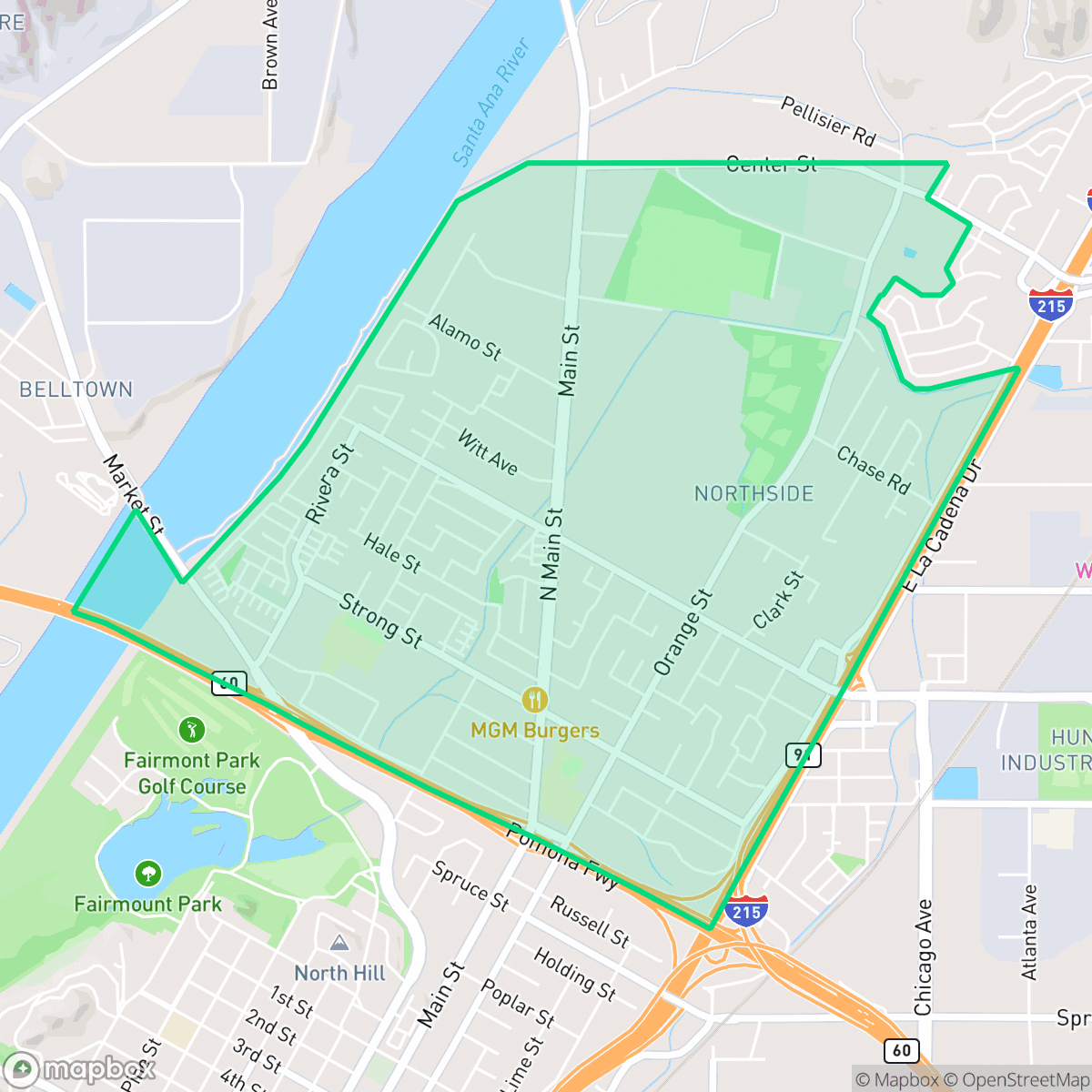
About Northside
Historically dominated by dairies, poultry ranches, and groves of citrus, walnut, and eucalyptus trees, the Northside neighborhood in Riverside represents a distinct agricultural legacy. The area includes the site of the early settlement of La Placita, which predates the city's founding. Modern development efforts in the neighborhood have centered on the Northside Specific Plan, which aims to preserve this heritage through the proposed establishment of a Spanish Town Heritage Village and the restoration of the Springbrook Arroyo. While the area remained largely undeveloped for much of the 20th century, it is currently undergoing a significant transformation, including the repurposing of the former Riverside Golf Course into a mixed-use community and recreational hub intended to celebrate the neighborhood's unique historical character.
The area balances its agricultural roots with a growing industrial footprint, featuring large-scale warehouses alongside residential pockets. The landscape is characterized by uniform housing layouts and mid-density apartments, creating a subdued, low-activity environment. While the neighborhood provides decent access to open parkland for dog walking, the presence of logistics centers and major transportation corridors contributes to a noticeable level of ambient noise and heavy truck traffic. Prospective residents should consider the environmental and infrastructure trade-offs, as the area faces significant risks regarding both flooding and wildfires. Walkability is constrained by gaps in the sidewalk network, particularly near arterial roads and highway crossings. The community maintains a diverse age demographic and a generally liberal political outlook, though access to health insurance remains lower than the city average. Families should note that the neighborhood is served by multiple school districts, each with varying levels of academic performance and institutional stability.
Neighborhood Scores Across 15 Qualities
Housing layouts vary from closely spaced multi-family units to detached suburban homes with moderate spacing. This level of privacy is consistent with the overall Riverside average.
Residential streets offer quiet routes for walking, but the lack of continuous sidewalks along major arterial roads makes pedestrian travel less convenient than the Riverside average. According to iHuus data, a highway corridor also interrupts the sidewalk network in certain sections of the neighborhood.
Standard tract housing and mid-density apartments define the landscape, featuring uniform rooflines and small yards. This visual profile is less varied than the Riverside city average, though some private backyard pools are present throughout the area.
Expansive parklands and large open fields provide ample space for pet walking. According to iHuus data, the available green space is slightly above the Riverside average, though some areas are constrained by narrow parkway strips.
Open land and undeveloped tracts are interspersed with large-scale industrial warehouses and suburban housing. This landscape provides a transition between residential pockets and more rural-fringe settings, matching the city average for urban-rural density.
Low-density residential blocks and light industrial warehouses create a subdued atmosphere with very little commercial activity. According to iHuus data, the level of local activity and social vibrancy is notably lower than the city average.
Frequent noise from nearby railroad tracks and heavy freeway traffic characterizes this area. According to iHuus data, acoustic comfort in Northside is notably lower than the Riverside average.
Air quality in Northside is generally good with rare instances of elevated readings. This level of air purity is roughly comparable to the average found across Riverside.
Significant logistics hubs and large-scale warehouses are present near the northern and eastern sectors, creating a more industrial character than much of Riverside. Residents may encounter increased heavy truck traffic and noise from these commercial zones, particularly near the highway and rail lines.
Health insurance access in Northside is lower than the average for Riverside. According to iHuus data, a smaller portion of the resident population is covered by health plans compared to the rest of the city.
Political leanings in Northside are notably more liberal than the Riverside average, according to iHuus data.
A balanced distribution of young adults, families, and older residents characterizes the area. This demographic spread is slightly lower than the Riverside average, according to iHuus data.
Flood risk in this area is notably higher than the Riverside average, as portions of the neighborhood fall within a designated 100-year floodplain. Residents should be aware that flood insurance is typically required for properties in this zone according to iHuus data.
Fire hazards in this area are significantly higher than the Riverside average, necessitating heightened awareness and maximum protection measures. According to iHuus data, the neighborhood faces an extreme risk of wildfire.
Address-Level Insights for Northside


iHuus Neighborhood Intelligence Insights
Get address-level neighborhood insights for Northside
- Street-level scores — see how individual blocks compare, not just neighborhood averages
- Micro-zone boundaries — identify quiet pockets, flood boundaries, and walkable clusters before you visit
- 15 dimensions in full — walkability, noise, air quality, school quality, insurance coverage, population age profile, urban/rural index, and more
- Boundary risk alerts — know if your address sits near a block boundary where scores drop, the kind of detail no listing will ever mention
- School insights — individual school ratings and insights, not just district-level data
- Compare before you commit — side-by-side data across neighborhoods, down to block precision
No credit card required
Compare with Any Neighborhood
| Dimension | Northside | Airport |
|---|---|---|
| 🚶 Walkabilityavg 7.91 | ||
| 🔊 Acoustic Comfortavg 4.28 | ||
| 🤫 Privacy Indexavg 5.41 | ||
| 🎨 Visual Appealavg 6.73 | ||
| 🐕 Dog Friendlinessavg 6.29 | ||
| 🗺️ Urban-Rural Indexavg 7.07 | ||
| ✨ Neighborhood Vibeavg 4.37 | ||
| 🏥 Health Insurance Coverageavg 6.35 | ||
| 🌿 Air Qualityavg 8.25 | ||
| 🏭 Industrial Proximityavg 8.09 | ||
| 🌊 Flood Safetyavg 1.24 | ||
| 🗳️ Ideological Leanavg 7.01 | ||
| 👥 Population Age Profileavg 4.57 | ||
| 🔥 Fire Safetyavg 0.35 | ||
| 🏫 School Quality |
Northside Rankings
School Districts Serving Northside
School Insights for Northside
Below average outcomes; significant attendance and academic challenges.
School Insights
See what's really behind every school rating near Northside
- Individual school ratings — each school's own score with outcome context, not just a district average
- Enrollment & class size data — student-to-teacher ratio and how it compares to the state average
- Full demographics breakdown — ethnicity and gender composition for every school in the enrollment zone
- Every school in the district — all schools within the enrollment boundary ranked by rating, not just the closest one
- Grade levels & benchmarks — elementary through high school, with below/above state-average flags
No credit card required