La Sierra, Riverside
Updated · 45,779 residents
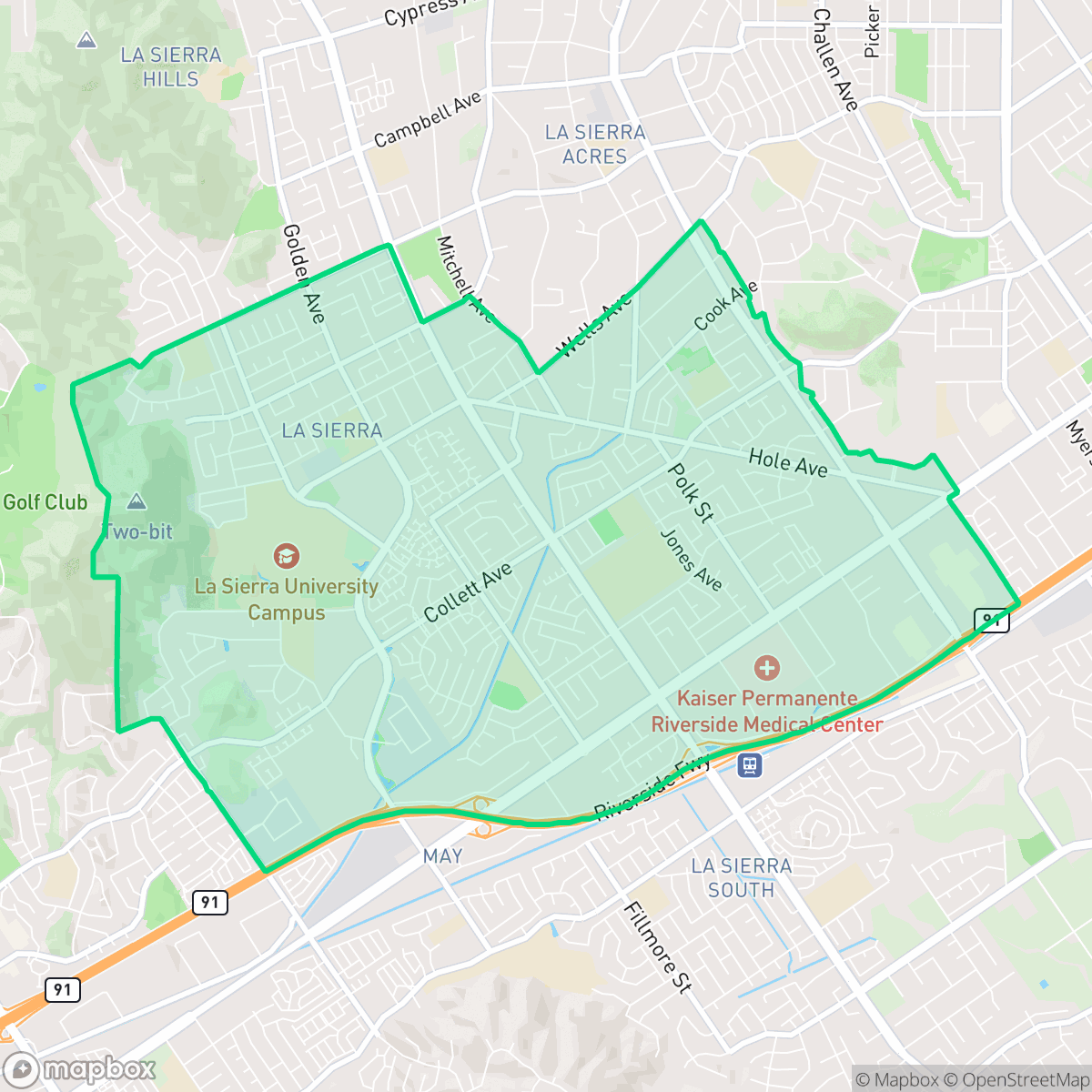
La Sierra is a diverse Riverside neighborhood defined by its educational anchor, La Sierra University, and a mix of suburban residential tracts. It offers high walkability and consistent sidewalk networks, though residents often experience noise from nearby highway traffic and closely spaced housing.
Key Highlights
About La Sierra
La Sierra, a neighborhood in southwestern Riverside, California, originated from the 1846 Mexican land grant Rancho La Sierra, awarded to Vicenta Sepulveda. In 1910, Los Angeles businessman Willits J. Hole acquired the territory, establishing the Hole Ranch and building the historic rustic-bungalow Hole Mansion, designed by architect Arthur Benton. Hole sold 400 acres of his ranch in 1922 to the Seventh-day Adventist Church, which established La Sierra Academy, now La Sierra University. The university retained much of the surrounding agricultural land for decades until the 1990s, when the master-planned Riverwalk community was developed. Annexed by the city of Riverside in 1964, the neighborhood’s modern identity remains deeply tied to its ranching origins, its historic university campus, and local landmarks.
This neighborhood serves as a significant residential and institutional hub in southwestern Riverside. Its landscape is characterized by a dense suburban layout that integrates single-family homes, apartment complexes, and the expansive grounds of the local university. The area features a well-connected grid of streets and sidewalks, making it more pedestrian-friendly than many surrounding communities. Daily life is supported by a variety of local dining options and small commercial centers that provide essential services to the local population.
Prospective residents should note that the area presents a balance of convenience and trade-offs. While the neighborhood boasts high walkability, according to iHuus data, the proximity to major freeways and commercial logistics centers contributes to a noticeable level of road noise. Housing density is relatively high, resulting in limited privacy between neighbors. The local schools within the Alvord and Riverside Unified districts show mixed academic performance, which may be a consideration for families. Overall, the area is best suited for those who prioritize accessibility and a central location over quiet, low-density living.
Neighborhood Scores Across 15 Qualities
Residential spacing is generally moderate with some shared property lines; however, the level of privacy is slightly lower than the Riverside average. Some areas feature closely packed housing clusters, while other sections offer more detached homes with private yards.
Extensive sidewalk networks and low-traffic cul-de-sacs provide safe pedestrian routes throughout much of the area. According to iHuus data, the connectivity of these paths is notably higher than the Riverside average.
Visual variety ranges from affluent pockets with manicured landscapes and private pools to more densely packed tract housing. This level of visual appeal is consistent with the city average.
Large public parks and various green belts provide sufficient space for pet owners. According to iHuus data, the availability of walking areas is roughly comparable to the city average.
Residential pockets feature a blend of single-family homes and apartment complexes integrated with commercial and industrial zones. This landscape is slightly more developed than the city average, presenting a transition between dense suburban sprawl and open, unpaved spaces.
Suburban pockets offer a mix of calm residential streets and lively commercial nodes with diverse dining options. This area provides more social activity and amenity variety than the Riverside average.
Steady sounds from nearby busy streets create a consistent ambient hum. This level of acoustic activity is slightly higher than the Riverside average.
Air quality is mostly clean with only rare instances of elevated readings, performing closely to the Riverside average according to iHuus data.
Primarily residential and light commercial, this area lacks heavy industrial hazards or large-scale manufacturing. While some edge zones near major highways feature logistics warehouses and truck activity, the neighborhood is slightly more removed from significant industrial density than the Riverside average, according to iHuus data.
Health insurance accessibility is slightly lower than the Riverside average, according to iHuus data. Residents may find fewer local options for coverage compared to other parts of the city.
Political leanings in this area lean more liberal than the Riverside average, according to iHuus data.
Residents live alongside a varied demographic of young adults, families, and seniors. This age distribution is largely consistent with the broader Riverside area, according to iHuus data.
Frequent flooding is a concern in this area as it sits within a designated floodplain, representing a higher risk level than most of Riverside. According to iHuus data, residents in this neighborhood will likely need to maintain flood insurance.
Significant fire hazards exist within this area, which is slightly higher than the average for Riverside. Residents should be aware of the extreme fire danger and ensure maximum protection measures are in place according to iHuus data.
Address-Level Insights for La Sierra


iHuus Neighborhood Intelligence Insights
Get address-level neighborhood insights for La Sierra
- Street-level scores — see how individual blocks compare, not just neighborhood averages
- Micro-zone boundaries — identify quiet pockets, flood boundaries, and walkable clusters before you visit
- 15 dimensions in full — walkability, noise, air quality, school quality, insurance coverage, population age profile, urban/rural index, and more
- Boundary risk alerts — know if your address sits near a block boundary where scores drop, the kind of detail no listing will ever mention
- School insights — individual school ratings and insights, not just district-level data
- Compare before you commit — side-by-side data across neighborhoods, down to block precision
No credit card required
Compare with Any Neighborhood
| Dimension | La Sierra | Airport |
|---|---|---|
| 🚶 Walkabilityavg 7.91 | ||
| 🔊 Acoustic Comfortavg 4.28 | ||
| 🤫 Privacy Indexavg 5.41 | ||
| 🎨 Visual Appealavg 6.73 | ||
| 🐕 Dog Friendlinessavg 6.29 | ||
| 🗺️ Urban-Rural Indexavg 7.07 | ||
| ✨ Neighborhood Vibeavg 4.37 | ||
| 🏥 Health Insurance Coverageavg 6.35 | ||
| 🌿 Air Qualityavg 8.25 | ||
| 🏭 Industrial Proximityavg 8.09 | ||
| 🌊 Flood Safetyavg 1.24 | ||
| 🗳️ Ideological Leanavg 7.01 | ||
| 👥 Population Age Profileavg 4.57 | ||
| 🔥 Fire Safetyavg 0.35 | ||
| 🏫 School Quality |
La Sierra Rankings
School Districts Serving La Sierra
School Insights for La Sierra
Below average outcomes; significant attendance and academic challenges.
School Insights
See what's really behind every school rating near La Sierra
- Individual school ratings — each school's own score with outcome context, not just a district average
- Enrollment & class size data — student-to-teacher ratio and how it compares to the state average
- Full demographics breakdown — ethnicity and gender composition for every school in the enrollment zone
- Every school in the district — all schools within the enrollment boundary ranked by rating, not just the closest one
- Grade levels & benchmarks — elementary through high school, with below/above state-average flags
No credit card required