La Sierra Hills, Riverside
Updated · 7,726 residents
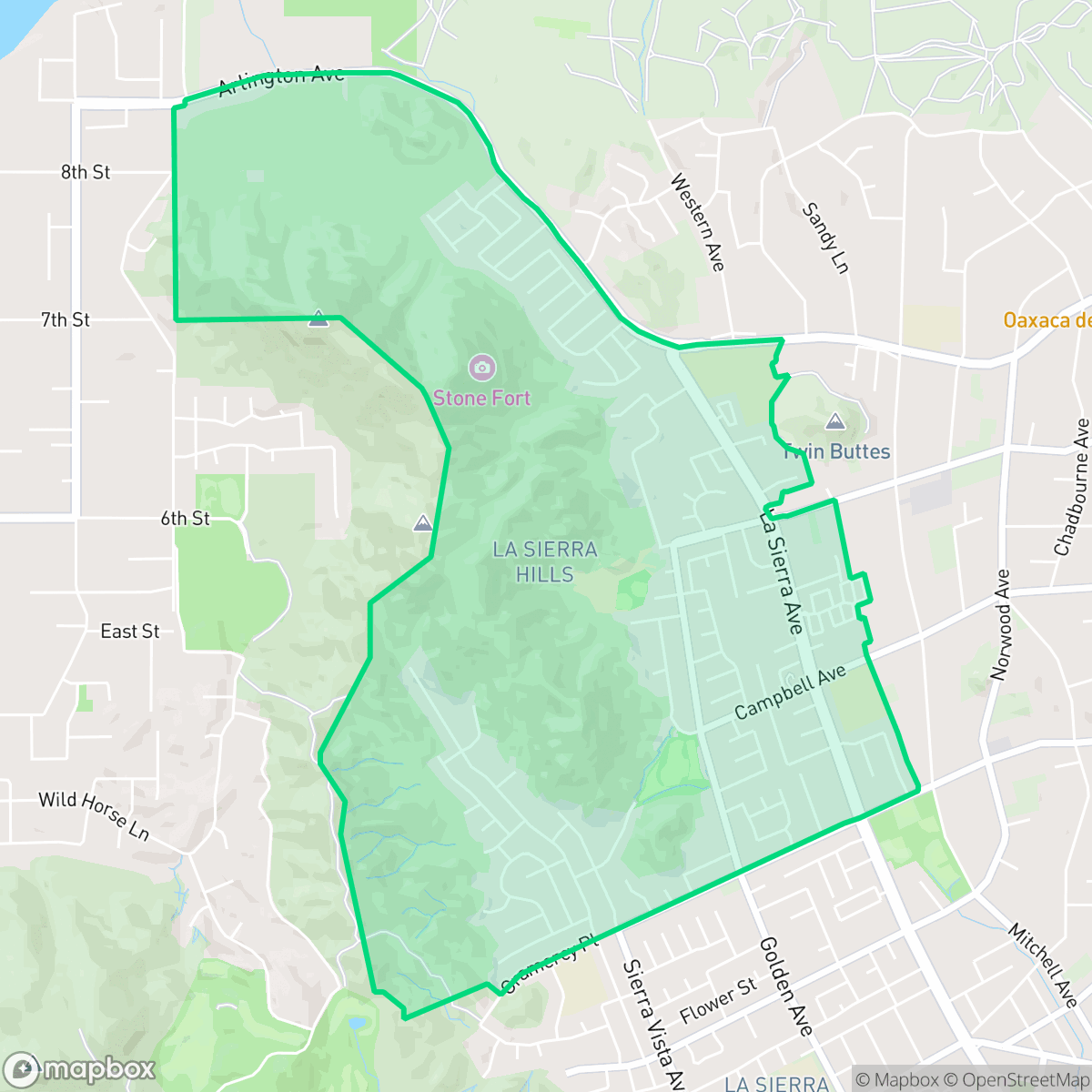
La Sierra Hills is a quiet, nature-oriented community in Riverside defined by its scenic, hilly terrain and low-density residential layout. While the area offers high visual appeal and excellent access to outdoor trails for dog owners, it remains a remote setting with limited local commercial amenities. Residents benefit from a peaceful acoustic environment and a lack of industrial activity, though the neighborhood requires reliance on personal vehicles for daily errands.
Key Highlights
About La Sierra Hills
The La Sierra Hills neighborhood in Riverside, California, traces its origins to the 1846 Rancho La Sierra Mexican land grant. The area was later part of the extensive Hole Ranch, established in 1910 by businessman Willitts J. Hole. Annexed by the city of Riverside between 1964 and 1965, the neighborhood is defined by its rugged, scenic terrain along the northern Temescal Mountains. To preserve its natural hillside beauty, local zoning regulations have historically restricted high-density development. This preservation effort was famously upheld by Riverside voters in 2014, who rejected Measure L to prevent major residential expansion in the area. Today, the neighborhood is home to Crestlawn Memorial Park and is known for its spacious, nature-oriented character.
The area is characterized by its spacious, suburban-to-rural atmosphere, featuring well-manicured landscaping and large lots that provide a sense of privacy. Its elevated position along the northern Temescal Mountains contributes to a high level of visual appeal, while the absence of heavy industry ensures a clean and quiet living environment. The neighborhood maintains a calm, serene vibe, making it a distinct departure from the denser, more commercialized parts of Riverside.
Prospective residents should note that the neighborhood prioritizes tranquility over convenience, as there are few local businesses or shops within walking distance. While the area is well-suited for those who value outdoor recreation and a quiet home life, it is important to consider the trade-offs regarding safety, specifically concerning flood and fire risks common to hillside environments. Academic options are varied, with local schools like Twinhill Elementary and Loma Vista Middle serving the community, while the surrounding districts provide a range of educational outcomes for families.
Neighborhood Scores Across 15 Qualities
Standard suburban spacing provides a moderate level of separation between homes, offering more buffer than the Riverside average. Fenced yards and varied lot sizes create a balance of proximity and individual space according to iHuus data.
Sidewalks are present along main streets and within low-traffic cul-de-sacs, though reaching local amenities often requires a vehicle. This level of accessibility is slightly below the Riverside average according to iHuus data.
Manicured landscaping, large homes, and frequent private pools create a visually pleasing environment that is more polished than the Riverside average. According to iHuus data, the area features consistent, well-maintained yards and spacious residential lots.
Extensive trail networks in the surrounding hills and nearby large public parks offer significant space for pets. According to iHuus data, the availability of connected green spaces makes this area more dog friendly than the Riverside average.
Open land and undeveloped lots are more frequent here than in the rest of Riverside. This creates a landscape of scattered homes interspersed with natural terrain and fields, according to iHuus data.
Low density and vast open spaces create a serene, tranquil atmosphere, though the area lacks the commercial activity found in more active parts of Riverside. Residents will find very few local businesses or social hubs within walking distance, making the neighborhood primarily residential and car-dependent.
Acoustic levels remain notably lower than the Riverside average, consisting primarily of infrequent distant trains or sporadic vehicle noise. According to iHuus data, the area maintains a calm environment suitable for those seeking minimal ambient disturbance.
Air quality remains consistently high with rare instances of elevated readings. This level of air purity is nearly comparable to the Riverside average, according to iHuus data.
Industrial presence is virtually nonexistent in this area, which consists entirely of residential streets and natural open spaces. This lack of heavy industry and hazardous facilities makes the neighborhood significantly cleaner than the Riverside average.
Health insurance access among residents is slightly lower than the Riverside city average, according to iHuus data.
Political leanings in this area are more evenly split between conservative and liberal residents compared to the more pronounced conservative lean found across the rest of Riverside.
Residents live alongside a balanced mix of young adults, families, and older populations. This demographic spread is largely consistent with the broader Riverside area, according to iHuus data.
Flood risk in this area is notably higher than the Riverside average. Residents should prepare for potential challenges regarding flood safety and elevated insurance premiums.
High wildfire danger is a significant concern in this area, with risk levels substantially higher than the Riverside average according to iHuus data.
Address-Level Insights for La Sierra Hills


iHuus Neighborhood Intelligence Insights
Get address-level neighborhood insights for La Sierra Hills
- Street-level scores — see how individual blocks compare, not just neighborhood averages
- Micro-zone boundaries — identify quiet pockets, flood boundaries, and walkable clusters before you visit
- 15 dimensions in full — walkability, noise, air quality, school quality, insurance coverage, population age profile, urban/rural index, and more
- Boundary risk alerts — know if your address sits near a block boundary where scores drop, the kind of detail no listing will ever mention
- School insights — individual school ratings and insights, not just district-level data
- Compare before you commit — side-by-side data across neighborhoods, down to block precision
No credit card required
Compare with Any Neighborhood
| Dimension | La Sierra Hills | Airport |
|---|---|---|
| 🚶 Walkabilityavg 7.91 | ||
| 🔊 Acoustic Comfortavg 4.28 | ||
| 🤫 Privacy Indexavg 5.41 | ||
| 🎨 Visual Appealavg 6.73 | ||
| 🐕 Dog Friendlinessavg 6.29 | ||
| 🗺️ Urban-Rural Indexavg 7.07 | ||
| ✨ Neighborhood Vibeavg 4.37 | ||
| 🏥 Health Insurance Coverageavg 6.35 | ||
| 🌿 Air Qualityavg 8.25 | ||
| 🏭 Industrial Proximityavg 8.09 | ||
| 🌊 Flood Safetyavg 1.24 | ||
| 🗳️ Ideological Leanavg 7.01 | ||
| 👥 Population Age Profileavg 4.57 | ||
| 🔥 Fire Safetyavg 0.35 | ||
| 🏫 School Quality |
La Sierra Hills Rankings
School Districts Serving La Sierra Hills
School Insights for La Sierra Hills
Below average outcomes; significant attendance and academic challenges.
School Insights
See what's really behind every school rating near La Sierra Hills
- Individual school ratings — each school's own score with outcome context, not just a district average
- Enrollment & class size data — student-to-teacher ratio and how it compares to the state average
- Full demographics breakdown — ethnicity and gender composition for every school in the enrollment zone
- Every school in the district — all schools within the enrollment boundary ranked by rating, not just the closest one
- Grade levels & benchmarks — elementary through high school, with below/above state-average flags
No credit card required