Hunter Industrial Park, Riverside
Updated · 6,880 residents
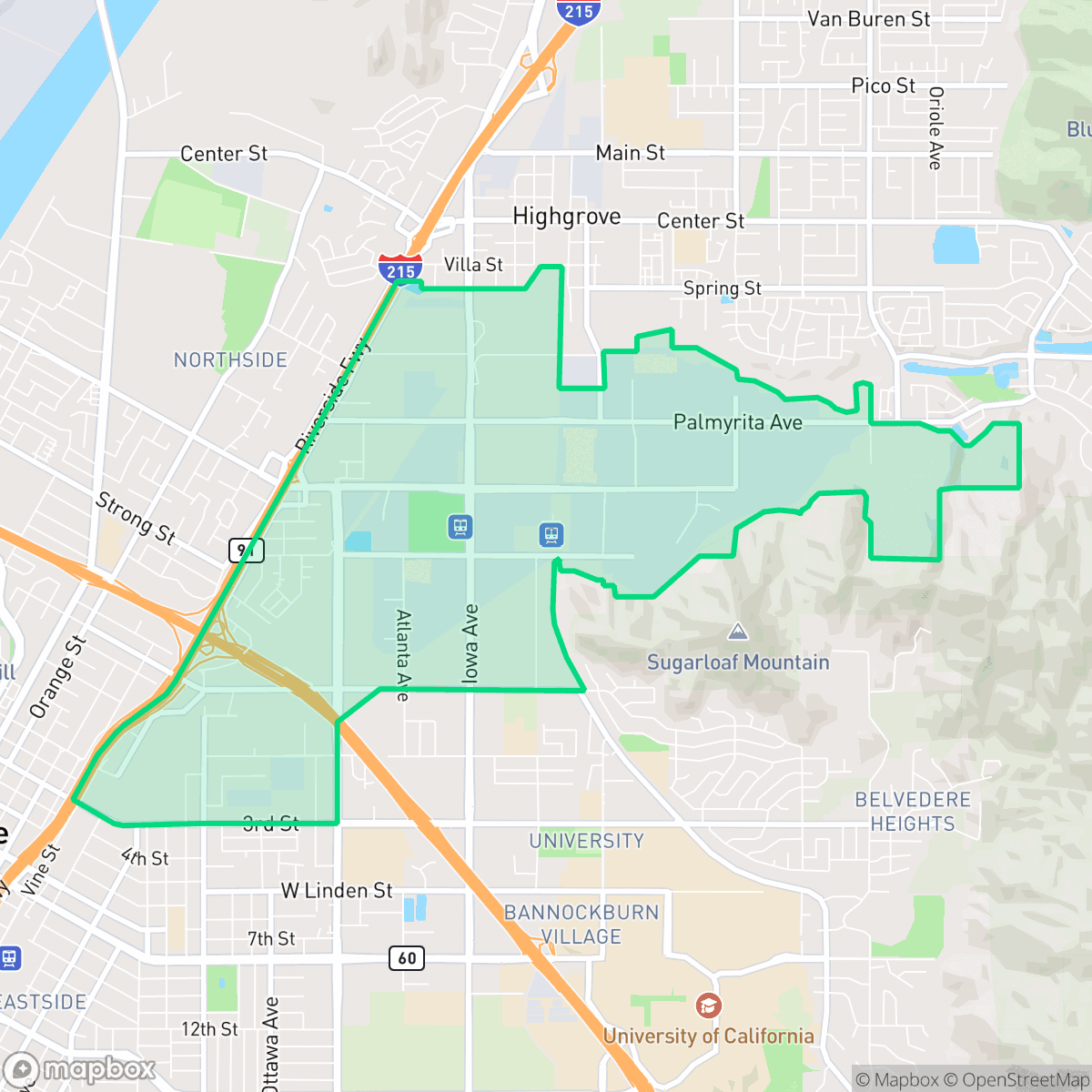
Hunter Industrial Park is a major logistics and manufacturing hub in northeast Riverside, defined by its expansive warehouse facilities and heavy freight corridors. While the area features quiet residential pockets and the historic Hunter Park, it is primarily car-dependent and characterized by significant industrial activity.
Key Highlights
About Hunter Industrial Park
Hunter Industrial Park, located in northeast Riverside, originated from the industrial complex and land holdings of Joe Hunter, a prominent local industrialist and founder of Hunter Engineering Company. In the 1950s, concerned by the decline of steam locomotives, Hunter set aside 40 acres of his property at the corner of Iowa and Columbia avenues to build a miniature 4,300-foot railroad. Following his death, this land was donated to the city and became Hunter Park. Since 1965, the volunteer-run Riverside Live Steamers have operated and expanded this historic 7.5-inch gauge backyard steam railroad, which now features over 10,000 feet of track. By the 1980s, the surrounding 1,200-acre master-planned commercial district emerged as a major Inland Empire hub for manufacturing, research, and corporate offices.
The neighborhood functions as a vital commercial and industrial engine for the Inland Empire, hosting massive logistics centers and corporate offices alongside active rail infrastructure. Residential life is concentrated in small, low-density pockets that sit in close proximity to large-scale warehouse operations. While the area maintains a calm, suburban atmosphere in its residential sections, the overall landscape is dominated by paved infrastructure and the constant movement of heavy commercial vehicles. According to iHuus data, the area offers a balanced air quality profile despite its heavy industrial presence, though residents should expect higher noise levels due to road traffic. This area is best suited for those who prioritize proximity to major employment hubs and highway access over pedestrian-friendly amenities. The neighborhood presents significant trade-offs regarding acoustic comfort and walkability, as most daily services require a vehicle. Prospective residents should also consider the fire safety profile of the region and the limited availability of local social and leisure destinations compared to more central parts of the city.
Neighborhood Scores Across 15 Qualities
Building spacing and separation between neighbors are roughly comparable to the Riverside average. Some areas lack significant visual buffers between residential structures and nearby industrial zones, according to iHuus data.
Sidewalk availability is inconsistent due to high-traffic industrial roads and dirt shoulders. According to iHuus data, walkability in this area is slightly lower than the Riverside average.
Visual interest is limited by uniform tract housing, modest lots, and a high density of large warehouse structures. This landscape is notably less visually diverse than the Riverside average due to the prevalence of industrial architecture.
Industrial landscapes and narrow sidewalk verges offer few opportunities for pet exercise. According to iHuus data, the lack of accessible public parks makes this area less dog friendly than the rest of Riverside.
Large-scale warehouses and logistics yards dominate the landscape, though some low-density residential pockets exist near the southern edges. This area is slightly less open than the Riverside average due to the dense concentration of paved infrastructure and commercial zones.
The area presents a subdued, industrial atmosphere characterized by warehouses, freight corridors, and limited commercial activity. According to iHuus data, the level of activity and social vibrancy is slightly below the Riverside average.
Frequent noise from nearby railroad tracks and heavy freeway traffic is common here. This level of acoustic disturbance is notably higher than the Riverside city average, according to iHuus data.
Air quality remains mostly clean with infrequent periods of elevated readings. This level of air purity is nearly consistent with the Riverside city average according to iHuus data.
Large-scale logistics hubs, active rail lines, and frequent heavy truck traffic characterize this area. According to iHuus data, the concentration of industrial warehouses and loading bays is significantly higher than the Riverside average.
Health insurance enrollment levels in this area are lower than the Riverside average, according to iHuus data.
Political leanings here are more liberal than the Riverside average. According to iHuus data, the area maintains a liberal majority with a modest opposing presence.
A balanced mix of young adults, families, and older residents inhabits the area. According to iHuus data, the age distribution is slightly more concentrated in specific age brackets than the Riverside average.
Flood vulnerability is significantly higher than the Riverside average because this area sits within a designated 100-year floodplain. According to iHuus data, properties in this location typically require flood insurance due to the increased risk of inundation.
Fire safety conditions in this area are notably lower than the Riverside average, according to iHuus data. This lack of safety infrastructure and high-risk profile may pose significant concerns for those occupying the district.
Address-Level Insights for Hunter Industrial Park


iHuus Neighborhood Intelligence Insights
Get address-level neighborhood insights for Hunter Industrial Park
- Street-level scores — see how individual blocks compare, not just neighborhood averages
- Micro-zone boundaries — identify quiet pockets, flood boundaries, and walkable clusters before you visit
- 15 dimensions in full — walkability, noise, air quality, school quality, insurance coverage, population age profile, urban/rural index, and more
- Boundary risk alerts — know if your address sits near a block boundary where scores drop, the kind of detail no listing will ever mention
- School insights — individual school ratings and insights, not just district-level data
- Compare before you commit — side-by-side data across neighborhoods, down to block precision
No credit card required
Compare with Any Neighborhood
| Dimension | Hunter Industrial Park | Airport |
|---|---|---|
| 🚶 Walkabilityavg 7.91 | ||
| 🔊 Acoustic Comfortavg 4.28 | ||
| 🤫 Privacy Indexavg 5.41 | ||
| 🎨 Visual Appealavg 6.73 | ||
| 🐕 Dog Friendlinessavg 6.29 | ||
| 🗺️ Urban-Rural Indexavg 7.07 | ||
| ✨ Neighborhood Vibeavg 4.37 | ||
| 🏥 Health Insurance Coverageavg 6.35 | ||
| 🌿 Air Qualityavg 8.25 | ||
| 🏭 Industrial Proximityavg 8.09 | ||
| 🌊 Flood Safetyavg 1.24 | ||
| 🗳️ Ideological Leanavg 7.01 | ||
| 👥 Population Age Profileavg 4.57 | ||
| 🔥 Fire Safetyavg 0.35 | ||
| 🏫 School Quality |
Hunter Industrial Park Rankings
School Districts Serving Hunter Industrial Park
School Insights for Hunter Industrial Park
Below average outcomes; significant attendance and academic challenges.
School Insights
See what's really behind every school rating near Hunter Industrial Park
- Individual school ratings — each school's own score with outcome context, not just a district average
- Enrollment & class size data — student-to-teacher ratio and how it compares to the state average
- Full demographics breakdown — ethnicity and gender composition for every school in the enrollment zone
- Every school in the district — all schools within the enrollment boundary ranked by rating, not just the closest one
- Grade levels & benchmarks — elementary through high school, with below/above state-average flags
No credit card required