Eastside, Riverside
Updated · 21,848 residents
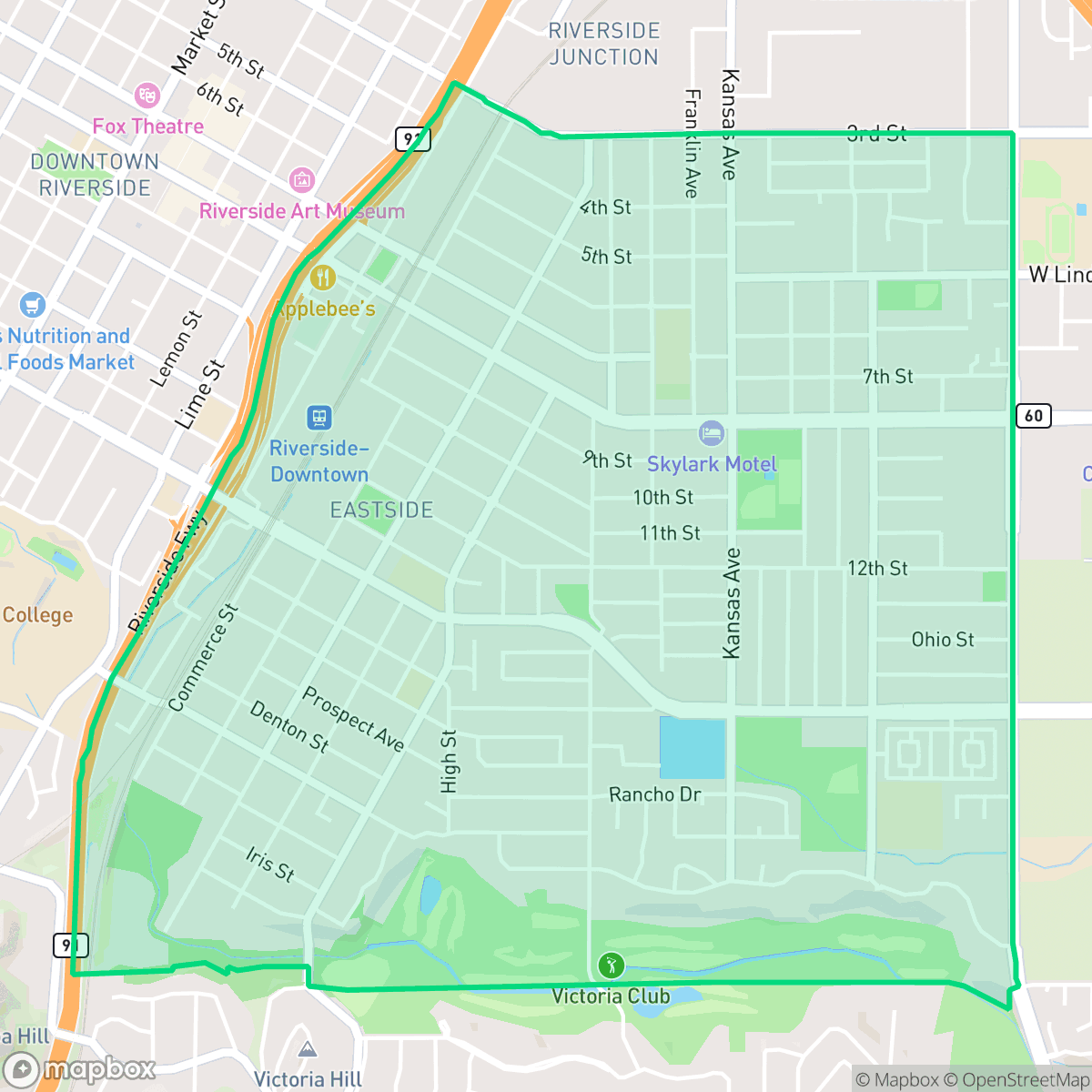
The Eastside is a historically rich neighborhood defined by its resilient community spirit and a highly walkable street grid. While residents enjoy easy access to local parks and schools, the area experiences frequent noise from nearby freeway and railroad corridors.
Key Highlights
About Eastside
The Eastside neighborhood in Riverside, California, is a historically significant district deeply rooted in the citrus industry that defined the region's early 20th-century economy. Originally a hub for citrus packing houses, it evolved into a multiracial community where Black, Mexican, and immigrant families—including those at the historic Pachappa Camp, the first organized Koreatown in the U.S.—lived and worked. The neighborhood served as a center for Black entrepreneurship and civil rights activism, with landmarks like the Stokes & Wiley Mercantile Hall and various community churches anchoring its social and political life. Despite historical segregation and under-investment, the Eastside remains defined by its resilient social networks, enduring Mexican-American heritage, and a legacy of labor and community-led advocacy that shaped the foundations of Riverside’s development.
This neighborhood functions as a diverse suburban mix, characterized by a strong liberal identity and a population spanning all age groups. The area is notable for its high degree of walkability, which allows residents to navigate between residential blocks and local amenities with ease. While the landscape is primarily residential, the visual character is varied, shifting between established homes with generous setbacks and more dense apartment layouts. According to iHuus data, the community benefits from a low presence of heavy industry, allowing for a focus on residential and open green spaces.
Prospective residents should consider several livability trade-offs, including a high risk of flooding and persistent acoustic disturbances stemming from major transportation infrastructure. While the neighborhood offers an active suburban lifestyle, it remains largely car-dependent for travel outside the immediate vicinity. Additionally, health insurance coverage rates in the area are lower than the city average, and the local school district presents a mix of specialized programs alongside performance gaps that vary by campus.
Neighborhood Scores Across 15 Qualities
Residential spacing is varied, ranging from detached homes with typical suburban setbacks to denser sections with minimal buffers between structures. This level of privacy is slightly lower than the Riverside average due to more compact housing layouts in certain parts of the neighborhood.
Pedestrians benefit from a comprehensive sidewalk network and clear crosswalks, particularly near schools and parks. This level of connectivity is notably higher than the Riverside city average, though large freeways and industrial blocks can occasionally interrupt the grid.
Streetscapes vary significantly between affluent pockets featuring large homes and pools and areas dominated by industrial warehouses or dense apartment complexes. According to iHuus data, the overall visual variety in this area is slightly below the Riverside average.
Accessible walking areas are provided by local parks and school athletic fields. While street verges vary, overall green access for pets is slightly below the city average according to iHuus data.
Residential tracts, industrial zones, and commercial clusters create a primarily suburban landscape. This environment is slightly more developed than the city average, featuring less open land and more dense urban infrastructure according to iHuus data.
Diverse dining and local amenities provide more activity than the typical Riverside neighborhood, though the area transitions between lively commercial blocks and quieter, low-density pockets. While some sections offer steady access to restaurants and parks, much of the landscape remains car-dependent due to industrial corridors and highway proximity.
Frequent noise from nearby freeway and railroad corridors makes this area louder than the Riverside average. Residents may experience consistent auditory disturbances due to these major transportation routes, according to iHuus data.
Air quality in this area is generally good with infrequent periods of elevated readings. According to iHuus data, the air quality is slightly lower than the Riverside city average.
Residential streets and open green spaces dominate the area, offering much less exposure to heavy industry than the Riverside average. According to iHuus data, there are no visible industrial hazards or large-scale warehouses within the neighborhood core.
Health insurance accessibility is lower than the Riverside city average, according to iHuus data. Fewer residents in this area have verified health coverage compared to the broader metropolitan area.
Voting patterns and census indicators show a predominantly liberal leaning that is notably higher than the Riverside average. According to iHuus data, this area reflects much stronger liberal political trends compared to the rest of the city.
Residents live alongside a balanced mix of young adults, families, and seniors. This age distribution is largely consistent with the broader Riverside area, according to iHuus data.
Significant flood risk exists in this area, which is notably higher than the Riverside city average. Residents should anticipate elevated or potentially prohibitive flood insurance costs based on iHuus data.
Address-Level Insights for Eastside


iHuus Neighborhood Intelligence Insights
Get address-level neighborhood insights for Eastside
- Street-level scores — see how individual blocks compare, not just neighborhood averages
- Micro-zone boundaries — identify quiet pockets, flood boundaries, and walkable clusters before you visit
- 15 dimensions in full — walkability, noise, air quality, school quality, insurance coverage, population age profile, urban/rural index, and more
- Boundary risk alerts — know if your address sits near a block boundary where scores drop, the kind of detail no listing will ever mention
- School insights — individual school ratings and insights, not just district-level data
- Compare before you commit — side-by-side data across neighborhoods, down to block precision
No credit card required
Compare with Any Neighborhood
| Dimension | Eastside | Airport |
|---|---|---|
| 🚶 Walkabilityavg 7.91 | ||
| 🔊 Acoustic Comfortavg 4.28 | ||
| 🤫 Privacy Indexavg 5.41 | ||
| 🎨 Visual Appealavg 6.73 | ||
| 🐕 Dog Friendlinessavg 6.29 | ||
| 🗺️ Urban-Rural Indexavg 7.07 | ||
| ✨ Neighborhood Vibeavg 4.37 | ||
| 🏥 Health Insurance Coverageavg 6.35 | ||
| 🌿 Air Qualityavg 8.25 | ||
| 🏭 Industrial Proximityavg 8.09 | ||
| 🌊 Flood Safetyavg 1.24 | ||
| 🗳️ Ideological Leanavg 7.01 | ||
| 👥 Population Age Profileavg 4.57 | ||
| 🔥 Fire Safetyavg 0.35 | ||
| 🏫 School Quality |
Eastside Rankings
School Districts Serving Eastside
School Insights for Eastside
Below average outcomes; significant attendance and academic challenges.
School Insights
See what's really behind every school rating near Eastside
- Individual school ratings — each school's own score with outcome context, not just a district average
- Enrollment & class size data — student-to-teacher ratio and how it compares to the state average
- Full demographics breakdown — ethnicity and gender composition for every school in the enrollment zone
- Every school in the district — all schools within the enrollment boundary ranked by rating, not just the closest one
- Grade levels & benchmarks — elementary through high school, with below/above state-average flags
No credit card required