Canyon Crest, Riverside
Updated · 21,271 residents
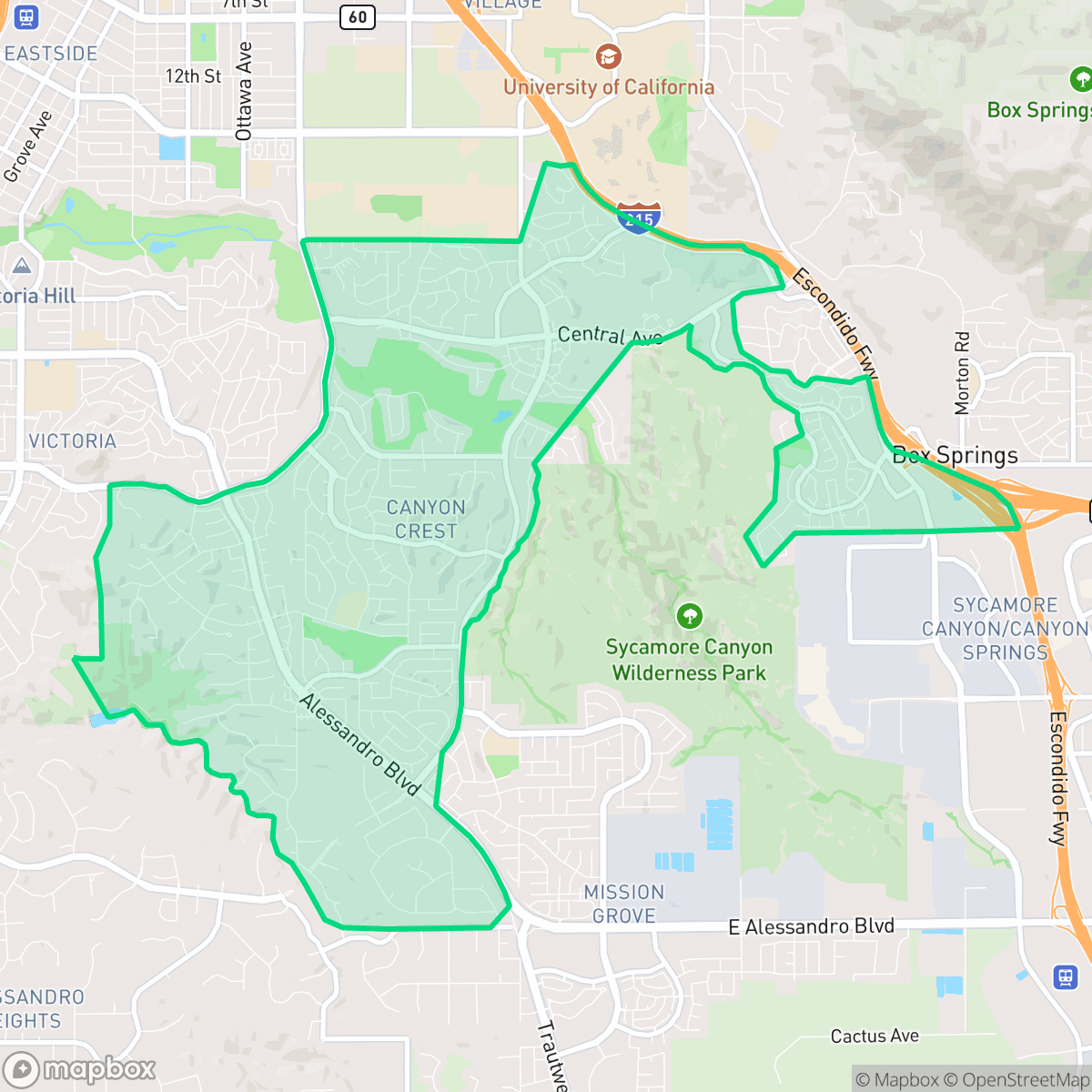
Canyon Crest is a large, established Riverside neighborhood known for its hilly terrain, proximity to natural open spaces like Sycamore Canyon Park, and a mix of residential densities. It features a well-connected sidewalk network centered around a local shopping hub, though residents experience varying levels of privacy due to its dense housing configurations.
Key Highlights
About Canyon Crest
Canyon Crest, one of Riverside’s largest neighborhoods, was formed through six land annexations between 1959 and 1986. The area’s roots lie in the citrus industry; in 1907, the 200-acre Monte Vista Nursery, which specialized in citrus stock, was established on the land now occupied by the Canyon Crest Towne Centre. The neighborhood features the William Childs House, a 1910 Craftsman bungalow listed on the National Register of Historic Places, and locally significant Art Deco entry monuments on University Drive that were salvaged from the old Buena Vista Bridge in the 1960s. Developed with modern subdivisions adapted to hilly terrain, Canyon Crest is bordered by natural open spaces like the Tequesquite Arroyo and Sycamore Canyon Park.
The neighborhood is characterized by its integration with the natural landscape, including the nearby Tequesquite Arroyo. The area offers a blend of modern suburban subdivisions and apartment complexes, creating a varied visual environment that ranges from high-density housing to more spacious, affluent residential pockets. Residents benefit from stable air quality and strong health insurance coverage, while the area's layout provides a balance of suburban convenience and access to expansive greenbelts.
Potential residents should note that while the area is well-connected by sidewalks, the overall vibe remains quiet and car-oriented for many daily errands. While the neighborhood avoids major industrial hazards, it experiences moderate noise levels from road traffic due to its proximity to major transit corridors. It is well-suited for those seeking an established suburban environment with easy access to outdoor recreation, though it may feel less active for those prioritizing a high-density, urban commercial lifestyle.
Neighborhood Scores Across 15 Qualities
Residential spacing varies between tightly packed apartment units and detached houses with moderate yard buffers. According to iHuus data, privacy levels are slightly higher than the Riverside city average.
Sidewalk networks and safe crossings connect residential zones to central shopping areas and greenbelt paths. This level of pedestrian accessibility is nearly on par with the Riverside average.
Large residential properties and proximity to golf course amenities provide a more manicured aesthetic than the Riverside average. According to iHuus data, the area features a mix of expansive private estates and well-maintained multi-family complexes.
Expansive green verges from the adjacent golf course and a large public park with trail access offer superior opportunities for dog exercise compared to the Riverside average. According to iHuus data, wide paths and significant separation from traffic make this an ideal area for pet owners.
Open land and scattered homes are common throughout the area, providing a more semi-rural feel than the typical Riverside urban landscape. According to iHuus data, the neighborhood features a mix of woodland and fields interspersed with developing suburban pockets.
Primarily a serene and low-density residential area, this neighborhood offers a tranquil atmosphere with fewer commercial destinations than the Riverside average. While some pockets near water features provide accessible dining and local services, much of the landscape is characterized by open space and a reliance on vehicles for most errands.
Local traffic from nearby busy streets creates a consistent level of ambient noise. This acoustic environment is slightly more active than the average for Riverside.
Air quality remains consistently high with rare instances of elevated readings. This level of cleanliness is slightly better than the Riverside average, according to iHuus data.
Industrial activity is virtually non-existent here, providing a quiet environment free from warehouses or heavy logistics hubs. This lack of industrial proximity is notably better than the Riverside average, according to iHuus data.
Health insurance accessibility is notably higher in Canyon Crest than the Riverside average, according to iHuus data.
Political leanings in this area are evenly split between conservative and liberal perspectives. This represents a more moderate ideological landscape than the more strongly conservative lean found across the broader Riverside area.
A balanced mix of young adults, families, and older residents characterizes the area. This demographic distribution is slightly more varied than the Riverside average, according to iHuus data.
Property within the 100-year floodplain is susceptible to flooding; according to iHuus data, this risk is slightly higher than the Riverside average and may necessitate flood insurance.
Extreme fire hazards characterize this area, presenting a significantly higher risk level than the Riverside average. Residents should prioritize stringent fire prevention measures and emergency preparedness.
Address-Level Insights for Canyon Crest


iHuus Neighborhood Intelligence Insights
Get address-level neighborhood insights for Canyon Crest
- Street-level scores — see how individual blocks compare, not just neighborhood averages
- Micro-zone boundaries — identify quiet pockets, flood boundaries, and walkable clusters before you visit
- 15 dimensions in full — walkability, noise, air quality, school quality, insurance coverage, population age profile, urban/rural index, and more
- Boundary risk alerts — know if your address sits near a block boundary where scores drop, the kind of detail no listing will ever mention
- School insights — individual school ratings and insights, not just district-level data
- Compare before you commit — side-by-side data across neighborhoods, down to block precision
No credit card required
Compare with Any Neighborhood
| Dimension | Canyon Crest | Airport |
|---|---|---|
| 🚶 Walkabilityavg 7.91 | ||
| 🔊 Acoustic Comfortavg 4.28 | ||
| 🤫 Privacy Indexavg 5.41 | ||
| 🎨 Visual Appealavg 6.73 | ||
| 🐕 Dog Friendlinessavg 6.29 | ||
| 🗺️ Urban-Rural Indexavg 7.07 | ||
| ✨ Neighborhood Vibeavg 4.37 | ||
| 🏥 Health Insurance Coverageavg 6.35 | ||
| 🌿 Air Qualityavg 8.25 | ||
| 🏭 Industrial Proximityavg 8.09 | ||
| 🌊 Flood Safetyavg 1.24 | ||
| 🗳️ Ideological Leanavg 7.01 | ||
| 👥 Population Age Profileavg 4.57 | ||
| 🔥 Fire Safetyavg 0.35 | ||
| 🏫 School Quality |
Canyon Crest Rankings
School Districts Serving Canyon Crest
School Insights for Canyon Crest
Below average outcomes; significant attendance and academic challenges.
School Insights
See what's really behind every school rating near Canyon Crest
- Individual school ratings — each school's own score with outcome context, not just a district average
- Enrollment & class size data — student-to-teacher ratio and how it compares to the state average
- Full demographics breakdown — ethnicity and gender composition for every school in the enrollment zone
- Every school in the district — all schools within the enrollment boundary ranked by rating, not just the closest one
- Grade levels & benchmarks — elementary through high school, with below/above state-average flags
No credit card required