Arlington, Riverside
Updated · 15,036 residents
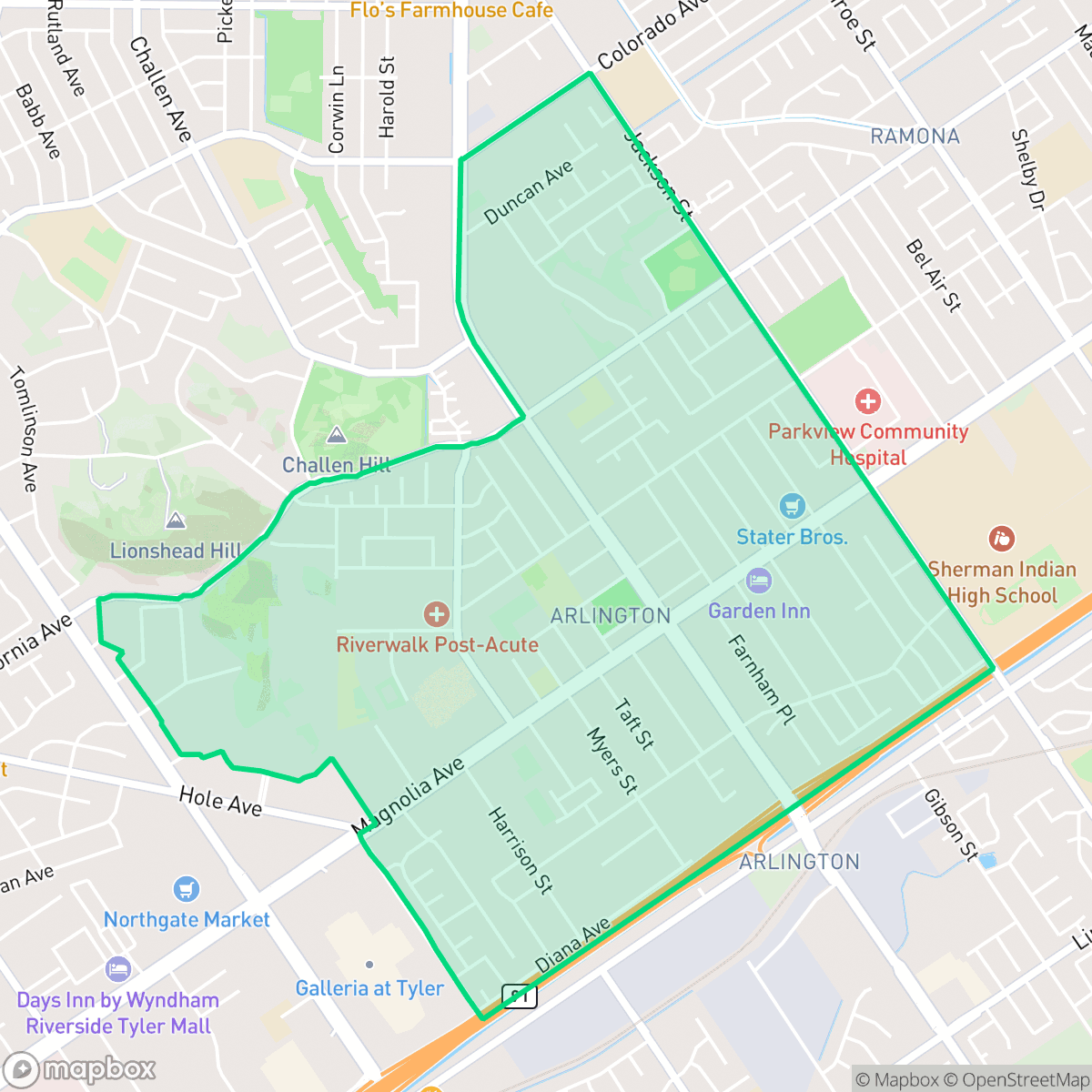
Arlington is a historic Riverside neighborhood defined by its citrus-growing origins and a semi-rural atmosphere that blends residential pockets with open space. While the area offers a mostly walkable environment, residents often experience significant noise from nearby transit corridors and should be aware of elevated environmental risks.
Key Highlights
About Arlington
Founded in 1875 as a citrus-growing colony, Arlington was once an independent community before its annexation by Riverside in the 1960s. Known historically as a "city within a city," the neighborhood developed along Magnolia Avenue, which remains its primary commercial and social artery. The area’s heritage is anchored by the 1909 Arlington Branch Library, a Carnegie building listed on the National Register of Historic Places, and the Sherman Indian Museum, located on the historic Sherman Indian High School campus. Originally connected to the region by the Riverside–Arlington electric railway, the neighborhood retains a distinct identity shaped by its early agricultural economy and the preservation of its nineteenth-century village character.
The area maintains a distinct identity through its mix of standard tract housing and quiet, semi-rural stretches. Residents benefit from a generally clean air environment and a social atmosphere that balances suburban calm with accessible commercial amenities along major thoroughfares. The neighborhood attracts a diverse demographic, ranging from families to older populations, who appreciate the transition between developed residential zones and larger, undeveloped natural spaces.
Prospective residents should consider the trade-offs of living in this part of Riverside, particularly regarding noise levels from nearby freeways and railroad tracks. While the community is largely walkable, the density of residential housing means limited privacy between neighbors, and those moving to the area should account for the higher risk of fire and flood hazards. Access to healthcare and school performance varies, as the neighborhood is served by districts currently navigating internal academic disparities and infrastructure transitions.
Neighborhood Scores Across 15 Qualities
Residential spacing in Arlington is tighter than the Riverside average, with many homes positioned closely to their neighbors. Some areas feature high density clusters where minimal setbacks and shared property lines reduce the amount of natural privacy buffering.
Sidewalks and crosswalks are widely available throughout residential areas, though proximity to high-traffic arterials and the local freeway can impact pedestrian comfort. According to iHuus data, the area remains slightly below the Riverside average for overall walkability due to these transit barriers.
Standard tract housing and multi-family units characterize the area, featuring consistent rooflines and modest lot sizes. The visual landscape is slightly less varied than the Riverside average due to the dense placement of homes and uniform architectural styles.
Access to dog walking space varies between wide desert hillsides and narrow, sidewalk-constrained streets. While some areas offer large public parks and open hills, other sections lack sufficient public green space compared to the Riverside average.
Open land and undeveloped hills are frequently interspersed with residential pockets, offering a more spacious environment than the more densely developed parts of Riverside. According to iHuus data, this area provides a transition between suburban housing and large natural or vacant spaces.
A mix of calm residential pockets and high-energy commercial corridors creates a social atmosphere that is more active than the Riverside average. While various dining and amenity options are available, many destinations require a car due to the spread-out nature of the neighborhood's businesses.
Frequent disturbances from nearby freeway traffic and railroad tracks characterize this area. Acoustic comfort in Arlington is notably lower than the Riverside city average according to iHuus data.
Air quality remains mostly clean with rare instances of elevated readings; this level is slightly below the Riverside city average according to iHuus data.
Minimal heavy industrial presence defines this area, though some large-scale warehouses and commercial structures are located near the northern and western edges. According to iHuus data, the neighborhood maintains a slightly higher concentration of industrial proximity compared to the Riverside average.
Health insurance accessibility in Arlington is slightly lower than the Riverside city average, according to iHuus data.
Political leanings in Arlington trend more liberal than the Riverside average. According to iHuus data, the area contains a liberal majority with a modest opposing presence.
Residents live alongside a balanced variety of young adults, families, and older populations. This age distribution is largely consistent with the broader Riverside area according to iHuus data.
Flood risk in this area is significantly higher than the Riverside average. According to iHuus data, residents should prepare for elevated or potentially prohibitive insurance costs due to the proximity to high-hazard zones.
Fire safety concerns are significant in this area, with risk levels appearing higher than the Riverside average according to iHuus data.
Address-Level Insights for Arlington


iHuus Neighborhood Intelligence Insights
Get address-level neighborhood insights for Arlington
- Street-level scores — see how individual blocks compare, not just neighborhood averages
- Micro-zone boundaries — identify quiet pockets, flood boundaries, and walkable clusters before you visit
- 15 dimensions in full — walkability, noise, air quality, school quality, insurance coverage, population age profile, urban/rural index, and more
- Boundary risk alerts — know if your address sits near a block boundary where scores drop, the kind of detail no listing will ever mention
- School insights — individual school ratings and insights, not just district-level data
- Compare before you commit — side-by-side data across neighborhoods, down to block precision
No credit card required
Compare with Any Neighborhood
| Dimension | Arlington | Airport |
|---|---|---|
| 🚶 Walkabilityavg 7.91 | ||
| 🔊 Acoustic Comfortavg 4.28 | ||
| 🤫 Privacy Indexavg 5.41 | ||
| 🎨 Visual Appealavg 6.73 | ||
| 🐕 Dog Friendlinessavg 6.29 | ||
| 🗺️ Urban-Rural Indexavg 7.07 | ||
| ✨ Neighborhood Vibeavg 4.37 | ||
| 🏥 Health Insurance Coverageavg 6.35 | ||
| 🌿 Air Qualityavg 8.25 | ||
| 🏭 Industrial Proximityavg 8.09 | ||
| 🌊 Flood Safetyavg 1.24 | ||
| 🗳️ Ideological Leanavg 7.01 | ||
| 👥 Population Age Profileavg 4.57 | ||
| 🔥 Fire Safetyavg 0.35 | ||
| 🏫 School Quality |
Arlington Rankings
School Districts Serving Arlington
School Insights for Arlington
Below average outcomes; significant attendance and academic challenges.
School Insights
See what's really behind every school rating near Arlington
- Individual school ratings — each school's own score with outcome context, not just a district average
- Enrollment & class size data — student-to-teacher ratio and how it compares to the state average
- Full demographics breakdown — ethnicity and gender composition for every school in the enrollment zone
- Every school in the district — all schools within the enrollment boundary ranked by rating, not just the closest one
- Grade levels & benchmarks — elementary through high school, with below/above state-average flags
No credit card required