Arlington South, Riverside
Updated · 6,945 residents
Arlington South is defined by its blend of mid-century suburban residential blocks and active logistics corridors. While the area offers residents convenient access to local dining and parks, it experiences significant noise from nearby road traffic and industrial activity.
Key Highlights
About Arlington South
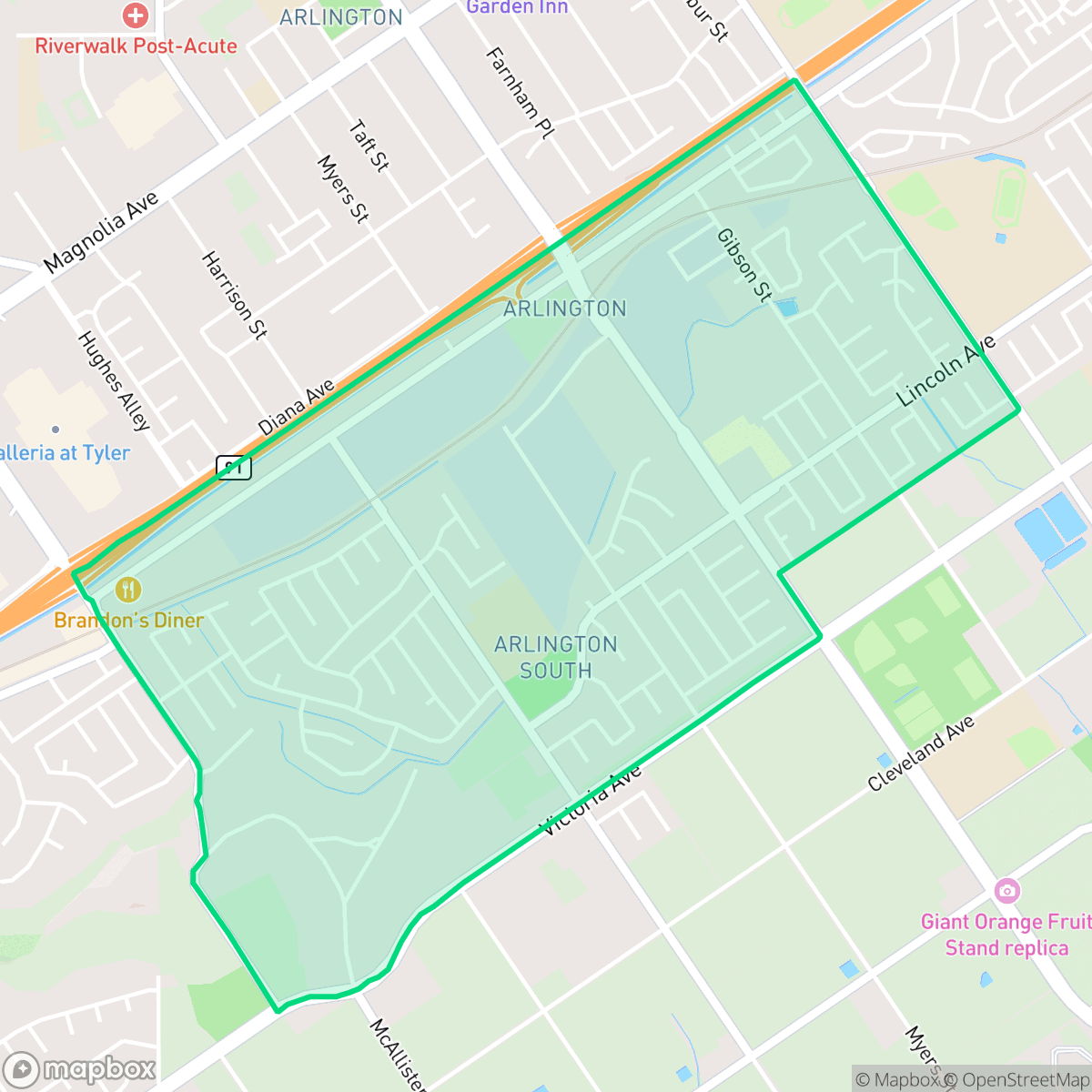
Located south of Arlington’s historic business district in Riverside, California, the Arlington South neighborhood has roots deeply tied to the region's late 19th-century citrus-growing boom. Following World War II, the agricultural landscape transitioned into a peaceful residential community, primarily developed in the 1950s and 1960s with mid-century ranch-style homes and bungalows. Arlington South's most defining landmark is the historic Van Buren Drive-In Theatre and Swap Meet. Opened in 1964 on the site of a former orange ranch, the theater expanded to three screens in 1975. In 2007, it underwent a major remodel that embraced an 'Old California, Orange Ranch' theme, featuring a prominent screen tower mural reminiscent of vintage citrus crate labels. Today, the neighborhood maintains its suburban character, flanked by local spaces like Harrison Park and the nearby California Citrus State Historic Park.
The neighborhood functions as a diverse suburban environment where residential streets sit alongside major transit infrastructure and commercial units. Residents benefit from high health insurance coverage and proximity to green spaces like Harrison Park, which provides a necessary respite from the dense logistics and warehouse activity characterizing parts of the district. The area maintains a functional, car-dependent layout, with various local services and dining options scattered throughout the community.
Prospective residents should consider the trade-offs of living in a transit-heavy corridor, as acoustic comfort is notably lower due to persistent road traffic. While the air quality remains relatively favorable, the proximity to industrial sites and the high fire risk rating are significant factors for long-term planning. The area is best suited for those who prioritize regional accessibility and established suburban infrastructure over quiet, low-density living.
Neighborhood Scores Across 15 Qualities
Residential spacing varies between dense clusters with minimal setbacks and more standard suburban layouts. This level of density is roughly in line with the average for Riverside.
Sidewalks are present on many residential streets and offer safe crossings, though connectivity is occasionally interrupted by the freeway and large industrial blocks. This level of walkability is roughly in line with the rest of Riverside.
Streetscapes range from affluent pockets featuring large homes and private pools to more uniform areas with standard tract housing. According to iHuus data, the visual quality of the landscape is consistent with the city average.
Open hillsides and large public parks provide ample space for pets, though narrow sidewalks and nearby freeway barriers can limit walking routes. According to iHuus data, the level of dog friendliness in this area is roughly comparable to the rest of Riverside.
A blend of suburban housing tracts and open spaces defines the area, mirroring the broader city average for semi-rural characteristics. According to iHuus data, the landscape includes a variety of single-family homes alongside industrial warehouses and agricultural edges.
A mix of residential streets and commercial hubs creates a level of activity that is slightly higher than the Riverside average. While some areas feature accessible dining and services, other pockets remain quiet with limited local amenities within walking distance.
Frequent noise from nearby railroad tracks and heavy freeway traffic characterizes this area. According to iHuus data, acoustic comfort is notably lower than the Riverside city average.
Air quality in this area remains consistently high with rare instances of elevated readings. This level of air purity is nearly identical to the broader Riverside average, according to iHuus data.
Large warehouses and a railway line create notable noise and heavy vehicle traffic in certain parts of the neighborhood. According to iHuus data, this level of industrial proximity is higher than the average found throughout Riverside.
Health insurance enrollment is notably higher here than the Riverside average, according to iHuus data. Most residents in this area maintain active health coverage.
Political leanings in this area are split relatively evenly between conservative and liberal residents, representing a more moderate landscape than the broader Riverside area.
A varied mix of young adults, families, and older residents characterizes the area. According to iHuus data, this demographic spread is slightly more balanced than the broader Riverside average.
Flood risk in this area is significantly higher than the Riverside average, as much of the neighborhood sits within a designated floodplain. According to iHuus data, property owners may need to carry specialized flood insurance due to this increased vulnerability.
Address-Level Insights for Arlington South


iHuus Neighborhood Intelligence Insights
Get address-level neighborhood insights for Arlington South
- Street-level scores — see how individual blocks compare, not just neighborhood averages
- Micro-zone boundaries — identify quiet pockets, flood boundaries, and walkable clusters before you visit
- 15 dimensions in full — walkability, noise, air quality, school quality, insurance coverage, population age profile, urban/rural index, and more
- Boundary risk alerts — know if your address sits near a block boundary where scores drop, the kind of detail no listing will ever mention
- School insights — individual school ratings and insights, not just district-level data
- Compare before you commit — side-by-side data across neighborhoods, down to block precision
No credit card required
Compare with Any Neighborhood
| Dimension | Arlington South | Airport |
|---|---|---|
| 🚶 Walkabilityavg 7.91 | ||
| 🔊 Acoustic Comfortavg 4.28 | ||
| 🤫 Privacy Indexavg 5.41 | ||
| 🎨 Visual Appealavg 6.73 | ||
| 🐕 Dog Friendlinessavg 6.29 | ||
| 🗺️ Urban-Rural Indexavg 7.07 | ||
| ✨ Neighborhood Vibeavg 4.37 | ||
| 🏥 Health Insurance Coverageavg 6.35 | ||
| 🌿 Air Qualityavg 8.25 | ||
| 🏭 Industrial Proximityavg 8.09 | ||
| 🌊 Flood Safetyavg 1.24 | ||
| 🗳️ Ideological Leanavg 7.01 | ||
| 👥 Population Age Profileavg 4.57 | ||
| 🔥 Fire Safetyavg 0.35 | ||
| 🏫 School Quality |
Arlington South Rankings
School Districts Serving Arlington South
School Insights for Arlington South
Below average outcomes; significant attendance and academic challenges.
School Insights
See what's really behind every school rating near Arlington South
- Individual school ratings — each school's own score with outcome context, not just a district average
- Enrollment & class size data — student-to-teacher ratio and how it compares to the state average
- Full demographics breakdown — ethnicity and gender composition for every school in the enrollment zone
- Every school in the district — all schools within the enrollment boundary ranked by rating, not just the closest one
- Grade levels & benchmarks — elementary through high school, with below/above state-average flags
No credit card required